

Quick Answer:
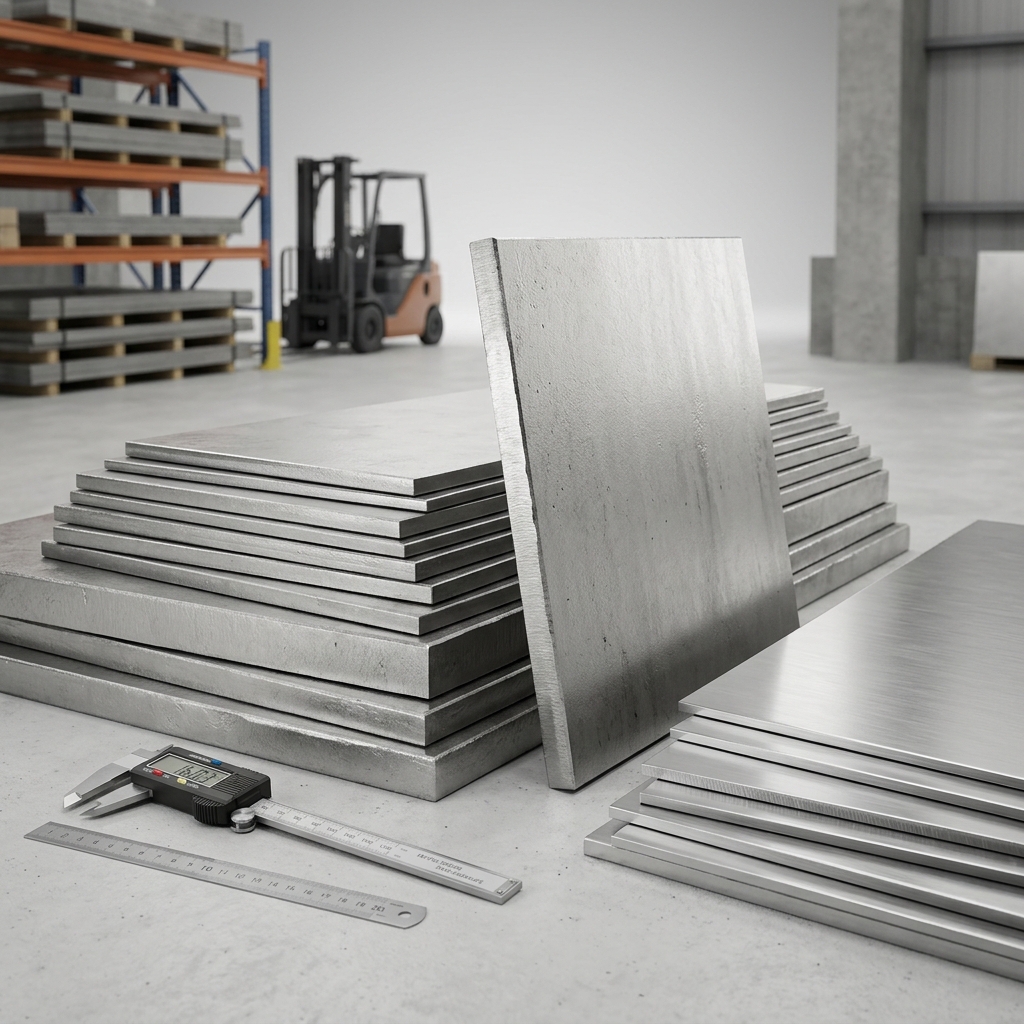
Stainless plate is a flat-rolled steel product with a minimum thickness of 3/16 inch (4.76 mm) and width ≥ 10 inches, governed by ASTM A240 and A480. Grade selection depends on chromium content, chloride exposure, mechanical load requirements, and surface finish specifications.
What Is Stainless Plate? Definitions and Standard Classifications
Stainless plate is formally defined under ASTM A480 as hot- or cold-rolled flat product with thickness ≥ 4.76 mm. It differs from stainless sheet (< 4.76 mm) and strip (width < 610 mm).
Key dimensional parameters:
- Thickness range: 4.76 mm – 200 mm+
- Standard widths: 1,000 mm, 1,219 mm (48″), 1,500 mm, 2,000 mm
- Mill lengths: 2,000 mm – 12,000 mm (custom cut available)
Primary product forms:
- Hot-rolled annealed and pickled (HRAP) — most common for structural use
- Cold-rolled annealed (CRA) — tighter tolerances, smoother finish
- Quenched and tempered (Q&T) — used in high-strength applications
Governing standards:
- ASTM A240: composition and mechanical property requirements
- ASTM A480: general requirements for flat-rolled stainless
- EN 10088-2: European equivalent for stainless flat products
Stainless plate is classified into five metallurgical families: austenitic, ferritic, martensitic, duplex, and precipitation-hardening. Austenitic grades (300 series) account for approximately 70% of global stainless plate consumption, per ISSF 2023 data.
How Chromium Content Determines Corrosion Resistance in Stainless Plate Grades
Chromium is the defining alloying element. At ≥ 10.5% Cr by weight, iron forms a self-repairing passive oxide layer (Cr₂O₃) approximately 1–3 nm thick. This layer is the basis of all corrosion resistance in stainless plate grades.
Chromium content thresholds and their effects:
| Cr% Range | Corrosion Resistance Level | Typical Grade |
|---|---|---|
| 10.5–12% | Mild atmospheric | 410, 409 |
| 16–18% | Moderate aqueous | 430, 304 |
| 18–20% | Enhanced with Mo addition | 316 |
| 22–26% | High-chloride environments | 2205, 2507 |
| 28–30% | Extreme oxidizing conditions | 310S |
Critical mechanism: Chromium content percentage alone does not guarantee performance. The Pitting Resistance Equivalent Number (PREN) provides a composite index:
PREN = %Cr + 3.3×%Mo + 16×%N
- 304 stainless plate: PREN ≈ 18–20
- 316 stainless plate: PREN ≈ 24–26
- 2205 duplex plate: PREN ≈ 34–36
- 2507 super duplex: PREN ≈ 42–43
A PREN above 40 is the accepted threshold for seawater immersion service. Grades below PREN 25 are unsuitable for continuous chloride exposure above 200 ppm Cl⁻.
ASTM A240 Mechanical Properties: 304 vs 316 vs 2205 Stainless Plate
ASTM A240 specifies minimum mechanical properties for each grade. These values directly govern structural load calculations and fabrication decisions.
Tensile and Yield Strength Comparison
| Property | 304 (S30400) | 316 (S31600) | 2205 (S32205) |
|---|---|---|---|
| Min. Tensile Strength | 515 MPa | 515 MPa | 620 MPa |
| Min. Yield Strength (0.2% offset) | 205 MPa | 205 MPa | 450 MPa |
| Min. Elongation (50mm gauge) | 40% | 40% | 25% |
| Hardness (max, HRB) | 92 | 95 | 31 HRC |
| Density | 7.93 g/cm³ | 7.98 g/cm³ | 7.82 g/cm³ |
Key Differences in Practice
304 stainless plate:
- Cost-effective baseline; widely available in all thicknesses
- Yield strength limits use in high-stress structural members without oversizing
- Not recommended where Cl⁻ > 200 ppm
316 stainless plate:
- 2–3% Mo addition raises PREN by ~6 points vs. 304
- Marginally higher cost (~15–25% premium over 304)
- Preferred for pharmaceutical, marine, and chemical processing
2205 duplex stainless plate:
- Yield strength is 2.2× higher than 304/316 — enables 30–40% material reduction by thickness
- Superior stress corrosion cracking (SCC) resistance vs. austenitic grades
- Requires controlled heat input during welding (interpass temp < 150°C)
Fabrication Implications
- 304/316 exhibit high work-hardening rates; cold forming increases yield strength by 20–50%
- 2205 has lower ductility; minimum bend radius = 2×t (vs. 1×t for 304)
- All three grades require post-weld pickling to restore passive layer
Surface Finish Ra Values and Performance in Hygienic Applications
Surface finish is quantified by Ra (arithmetic mean roughness) in µm. For stainless plate used in food, pharmaceutical, and biotech environments, Ra directly affects cleanability, biofilm adhesion risk, and regulatory compliance.
Standard Finish Designations
| Finish Code | Ra (µm) | Description | Typical Application |
|---|---|---|---|
| No. 1 | > 3.0 | Hot-rolled, annealed, pickled | Structural, non-visible |
| No. 2B | 0.1–0.5 | Cold-rolled, bright annealed | General industrial |
| No. 2BA (BA) | < 0.1 | Bright annealed, reflective | Pharma, food contact |
| No. 4 | 0.2–0.8 | Brushed, unidirectional | Kitchen equipment |
| No. 8 (Mirror) | < 0.05 | Polished to mirror | Decorative, optical |
| Electropolished | < 0.4 (post-EP) | Electrochemical smoothing | Bioprocessing, sterile |
EHEDG and 3-A Sanitary Standards require Ra ≤ 0.8 µm for food-contact surfaces. Pharmaceutical cGMP guidelines (FDA 21 CFR) typically mandate Ra ≤ 0.5 µm for product-contact stainless plate surfaces.
Why Ra matters beyond aesthetics:
- Ra > 1.6 µm: bacterial adhesion increases exponentially (per studies in Journal of Food Engineering, 2019)
- Ra < 0.4 µm: biofilm formation rate drops by ~60% vs. Ra 0.8 µm
- Electropolishing removes 20–40 µm of surface material, eliminating embedded iron particles and improving PREN by 2–4 points
Chloride Concentration Thresholds and Pitting Corrosion in Marine-Grade Stainless Plate
Pitting corrosion initiates when chloride concentration exceeds the critical pitting temperature (CPT) threshold for a given grade. This is the primary failure mode for stainless plate in marine and coastal environments.
Chloride thresholds by grade (at ambient temperature, neutral pH):
| Grade | Max. Safe Cl⁻ (ppm) | CPT (°C) | Typical Marine Suitability |
|---|---|---|---|
| 304 | < 200 | ~15 | Not recommended offshore |
| 316L | < 1,000 | ~25 | Coastal, splash zone only |
| 2205 | < 5,000 | ~35 | Offshore structures |
| 2507 | < 20,000 | ~50 | Full seawater immersion |
| 254 SMO | < 25,000 | ~60 | Desalination, deep sea |
Pitting initiation mechanism:
- Cl⁻ ions adsorb preferentially at passive film defects (inclusions, grain boundaries)
- Local acidification (pH drops to 1–3 inside pit)
- Autocatalytic pit growth accelerates — self-sustaining once initiated
Prevention strategies:
- Specify PREN > 40 for continuous seawater contact
- Maintain pH > 7 in process streams where possible
- Cathodic protection reduces pitting risk for submerged structures
- Avoid crevice geometries; use full-penetration welds
The critical crevice temperature (CCT) is typically 10–15°C below CPT — crevice corrosion initiates at lower chloride levels than open-surface pitting.
ASTM A480 Thickness Tolerances and Impact on Structural Load Calculations
ASTM A480 defines permissible thickness variations for stainless plate. These tolerances are not cosmetic — they directly affect minimum section modulus and design load capacity in structural applications.
Thickness Tolerance Table (ASTM A480, Hot-Rolled Plate)
| Nominal Thickness (mm) | Width ≤ 1,500 mm Tolerance | Width > 1,500 mm Tolerance |
|---|---|---|
| 4.76 – 6.35 | +0.74 / −0.00 mm | +0.84 / −0.00 mm |
| 6.35 – 9.53 | +0.84 / −0.00 mm | +1.07 / −0.00 mm |
| 9.53 – 12.70 | +1.07 / −0.00 mm | +1.22 / −0.00 mm |
| 12.70 – 25.40 | +1.37 / −0.00 mm | +1.52 / −0.00 mm |
| 25.40 – 50.80 | +1.65 / −0.00 mm | +1.91 / −0.00 mm |
ASTM A480 uses a minus-zero tolerance system — actual thickness is never less than nominal. However, positive tolerance means actual thickness can exceed nominal by up to 1.91 mm at wider widths.
Structural engineering implications:
- Designers must use nominal thickness (not actual) as the basis for minimum load calculations per AISC and ASCE standards
- Positive tolerance adds material weight; for large structures, this affects dead load calculations by 2–8%
- When ordering to minimum thickness for weight-critical applications, specify “minimum thickness” on the purchase order — mills will target the lower end of tolerance range
- Flatness tolerance (per A480 Table A2.9) also affects weld fit-up and machined surface quality
Procurement note: Specify ASTM A480 explicitly on purchase orders. Without this reference, mills may apply less stringent internal tolerances, creating dimensional non-conformances in precision fabrication.
Real-World Application Scenarios
Scenario 1: Offshore Oil & Gas Platform Deck Plating
- Grade selected: 2205 duplex stainless plate, 12 mm
- Reason: PREN 35 exceeds seawater threshold; yield strength 450 MPa reduces plate weight vs. 316
- Standard: NACE MR0175 / ISO 15156 compliance required
- Surface finish: No. 1 HRAP acceptable for non-process areas
Scenario 2: Pharmaceutical Clean Room Wall Cladding
- Grade selected: 316L stainless plate, 3 mm (sheet-plate boundary)
- Reason: Mo content resists cleaning chemical (peracetic acid, NaOH) attack; Ra ≤ 0.5 µm required
- Standard: FDA 21 CFR Part 211; ASME BPE surface finish specification
- Finish: Electropolished to Ra 0.25 µm
Scenario 3: Chemical Storage Tank Shell
- Grade selected: 304L stainless plate, 6 mm
- Reason: Low carbon (L grade) prevents sensitization during welding; adequate for dilute acid storage
- Standard: ASME Section VIII Div. 1 pressure vessel code
- Weld requirement: Full radiographic examination (RT) per UW-51
FAQ: Stainless Plate — Rapid-Reference Answers
Q1: How does chromium content percentage determine corrosion resistance in stainless plate grades?
Cr ≥ 10.5% forms Cr₂O₃ passive film; higher Cr raises PREN and CPT thresholds proportionally.
Q2: How do ASTM A240 mechanical properties differ across 304, 316, and 2205 stainless plate?
2205 yields at 450 MPa vs. 205 MPa for 304/316; tensile is 620 MPa vs. 515 MPa.
Q3: How does surface finish Ra value affect stainless plate performance in hygienic applications?
Ra ≤ 0.8 µm required by EHEDG; Ra < 0.4 µm reduces biofilm adhesion by ~60%.
Q4: How does chloride concentration threshold trigger pitting corrosion in marine-grade stainless plate?
316L fails above ~1,000 ppm Cl⁻; 2205 handles up to ~5,000 ppm; 2507 tolerates seawater.
Q5: How does stainless plate thickness tolerance per ASTM A480 impact structural load calculations?
Nominal thickness governs minimum design; positive tolerance adds weight but not design credit.
Q6: What is the difference between 304 and 304L stainless plate?
304L has max 0.03% C vs. 0.08% for 304; L grade resists sensitization in heat-affected zones.
Q7: When should duplex stainless plate replace austenitic grades?
When Cl⁻ > 1,000 ppm, SCC risk is high, or structural weight reduction > 25% is required.
Q8: What ASTM standards govern stainless plate procurement?
ASTM A240 (composition/properties) + ASTM A480 (dimensional tolerances) are mandatory references.
Conclusion and Selection Guidance
Selecting the correct stainless plate grade requires simultaneous evaluation of four parameters: corrosion environment (PREN vs. Cl⁻ concentration), mechanical load (yield/tensile per ASTM A240), surface finish requirement (Ra value vs. application standard), and dimensional tolerance (ASTM A480 compliance).
Decision framework:
- General industrial, dry environments → 304 stainless plate
- Moderate chloride, chemical processing → 316L stainless plate
- Marine, high-stress, SCC-risk environments → 2205 duplex stainless plate
- Seawater immersion, desalination → 2507 or 254 SMO
Always specify governing standards (ASTM A240 + A480) on purchase orders. For hygienic applications, define Ra value and post-processing requirements (electropolish, passivation per ASTM A967) explicitly. Engage a certified material test report (MTR/CMTRs) for every heat of stainless plate used in pressure, structural, or regulated applications.
References and Standards
- ASTM A240/A240M — Standard Specification for Chromium and Chromium-Nickel Stainless Steel Plate, Sheet, and Strip for Pressure Vessels and for General Applications
- ASTM A480/A480M — Standard Specification for General Requirements for Flat-Rolled Stainless and Heat-Resisting Steel Plate, Sheet, and Strip
- ASTM A967 — Standard Specification for Chemical Passivation Treatments for Stainless Steel Parts
- NACE MR0175 / ISO 15156 — Materials for Use in H₂S-Containing Environments in Oil and Gas Production
- EHEDG Document 8 — Hygienic Equipment Design Criteria, European Hygienic Engineering & Design Group
- International Stainless Steel Forum (ISSF) — Stainless Steel in Figures 2023
- ASME BPE-2022 — Bioprocessing Equipment Standard, surface finish requirements
- Journal of Food Engineering, Vol. 241, 2019 — “Effect of surface roughness on bacterial adhesion to stainless steel”
- EN 10088-2:2014 — Stainless Steels — Technical Delivery Conditions for Sheet/Plate and Strip
- Outokumpu Stainless Steel Handbook, 11th Edition — Corrosion resistance data and PREN values