

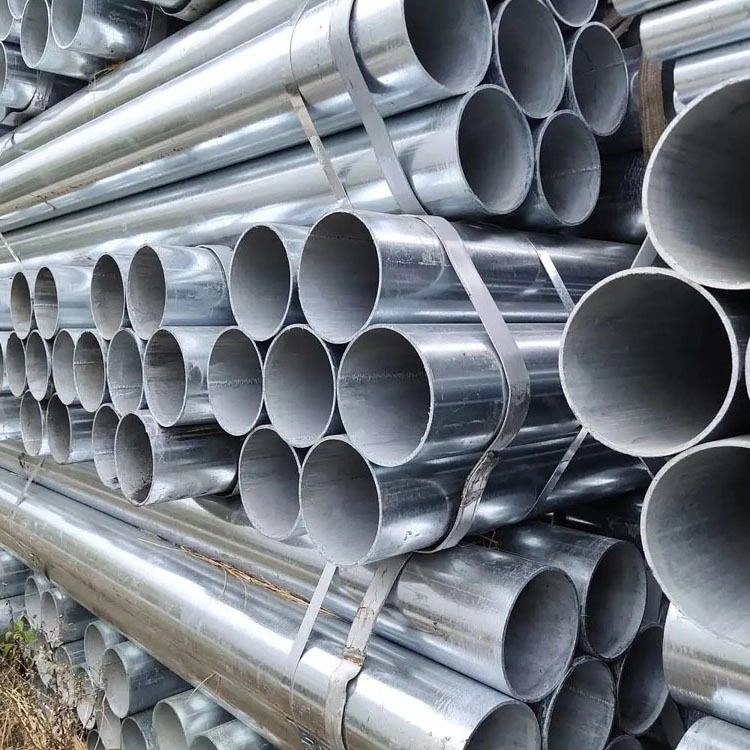
Quick Answer: Galvanized steel round pipe is carbon steel pipe coated with zinc via hot-dip or electro-galvanizing processes, delivering corrosion resistance across industrial, agricultural, and structural applications. Zinc coating thickness directly determines service life, with standard grades lasting 20–80 years depending on the environment.
What Is Galvanized Steel Round Pipe?
Galvanized steel round pipe is manufactured by applying a metallurgically bonded zinc layer to a carbon steel substrate, creating a sacrificial barrier against oxidation.
Two primary production methods:
- Hot-dip galvanizing: Steel is immersed in molten zinc at ~450°C, producing a 45–85 µm coating (ASTM A123 standard)
- Electro-galvanizing: Electrochemical deposition yields thinner coatings (5–25 µm), suited for interior applications
Core material properties:
| Property | Specification |
|---|---|
| Base material | ASTM A53 Grade A/B carbon steel |
| Zinc coating class | G60 (0.60 oz/ft²) to G210 (2.10 oz/ft²) |
| Tensile strength (Gr. B) | 415 MPa minimum |
| Yield strength (Gr. B) | 240 MPa minimum |
| Operating temperature | -40°C to 200°C (zinc integrity limit) |
Governing standards:
- ASTM A53: Seamless and welded black and hot-dipped zinc-coated pipe
- ASTM A123: Zinc coating on iron and steel products
- ASTM A500: Cold-formed welded structural tubing tolerances
- EN 10255: European standard for non-alloy steel tubes for welding
ASTM A53 mandates wall thickness tolerances of ±12.5% for seamless pipe and specifies hydrostatic test pressures by schedule. These standards govern galvanized steel round pipe manufacturing tolerances across global supply chains.
Primary Applications of Galvanized Steel Round Pipe
Construction & Structural Framing
Galvanized round pipe is load-bearing infrastructure in scaffolding, handrails, columns, and structural frames.
Schedule comparison for structural use:
| Parameter | Schedule 40 | Schedule 80 |
|---|---|---|
| Wall thickness (2″ pipe) | 3.91 mm | 5.54 mm |
| Pressure rating | 150 PSI (water) | 300 PSI (water) |
| Yield load (2″ pipe) | ~18 kN axial | ~26 kN axial |
| Weight per meter | 5.44 kg | 7.47 kg |
| Typical use | Light framing, handrails | Heavy structural columns |
Schedule 40 suits light-duty scaffolding and decorative structures. Schedule 80 handles compressive column loads exceeding 25 kN — the structural load rating differentiating these schedules is primarily wall thickness and resultant moment of inertia.
Key construction applications:
- Highway guardrail posts and safety barriers
- Temporary and permanent scaffolding systems
- Greenhouse structural frames
- Industrial mezzanine supports
Plumbing & Water Distribution
Galvanized pipe dominated residential plumbing from 1900–1960. Modern use is primarily commercial and industrial.
Performance limitations in plumbing:
Zinc layers fail under high-temperature plumbing conditions above 65°C (149°F). At sustained temperatures exceeding this threshold:
- Zinc-iron intermetallic layers (delta and zeta phases) accelerate dissolution
- Internal zinc oxide deposits accumulate, reducing flow diameter
- White rust formation precedes pitting corrosion in the steel substrate
- ASTM A53 explicitly limits galvanized pipe to cold-water service in many building codes
Recommended plumbing applications:
- Cold-water mains (below 50°C continuous service)
- Fire suppression sprinkler systems (NFPA 13 compliant)
- Industrial process water lines
- Underground water supply with polyethylene sleeve protection
Agricultural Fencing & Irrigation
Galvanized round pipe for agriculture outperforms black steel in outdoor exposure by a factor of 4–8x service life.
Galvanized vs. black steel pipe — agricultural performance:
| Factor | Galvanized Round Pipe | Black Steel Pipe |
|---|---|---|
| Surface rust onset | 5–15 years (G90 coating) | 6–18 months |
| Irrigation lifespan | 20–40 years | 5–10 years |
| Fencing post longevity | 25–50 years | 8–15 years |
| Maintenance frequency | Low (inspect every 5 yrs) | High (annual coating) |
| Cost over 20 years | Lower (lifecycle basis) | Higher (replacement cycles) |
Agricultural use cases:
- Center-pivot irrigation lateral pipes (2″–6″ diameter)
- Livestock pen and corral fencing posts
- Vineyard trellis systems
- Greenhouse hydroponic pipe runs
For agricultural irrigation versus black steel, galvanized round pipe eliminates annual repainting costs and reduces pipeline failure risk during critical growing seasons.
How Zinc Coating Thickness Affects Corrosion Lifespan
Zinc coating weight is the single most predictive variable for galvanized steel pipe service life.
Coating class vs. expected lifespan:
| ASTM Coating Class | Zinc Weight (oz/ft²) | Thickness (µm) | Rural Lifespan | Industrial Lifespan |
|---|---|---|---|---|
| G60 | 0.60 | ~25 µm | 15–25 years | 8–12 years |
| G90 | 0.90 | ~38 µm | 25–40 years | 12–20 years |
| G210 | 2.10 | ~85 µm | 50–80 years | 25–40 years |
Zinc corrosion mechanism:
- Zinc oxidizes preferentially, protecting base steel (cathodic protection)
- Zinc carbonate patina (ZnCO₃) forms in atmospheric exposure, slowing zinc consumption
- Corrosion rate in rural air: ~0.5–1.5 µm/year
- Corrosion rate in industrial/marine air: 2–10 µm/year (ISO 9223 classification)
Zinc coating thickness directly determines galvanized steel pipe corrosion lifespan — doubling coating weight approximately doubles service life under equivalent exposure conditions.
Galvanized Steel Round Pipe Buying Guide
Selecting the Right Schedule & Coating
Decision matrix by application:
| Application | Recommended Schedule | Minimum Coating Class |
|---|---|---|
| Residential fencing | SCH 40 | G90 |
| Agricultural irrigation | SCH 40 | G90 |
| Structural columns | SCH 80 | G90 |
| Fire suppression | SCH 40 | G90 |
| Marine/coastal outdoor | SCH 40 | G210 |
| Underground installation | SCH 40 | G210 + sleeve |
Key Purchasing Specifications to Verify
- Mill certification: Request ASTM A53 certified test reports (CTRs) confirming tensile, yield, and coating weight
- Dimensional tolerances: OD tolerance ±0.5mm for structural applications; wall thickness ±12.5% per ASTM A53
- Threading compatibility: NPT threading (ASME B1.20.1) must be specified for plumbing connections
- Weld seam type: ERW (electric resistance welded) for standard service; seamless for high-pressure applications
- Surface condition: Inspect for bare spots, blisters, or flux inclusions indicating poor galvanizing adhesion
Price Factors
- Zinc LME spot price directly impacts galvanizing surcharge (typically 15–25% of base pipe cost)
- G210 coating commands 30–45% premium over G60 equivalent
- Seamless pipe runs 20–40% higher than ERW in equivalent schedule and diameter
Real-World Application Case Studies
Case 1 — Municipal Water Main Replacement (Phoenix, AZ) A 1950s-era galvanized water main (2″ Schedule 40, G60 coating) serving 400 residential connections was replaced after 65 years of service. Failure mode: internal zinc oxide accumulation reduced bore diameter by 38%, dropping flow rate below minimum pressure codes. Replacement used HDPE, but new above-ground sections retained galvanized pipe with G90 coating.
Case 2 — Dairy Farm Corral Fencing (Iowa) A 200-acre dairy operation installed 4,800 linear feet of 2″ galvanized round pipe (Schedule 40, G90) corral fencing in 2003. Twenty-year inspection (2023) showed surface white rust on 12% of posts with no structural compromise. Equivalent black steel posts installed in adjacent paddocks required full replacement in 2011.
Case 3 — Industrial Scaffolding (Singapore Port) Marine-environment scaffolding using G210 hot-dip galvanized 48.3mm OD pipe (EN 39 standard) demonstrated 8-year service cycles without structural degradation, versus 3-year cycles with G60 pipe previously used.
FAQ — Galvanized Steel Round Pipe
Q1: How does zinc coating thickness affect galvanized steel pipe corrosion lifespan?
Doubling zinc thickness (µm) approximately doubles service life under identical exposure conditions.
Q2: Which structural load ratings differentiate Schedule 40 vs Schedule 80 galvanized pipe?
Schedule 80 wall thickness is ~42% greater than Schedule 40, yielding approximately 45% higher axial load capacity.
Q3: How does galvanized round pipe perform in agricultural irrigation versus black steel?
Galvanized pipe lasts 20–40 years in irrigation service; black steel requires replacement within 5–10 years.
Q4: What ASTM standards govern galvanized steel round pipe manufacturing tolerances?
ASTM A53 governs pipe dimensions and coating; ASTM A123 governs zinc coating weight requirements.
Q5: How do galvanized pipe zinc layers fail under high-temperature plumbing conditions?
Above 65°C, zinc-iron intermetallic phases dissolve, releasing zinc oxide deposits that restrict flow and initiate substrate corrosion.
Q6: Can galvanized pipe be welded in the field?
Yes, but zinc fumes require respiratory protection; post-weld cold galvanizing compound (zinc-rich paint) must repair bare weld zones.
Q7: What diameter range is standard for galvanized round pipe?
Commercial range: ½” to 12″ NPS (ASTM A53); structural tube: 21.3mm to 508mm OD.
Q8: Is galvanized pipe safe for drinking water?
Modern codes (EPA Lead and Copper Rule) restrict galvanized pipe in potable water due to zinc leaching and internal corrosion byproducts accumulating lead from older solder joints.
Conclusion & Buying Recommendations
Galvanized steel round pipe delivers verified corrosion resistance across construction, agriculture, and industrial plumbing through zinc’s sacrificial protection mechanism. Key selection criteria:
- Match coating class to environment: G90 minimum for outdoor agricultural use; G210 for marine or industrial chemical exposure
- Specify schedule by load requirement: Schedule 40 for standard framing and fencing; Schedule 80 for structural columns exceeding 20 kN compressive loads
- Avoid hot-water plumbing service: Sustained temperatures above 65°C degrade zinc integrity and create water quality issues
- Demand mill certifications: ASTM A53 CTRs confirm coating weight and mechanical properties before procurement
- Calculate lifecycle cost: G210 pipe’s 45% price premium is typically recovered within 8–12 years versus G60 in corrosive environments
For procurement, verify supplier compliance with ASTM A53 or EN 10255, request third-party inspection for large orders, and confirm zinc coating weight by weight-loss testing per ASTM A90 rather than relying solely on visual inspection.
References & Standards:
- ASTM A53/A53M-22: Standard Specification for Pipe, Steel, Black and Hot-Dip Galvanized, Welded and Seamless
- ASTM A123/A123M-17: Standard Specification for Zinc (Hot-Dip Galvanized) Coatings on Iron and Steel Products
- ASTM A90/A90M-16: Standard Test Method for Weight of Coating on Zinc-Coated Iron and Steel Articles
- ISO 9223:2012: Corrosion of Metals and Alloys — Corrosivity of Atmospheres — Classification
- ASME B1.20.1-2013: Pipe Threads, General Purpose (Inch)
- NFPA 13-2022: Standard for the Installation of Sprinkler Systems
- American Galvanizers Association (AGA): Hot-Dip Galvanizing for Corrosion Protection, 2020 Edition
- EN 10255:2004: Non-alloy steel tubes suitable for welding and threading — Technical delivery conditions