

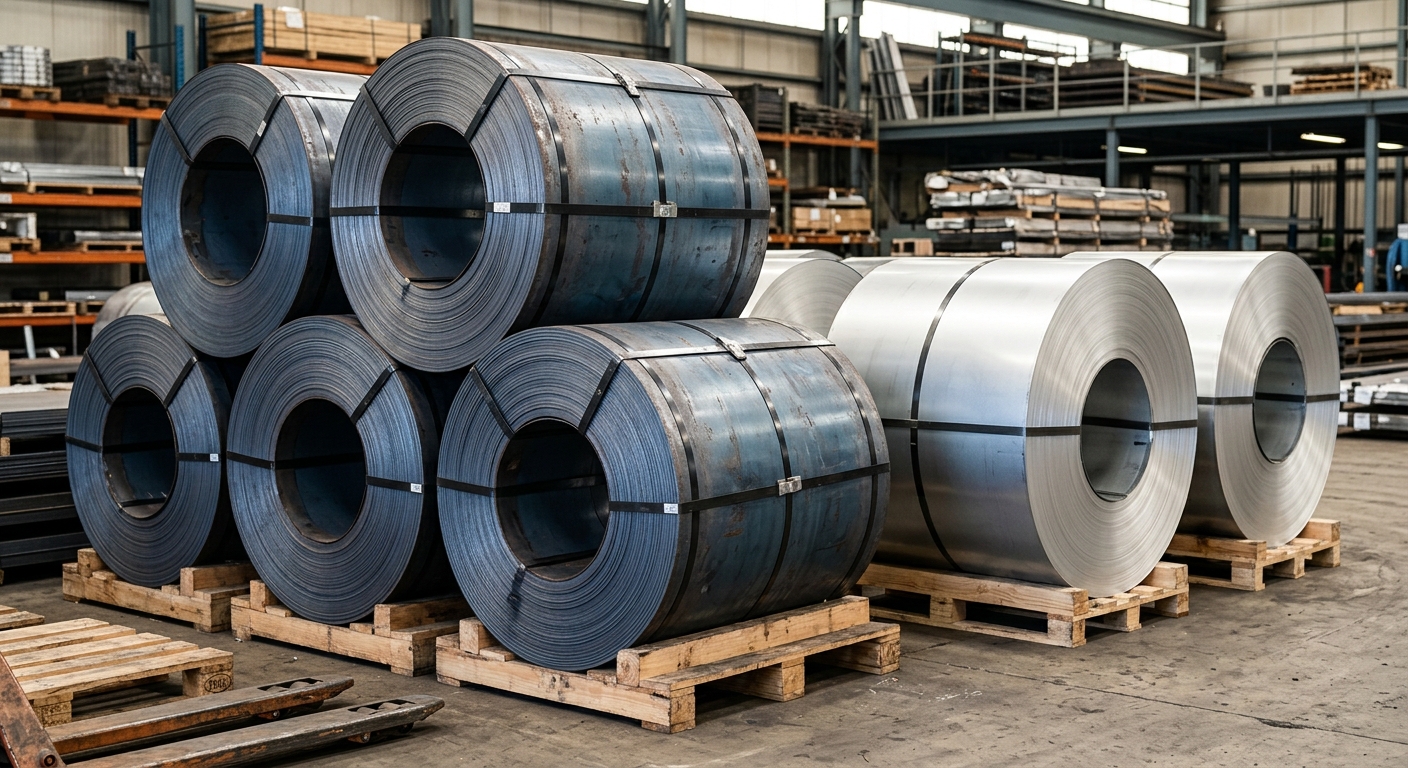
Carbon steel coils rank among the most strategically sourced flat-rolled steel products in global industrial supply chains. From automotive stamping lines to structural building components, their versatility, cost efficiency, and broad processing compatibility make them a foundational material across dozens of manufacturing sectors.
This guide is structured for procurement engineers, sourcing managers, and technical buyers who need a reliable reference for grade selection, application mapping, and supplier specification. It covers material classification by carbon content, mechanical property benchmarks across major international grades, industry-specific application logic, hot-rolled versus cold-rolled process selection, and a direct comparison against stainless steel coil for procurement decision-making.
Whether you are qualifying a new supplier, revising a bill of materials, or evaluating surface treatment options for corrosive environments, the following sections provide the technical depth and commercial context required to make informed sourcing decisions. All grade references align with ASTM, EN, and GB/T standards to support cross-border procurement workflows.
What Are Carbon Steel Coils? Material Classification & Grades
1. Definition & Steel Coil Material Classification
Carbon steel coils are continuous flat-rolled steel strips wound into coil form, produced from steel alloys where carbon is the primary strengthening element, with carbon content typically ranging from 0.05% to 1.0%. Unlike stainless steel — which requires a minimum 10.5% chromium addition for corrosion resistance — or alloy steel, which incorporates elements such as manganese, nickel, or molybdenum beyond standard limits, carbon steel derives its core mechanical characteristics almost entirely from its carbon-to-iron ratio.
The classification breaks into three functional tiers:
- Low-carbon steel (C ≤ 0.25%): Highest ductility, excellent formability and weldability. Dominates stamping, drawing, and sheet metal fabrication.
- Medium-carbon steel (0.25% < C ≤ 0.60%): Balanced strength-to-toughness ratio. Used in structural sections, pipes, and mechanical components.
- High-carbon steel (C > 0.60%): Maximum hardness and wear resistance, reduced weldability. Applied in springs, cutting tools, and wear plates.
This carbon-content boundary directly governs downstream process compatibility — a critical parameter when specifying coil grade against a manufacturing requirement.
2. Key Mechanical & Chemical Properties by Grade
The table below consolidates the most commercially relevant carbon steel coil grades across ASTM, EN, and GB/T standards, providing a direct specification reference for procurement documents.
Carbon Steel Coil Grade Comparison
| Grade | C Content (%) | Yield Strength (MPa) | Tensile Strength (MPa) | Typical Process | Common Standard |
|---|---|---|---|---|---|
| SPCC | ≤ 0.12 | ≥ 270 | 270–410 | Cold Rolled | JIS G3141 |
| Q235B | ≤ 0.20 | ≥ 235 | 370–500 | Hot/Cold Rolled | GB/T 700 |
| SPHC | ≤ 0.15 | ≥ 270 | ≥ 270 | Hot Rolled | JIS G3131 |
| SAE 1045 | 0.43–0.50 | ≥ 530 | ≥ 625 | Hot Rolled / Normalized | ASTM A29 |
| DC01 (CR4) | ≤ 0.12 | 140–280 | 270–410 | Cold Rolled | EN 10130 |
| A1008 CS Type B | ≤ 0.15 | ≥ 170 | 290–380 | Cold Rolled | ASTM A1008 |
Key procurement takeaway: weldability decreases as carbon content rises. Grades above SAE 1035 typically require pre-heat protocols, which adds process cost in fabrication. Specify carbon equivalent (CE) values in purchase orders when downstream welding is involved.
Carbon Steel Coil Applications: Industry-by-Industry Breakdown
1. Carbon Steel Coil Uses in Manufacturing & Automotive
The automotive sector is the single largest consumer of carbon steel coil globally, absorbing an estimated 40–45% of flat-rolled output in major producing economies. Low-carbon cold-rolled coil — particularly SPCC, DC01, and ASTM A1008 grades — feeds stamping lines producing door panels, floor reinforcements, seat frames, and chassis cross-members. The material’s deep-drawing capability, measured by the Lankford coefficient (r-value), is a primary selection criterion for complex-geometry press operations.
Hot-rolled carbon steel coil serves automotive structural and underbody applications where surface finish is secondary to load-bearing performance. SPHC and Q345 grades are standard inputs for frame rails, suspension brackets, and wheel rim blanks, where thickness tolerances of ±0.15 mm and consistent yield strength are procurement-critical specifications.
Beyond automotive, manufacturing applications include:
- Pipe and tube forming: ERW (electric resistance welded) tube mills process HR coil in widths matched to target pipe OD
- General metal fabrication: Medium-carbon grades for agricultural machinery, material handling equipment, and industrial enclosures
- Appliance manufacturing: CR coil for washing machine drums, refrigerator cabinets, and HVAC casings
2. Carbon Steel Coil for Construction & Infrastructure
Construction is the second-largest end-use sector. Carbon steel coil for construction applications typically enters the supply chain through two downstream conversion paths: prepainted/coated coil for roofing and wall cladding systems, and slit/cut-to-length coil for structural section roll-forming.
For roofing and facade panels, a hot-dip galvanized carbon steel substrate (GI coil, typically DX51D grade per EN 10346) receives a color coating layer, producing prepainted steel used in commercial and industrial buildings. The base steel’s yield strength — commonly 280–350 MPa — determines the panel’s spanning capability and wind load resistance.
Structural applications require heavier gauges (4–16 mm) in Q235, Q345, or S355 equivalent grades, processed into purlins, cold-formed channels, and light-gauge steel framing. Procurement specifications for construction-grade coil must address:
- Charpy impact toughness at low temperatures for cold-climate projects
- Surface flatness (I-unit values) for roll-forming line compatibility
- Coil inner diameter (508 mm or 610 mm) matched to decoiler equipment
Hot Rolled vs Cold Rolled Carbon Steel Coil: Process & Performance
1. Hot Rolled Carbon Steel Coil Applications
Hot rolling processes steel above its recrystallization temperature (typically 1100–1250°C), producing coil with a characteristic blue-grey mill scale surface. The process allows efficient production across a wide thickness range — commercially from 2 mm to 25 mm — at lower per-tonne cost relative to cold rolling.
HR carbon steel coil is the preferred specification when:
- Surface appearance is not a functional requirement
- Thickness exceeds the practical range of cold rolling (> 3 mm)
- Applications involve heavy forming, flame cutting, or weld fabrication
- Budget constraints prioritize material cost over dimensional precision
Typical HR coil tolerances: thickness ±(0.1–0.3) mm depending on gauge; width ±5 mm for slit coil. Mill scale must be addressed (shot blast, acid pickle) before painting or coating in downstream operations.
2. Cold Rolled Carbon Steel Coil Applications
Cold rolling reduces hot-rolled substrate at ambient temperature, achieving tighter dimensional control, improved surface quality, and enhanced mechanical uniformity. Standard CR coil thickness ranges from 0.3 mm to 3.0 mm, with surface roughness (Ra) values typically 0.6–1.9 µm for stamping grades.
CR carbon steel coil is specified for:
- Appliance and electronics enclosures: Bright or matte finish surfaces that accept paint or powder coat without pre-grinding
- Precision stamping: Tighter thickness tolerances (±0.05 mm) reduce scrap rates on high-volume press lines
- Automotive exposed panels: Class A surface requirements demand CR substrate with controlled roughness profiles
The additional processing cost of CR coil — typically 15–25% premium over equivalent HR grades — is justified by reduced downstream finishing cost and tighter part-to-part dimensional consistency.
Carbon Steel Coil vs Stainless Steel Coil: Procurement Decision Guide
1. Performance & Cost Comparison
The carbon steel vs stainless steel decision is fundamentally an environment-versus-budget trade-off. Stainless steel coil (304 or 316 grade) carries a price index approximately 3.5–5× higher than equivalent-gauge carbon steel coil, driven by nickel and chromium alloying costs. For most indoor manufacturing and protected structural applications, this premium is not justified.
Carbon Steel Coil vs Stainless Steel Coil: Procurement Criteria
| Criteria | Carbon Steel Coil | Stainless Steel Coil |
|---|---|---|
| Price Index (relative) | 1.0× (baseline) | 3.5–5.0× |
| Corrosion Resistance | Low (requires coating) | High (inherent) |
| Weldability | Excellent (low-C grades) | Good (requires filler matching) |
| Surface Finish Options | Mill, pickled, galvanized, painted | 2B, BA, No.4, brushed |
| Magnetic Properties | Magnetic | Austenitic grades: non-magnetic |
| Typical Application | Automotive, construction, appliances | Food processing, chemical, marine |
Carbon steel with appropriate surface treatment (galvanizing, epoxy coating) delivers adequate corrosion protection for most non-immersion environments at a fraction of stainless steel cost.
2. Surface Treatment & Coating Options for Carbon Steel Coil
Surface treatment is the primary mechanism for extending carbon steel coil service life in corrosive or outdoor environments:
- Hot-dip galvanizing (GI/GC): Zinc coating weight Z100–Z275 g/m² per EN 10346; standard for roofing, automotive underbody, and HVAC
- Galvalume (GL/AZ): Zinc-aluminum alloy coating; superior heat resistance vs pure zinc; common in metal roofing
- Phosphating + oiling: Temporary corrosion protection for transit and storage; standard for CR coil export packaging
- Prepainted (PPGI/PPGL): Polyester or PVDF topcoat over galvanized substrate; 10–25 year warranty coatings available for architectural applications
Specify coating weight, spangle type, and passivation treatment in purchase orders to ensure downstream compatibility with forming and welding operations.
Conclusion
Carbon steel coils deliver a combination of mechanical versatility, processing compatibility, and cost efficiency that no substitute material currently replicates at scale. The selection logic is straightforward: match carbon content to strength requirement, select HR or CR process based on dimensional and surface needs, and apply appropriate coating when corrosion exposure is a factor.
For procurement teams, the critical discipline is specification precision — carbon equivalent values, tolerance class, coating weight, and standard compliance must be locked in purchase orders, not left to supplier interpretation. Ambiguous specifications are the primary source of quality disputes in flat-rolled steel procurement.
If you are qualifying a carbon steel coil supplier or preparing technical specifications for an upcoming sourcing round, contact our technical team for grade recommendation support, sample material availability, and compliance documentation review.