

Stainless steel coils are among the most versatile semi-finished materials in modern manufacturing. From chemical processing pipelines to architectural cladding and precision medical devices, the stainless steel coil serves as the foundational feedstock for thousands of fabricated components. Yet selecting the wrong grade — even within the same alloy family — can result in premature corrosion, failed welds, regulatory non-compliance, or unnecessary material cost.
This article provides procurement engineers, project managers, and OEM buyers with a clear technical reference: what stainless steel coils are, how they are made, where they are used, and — critically — how to match the right grade to your specific project variables. Whether you are evaluating Grade 304 for food-grade equipment or Grade 2205 duplex for aggressive chemical environments, the decision framework presented here will help you specify confidently and procure efficiently.
Understanding Stainless Steel Coils: Definition & Manufacturing Fundamentals
1. What Is a Stainless Steel Coil and How Is It Produced?
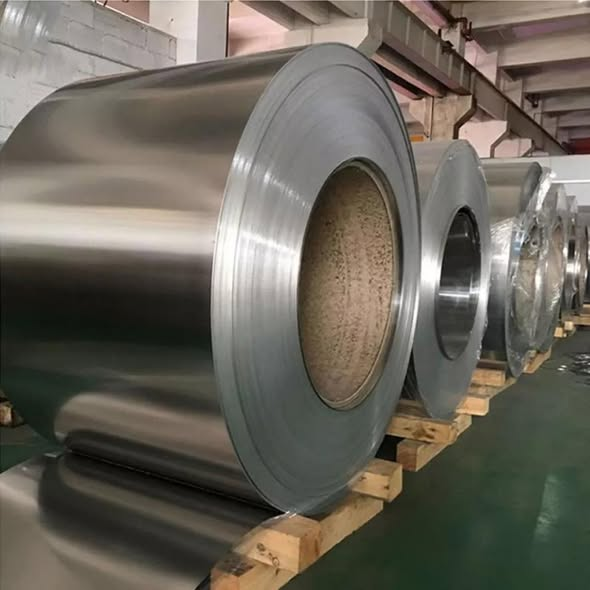
A stainless steel coil is a continuous strip of stainless steel that has been rolled, processed, and wound into a cylindrical roll for efficient storage, transport, and downstream fabrication. The production route directly influences the coil’s mechanical properties and surface quality.
Hot-Rolling (HR): Slabs are processed above the recrystallization temperature (~1100°C), producing thicker gauges (typically> 4 mm) with a scaled, rougher surface designated as No.1 finish. Hot-rolled coils are commonly used in structural and heavy industrial applications where surface aesthetics are secondary.
Cold-Rolling (CR): Hot-rolled coils are further processed at room temperature, reducing thickness with high dimensional precision (typically 0.1–3mm). Cold rolling improves tensile strength through work hardening and enables tighter tolerances. The resulting surface finishes include:
- 2B Finish: Smooth, moderately reflective — the industry standard for most industrial and commercial applications.
- BA (Bright Annealed): Mirror-like reflectivity, achieved through annealing in a controlled atmosphere; preferred for decorative and hygienic applications.
- No.4 / Brushed: Linear grain finish used in architectural panels and kitchen equipment.
Post-rolling, coils undergo annealing and pickling (AP) to relieve internal stress, restore corrosion resistance, and remove surface oxides. Precise slitting to specified widths completes the production cycle before shipment.
2. Key Physical & Mechanical Properties That Define Performance
The defining characteristic of stainless steel is its passive chromium oxide layer — a self-repairing, nanometer-thin film that forms when chromium content exceeds 10.5% by weight. This layer provides corrosion resistance without coatings or surface treatments.
Key mechanical benchmarks vary by grade but generally include:
- Tensile Strength: 485–860 MPa depending on grade and temper
- Yield Strength (0.2% proof): 170–690 MPa
- Elongation: 20–50%, enabling deep drawing and complex forming
- Hardness: Typically 70–96 HRB for austenitic grades
For procurement teams, understanding these properties is essential when specifying coils for stamping, roll forming, or high-stress structural applications.
Stainless Steel Coil Applications Across Industries
1. Core Industrial Use Cases
Stainless steel coils are the primary input material across a broad spectrum of industrial sectors. The combination of corrosion resistance, formability, and hygienic surface characteristics makes the coil format ideal for high-volume, precision-fabricated components.
Food & Beverage Processing: Grade 304 and 316 coils are stamped and formed into tanks, conveyors, heat exchangers, and processing vessels. FDA and EU food-contact compliance requires low surface roughness (Ra ≤ 0.8μm) and resistance to cleaning agents.
Chemical & Petrochemical Processing: Aggressive media — acids, chlorides, high-temperature gases — demand Grade 316L or duplex 2205. Coils are fabricated into reactor linings, pipe fittings, and valve bodies where pitting and crevice corrosion resistance are critical.
HVAC & Heat Exchangers: Thin-gauge cold-rolled coils (0.3–1.0mm) are precision-formed into fin-and-tube heat exchanger components. Grade 304 is standard; coastal or marine HVAC systems specify 316 for chloride resistance.
Automotive Stamping: Grade 409, 430, and 304 coils feed progressive dies for exhaust systems, trim components, and structural reinforcements. Formability, consistent thickness tolerance (±0.02mm), and high-volume coil weights are key procurement criteria.
Oil & Gas: Coils for downhole tools, subsea connectors, and topside equipment must meet stringent NACE MR0175 sour service requirements, typically fulfilled by duplex or super-duplex grades.
2. Commercial & Architectural Applications
Beyond heavy industry, stainless steel coils supply fabricators serving commercial construction and specialized equipment markets.
- Architectural Cladding & Facades: BA and No.4 finish coils are roll-formed or press-braked into panels for building exteriors, elevator interiors, and escalator balustrades.
- Commercial Kitchen Equipment: Grade 304 coils are the default for countertops, sinks, and cabinetry due to their cleanability and resistance to food acids.
- Medical Devices & Surgical Instruments: Ultra-thin 316L coils (down to 0.05mm) are precision-stamped for implantable components and instrument bodies, where biocompatibility and sterilization resistance are mandatory.
- Signage & Consumer Appliances: Grade 201 and 430 coils serve cost-sensitive decorative applications where moderate corrosion resistance is acceptable.
Grade vs. Application Matrix
| Grade | Corrosion Resistance | Weldability | Typical Application | Operating Temp. Range | Relative Cost Index |
|---|---|---|---|---|---|
| 201 | Moderate | Good | Decorative, light structural | -200°C to 800°C | ★★☆☆☆ |
| 304 | Good | Excellent | Food processing, HVAC, general fabrication | -200°C to 870°C | ★★★☆☆ |
| 316L | Very Good | Excellent | Chemical, marine, medical | -200°C to 870°C | ★★★★☆ |
| 430 | Moderate | Fair | Automotive trim, appliances | Up to 815°C | ★★☆☆☆ |
| 2205 | Excellent | Good | Oil & gas, chemical, offshore | -50°C to 300°C | ★★★★★ |
Stainless Steel Coil Grades: Technical Breakdown & Selection Criteria
1. Comparing the Most Specified Grades (200 / 300 / 400 Series)
Stainless steel grades are classified by microstructure, which determines their fundamental property profile:
Austenitic (300 Series & 200 Series): Face-centered cubic structure, non-magnetic in the annealed state, excellent formability and toughness. Grade 304 (18% Cr, 8% Ni) is the global workhorse. Grade 316L adds 2–3% molybdenum, elevating pitting resistance significantly. Grade 201 substitutes manganese and nitrogen for nickel, reducing cost while maintaining moderate performance.
Ferritic (400 Series): Body-centered cubic structure, magnetic, lower nickel content. Grade 430 (16–18% Cr) offers good oxidation resistance and is cost-effective for non-critical corrosion environments. Limited toughness at low temperatures restricts its use in cryogenic applications.
Duplex (e.g., 2205): Mixed austenitic-ferritic microstructure delivers approximately twice the yield strength of standard 304, superior stress corrosion cracking resistance, and reduced susceptibility to chloride-induced pitting. The trade-off is narrower fabrication temperature windows and higher material cost.
2. Compliance Standards & Certifications Buyers Must Verify
Reputable stainless steel coil suppliers operate under internationally recognized quality frameworks. Buyers should require documentation confirming:
- ASTM A240/A240M: Standard specification for chromium and chromium-nickel stainless steel plate, sheet, and strip — the primary reference for North American procurement.
- EN 10088-2: European equivalent covering flat products for general purposes.
- ISO 9001:2015: Quality management system certification for the mill, ensuring process consistency.
- Mill Test Certificate (MTC) / Certificate of Conformance (CoC): Heat-traceable chemical composition and mechanical test results. Verify that reported values align with the specified grade’s composition limits — particularly for Cr, Ni, Mo, and C content.
Never accept grade claims without a traceable MTC from the producing mill. Third-party PMI (Positive Material Identification) testing via XRF analyzer is recommended for high-value or safety-critical orders.
How to Choose the Right Stainless Steel Coil Grade for Your Project
Decision Framework: Matching Grade to Project Variables
Grade selection should be driven by a structured analysis of four primary variables:
1. Environmental Exposure:
- Chloride concentration (seawater, de-icing salts, HCl): Requires Mo-bearing grades (316L, 2205).
- Strong oxidizing acids (HNO₃): Grade 304 or 310S performs well; avoid 316 in concentrated HNO₃.
- Elevated temperatures (>500°C continuous): Specify 310S or 321 for oxidation resistance.
2. Mechanical Load Requirements:
- High-strength structural applications: Duplex 2205 reduces material thickness requirements.
- Deep drawing or complex forming: Austenitic grades (304, 316L) with high elongation values are preferred.
3. Fabrication Method:
- Welding: Low-carbon grades (304L, 316L) prevent sensitization and intergranular corrosion in heat-affected zones.
- Roll forming and bending: Verify minimum bend radius against the grade’s elongation specification.
- High-speed stamping: Consistent coil hardness and thickness tolerance (±0.02mm or tighter) are critical for die longevity.
4. Regulatory & Hygienic Requirements:
- Food contact: EHEDG, FDA 21 CFR, or EU 1935/2004 compliance may mandate 304 or 316L with specific surface finish.
- Medical/implantable: ASTM F138 (316L) or ISO 5832-1 certification required.
Total Cost of Ownership vs. Upfront Material Cost
The lowest-cost grade at purchase is rarely the lowest-cost solution over a component’s service life. Consider:
- Maintenance & Replacement Cycles: Specifying 304 in a chloride-rich environment instead of 316L may result in pitting failure within 2–3 years, far exceeding the initial material cost differential.
- Grade Substitution Risks: Substituting 201 for 304 in food processing equipment may void certifications and create regulatory liability.
- MOQ and Lead Time: Specialty grades (2205, 904L) carry longer lead times (8–14 weeks vs. 2–4 weeks for 304/316) and higher minimum order quantities. Factor this into project scheduling.
- Scrap and Yield Rates: Tighter thickness tolerances and consistent coil hardness reduce stamping scrap rates, improving overall fabrication economics.
FAQ
Q1: What is the difference between 304 and 316 stainless steel coil for marine or chemical environments?
The critical differentiator is molybdenum content. Grade 316 contains 2–3% Mo, which significantly improves resistance to chloride-induced pitting and crevice corrosion. In marine splash zones, chemical reactors handling halide compounds, or coastal HVAC systems, 316L is the minimum specification. Grade 304 is suitable for mild environments but will exhibit surface pitting under sustained chloride exposure above approximately 200 ppm.
Q2: How do I verify the grade and quality of a stainless steel coil before placing a bulk order?
Request a full Mill Test Certificate (MTC) traceable to the production heat number. Cross-reference the chemical composition (particularly Cr, Ni, Mo, C) against ASTM A240 or EN 10088 limits for the specified grade. For critical applications, supplement with third-party XRF (Positive Material Identification) testing on incoming coils. Surface finish should be verified against Ra measurements or visual comparison to certified reference panels.
Q3: Can stainless steel coils be custom-slit to specific widths and thicknesses for OEM production?
Yes. Precision slitting is a standard value-added service offered by most stainless steel coil distributors and service centers. Width tolerances of ±0.1mm and thickness tolerances of ±0.02mm are achievable for cold-rolled coils. Specify your required inner diameter (ID), outer diameter (OD), and coil weight limits alongside dimensional requirements to ensure compatibility with your uncoiling and feeding equipment.
Conclusion
Selecting the right stainless steel coil grade is not a default decision — it is an engineering specification that directly impacts component performance, fabrication efficiency, regulatory compliance, and long-term operating cost. The decision framework is clear: define your environmental exposure conditions first, then assess mechanical and fabrication requirements, and finally evaluate total cost of ownership rather than material price alone.
For procurement teams entering volume commitments, the non-negotiable first step is obtaining certified Mill Test Certificates from the producing mill, confirming chemical composition and mechanical properties against the applicable ASTM or EN standard. Where application risk is high — offshore, chemical processing, medical — supplement documentation review with independent PMI verification.
Engage your supplier early in the specification process. A technically capable stainless steel coil supplier will provide grade recommendations, sample coils for trial fabrication, and application engineering support — reducing the risk of costly mid-project grade changes. Request samples and certified documentation before committing to any volume order.