

Galvanized square rectangular tubes represent one of the most specified structural steel products in global construction and industrial supply chains. Their combination of precise geometry, mechanical strength, and factory-applied corrosion protection makes them a preferred choice over painted or bare steel alternatives — particularly in projects where maintenance access is limited or service life demands exceed 20 years.
This guide addresses the full procurement decision cycle: from understanding the metallurgical basis of zinc coating protection, through dimensional specifications and compliance standards, to the specific end-use applications that drive demand across construction, infrastructure, and industrial sectors. Whether you are a structural engineer specifying materials for a greenhouse framework or a procurement manager sourcing structural hollow sections for an export project, this article provides the technical and commercial reference points you need.
Understanding Galvanized Square & Rectangular Tubes
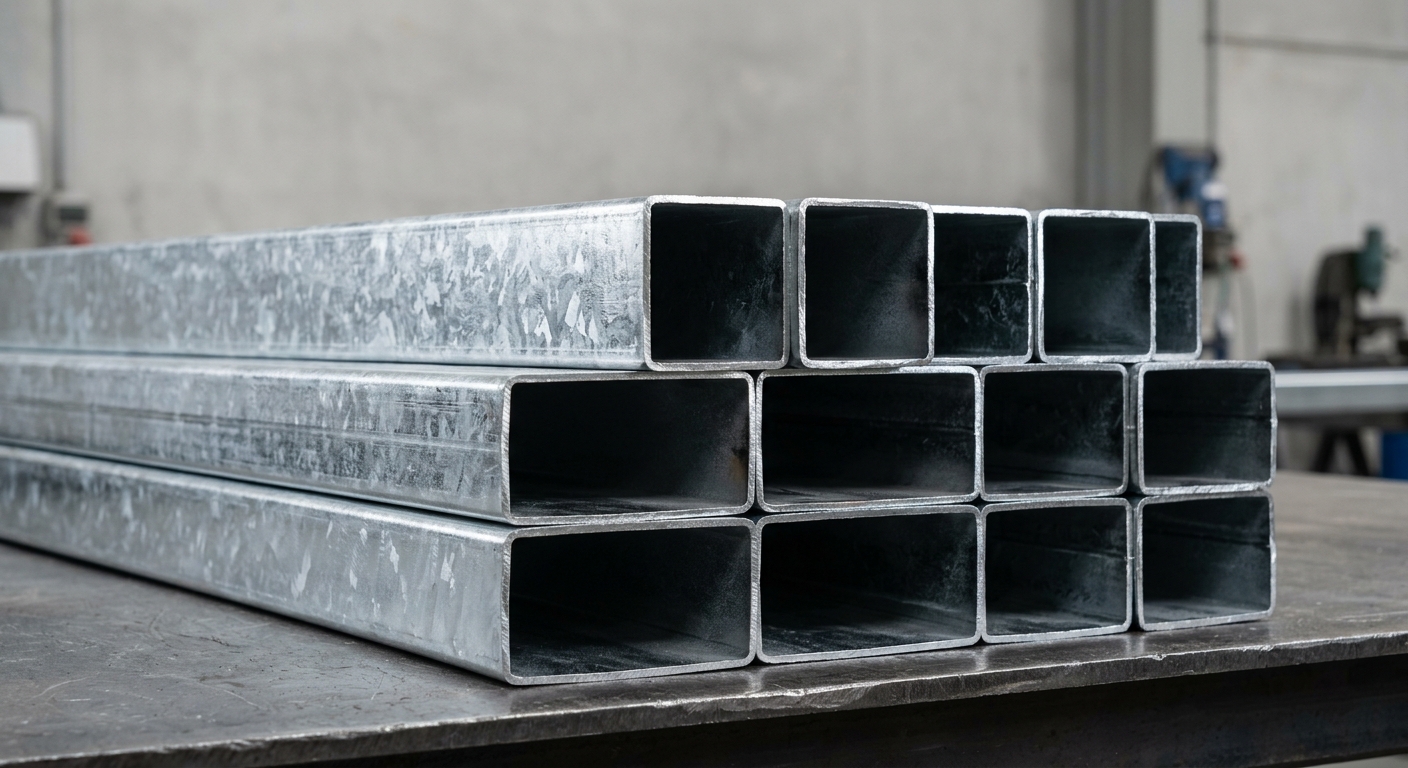
1. What Is Galvanized Square/Rectangular Tube?
A galvanized square or rectangular tube is a cold-formed or hot-formed hollow structural section (HSS) manufactured from low-carbon or high-strength steel, then coated with a zinc layer to prevent oxidation. The base tube geometry — either equal-sided (square) or unequal-sided (rectangular) — provides predictable section modulus values critical for structural calculations.
Two primary galvanizing processes are used in commercial production:
- Hot-Dip Galvanizing (HDG): The fabricated tube is immersed in a bath of molten zinc at approximately 450°C. This creates a metallurgically bonded zinc-iron alloy layer topped by a pure zinc outer layer. HDG coatings typically achieve 45–85 µm thickness and provide superior corrosion resistance in aggressive environments.
- Electro-Galvanizing: Zinc is deposited electrochemically at ambient temperature, producing a thinner, more uniform coating (5–25 µm). This process is preferred where tight dimensional tolerances and a smooth decorative finish are required, though corrosion resistance is comparatively lower.
The zinc protection mechanism operates on two levels: barrier protection (physically sealing steel from moisture and oxygen) and cathodic/sacrificial protection (zinc oxidizes preferentially, protecting exposed steel at cut edges or minor surface damage). This dual mechanism is why galvanized tubes outperform organic coatings in long-term field performance.
2. Key Material & Surface Properties
The base steel grade directly determines mechanical performance. Common grades include:
- Q235 / S235JR: General structural grade; yield strength ≥235 MPa. Suitable for light-duty framing and non-critical structures.
- Q345 / S355: Higher-strength grade; yield strength ≥345 MPa. Specified for load-bearing columns, trusses, and infrastructure applications.
- ASTM A500 Grade B/C: North American standard for cold-formed HSS; minimum yield 315–345 MPa.
Zinc coating mass is quantified in grams per square meter (g/m²) per EN ISO 1461 or ASTM A123. A coating of 275 g/m² (approximately 39 µm average) is the standard minimum for structural outdoor applications; heavy-duty marine or industrial environments typically specify 450–600 g/m². Surface finish classifications include regular spangle, minimized spangle, and skin-passed — each affecting paint adhesion for secondary coating systems.
Technical Specifications & Compliance Standards
1. Dimensional Parameters & Tolerances
Galvanized square and rectangular tubes are produced across a wide dimensional range to accommodate diverse structural loads and fabrication requirements.
| Profile Type | Cross-Section (mm) | Wall Thickness (mm) | Zinc Coating (g/m²) | Primary Standard |
|---|---|---|---|---|
| Square Tube | 20×20 – 400×400 | 1.0 – 16.0 | 120 – 600 | GB/T 6728, EN 10219 |
| Rectangular Tube | 30×20 – 500×300 | 1.0 – 16.0 | 120 – 600 | GB/T 6728, EN 10219 |
| Square Tube (NA) | 25×25 – 305×305 | 1.6 – 12.7 | 275 – 450 | ASTM A500 / A123 |
| Rectangular Tube (NA) | 50×25 – 400×200 | 1.6 – 12.7 | 275 – 450 | ASTM A500 / A123 |
Standard delivery lengths are 6 m and 12 m, with custom cut-to-length service available from most mills. Wall thickness tolerances are typically ±10% per EN 10219 and ±10% per ASTM A500. Straightness tolerance is generally ≤1 mm per 1,000 mm of length, which is critical for curtain wall and precision frame assembly.
Weight per meter is calculated from nominal cross-section and wall thickness, enabling accurate freight and structural load calculations during project planning.
2. Industry Compliance & Certification
Specifying the correct compliance standard is essential for project approval and cross-border trade. The three dominant frameworks are:
- EN 10219-1/2 (Europe): Covers cold-formed welded structural HSS in non-alloy and fine-grain steels. Mandates mechanical testing, dimensional verification, and chemical composition reporting per heat.
- ASTM A500 (North America): Standard for cold-formed welded and seamless carbon steel structural tubing. Requires tensile, yield, and elongation test reports per heat lot.
- GB/T 6728 (China): National standard for cold-formed steel hollow sections; widely referenced in Asian infrastructure and export project documentation.
For the zinc coating itself, EN ISO 1461 (hot-dip galvanizing) and ASTM A123/A653 govern coating mass, adhesion, and uniformity. B2B buyers should require mill test reports (MTR) with each shipment, confirming heat number traceability, mechanical test results, and coating mass measurements. Third-party inspection by SGS, BV, or equivalent bodies is recommended for high-value or export-critical orders.
Core Applications of Galvanized Square & Rectangular Tubes
1. Construction & Structural Uses
Galvanized square and rectangular tubes are foundational components in modern construction systems, valued for their dimensional consistency and elimination of on-site painting.
Primary construction applications include:
- Building Frames & Secondary Steel: Light-gauge rectangular tubes serve as purlins, girts, and secondary framing members in pre-engineered metal buildings, reducing erection time versus hot-rolled sections.
- Curtain Wall & Façade Support: Square HSS provides the sub-frame grid for glass and cladding systems where corrosion resistance behind the façade is non-negotiable.
- Roof Trusses & Space Frames: The closed section geometry of square tubes offers superior torsional rigidity compared to open sections (angles, channels), making them efficient chord and web members in truss design.
- Scaffolding & Temporary Works: Galvanized rectangular tubes are increasingly replacing painted scaffolding components, reducing inspection costs and extending rental asset life.
- Residential & Commercial Carports, Pergolas, Fencing: Pre-galvanized square tubes are specified in architectural metalwork where aesthetic consistency and weather resistance must be maintained without repainting.
The anti-corrosion advantage is particularly decisive in coastal, humid tropical, or industrial-atmosphere environments where painted steel requires recoating every 5–7 years.
2. Industrial & Infrastructure Applications
Beyond construction, galvanized hollow sections address a broad range of industrial service conditions:
- Greenhouse & Horticultural Structures: The combination of moisture-laden air, irrigation systems, and chemical fertilizers creates an aggressive corrosion environment. Galvanized rectangular tubes provide 15–25 year service life without maintenance coating in most temperate climates.
- Solar Panel Mounting Structures: Utility-scale photovoltaic installations require ground-mount racking systems that remain structurally sound for 25+ year project lifespans. Hot-dip galvanized square tubes are the dominant material choice for torque tubes, purlins, and cross-members.
- Highway Guardrails & Traffic Infrastructure: Rectangular HSS forms the post and beam systems in safety barriers, sign gantries, and pedestrian guardrails — applications where field repainting is impractical.
- Conveyor Frames & Material Handling Equipment: Industrial environments with dust, moisture, or chemical exposure benefit from galvanized frames that maintain structural integrity without scheduled coating maintenance.
- Agricultural Equipment & Storage: Grain storage structures, livestock enclosures, and equipment frames specified in galvanized rectangular tube reduce total cost of ownership in rural environments where maintenance labor is scarce.
Across these applications, the lifecycle cost argument consistently favors galvanized steel over painted alternatives when the analysis horizon extends beyond 10 years.
Commercial Value & Procurement Considerations
1. Cost-Benefit Analysis vs. Alternative Materials
A rigorous total cost of ownership (TCO) comparison across a 25-year service life reveals the commercial case for galvanized tubes:
| Material | Initial Cost Index | Recoating Cycle | 25-Year Maintenance Cost | Relative TCO |
|---|---|---|---|---|
| Galvanized Square/Rect. Tube | 1.15× | None (typical) | Minimal | Low |
| Painted Carbon Steel Tube | 1.00× | Every 5–7 years | High | High |
| Stainless Steel Tube (304) | 3.5–5.0× | None | Minimal | Very High |
The premium for galvanized over painted steel is typically 10–20% at point of purchase — a cost recovered within the first repainting cycle avoided. Stainless steel, while maintenance-free, carries a capital cost premium of 3.5–5× that is rarely justified in structural applications where aesthetic finish is not the primary requirement.
2. Sourcing Criteria for B2B Buyers
When qualifying suppliers for galvanized square and rectangular tube procurement, evaluate against the following criteria:
- Mill Certification Traceability: Require heat-number-linked MTRs covering chemical composition, mechanical properties, and zinc coating mass per coil/batch.
- Dimensional Tolerance Compliance: Request first-article inspection reports confirming cross-section dimensions, wall thickness, and straightness against specified standard.
- MOQ & Custom Processing: Confirm minimum order quantities (typically 5–20 MT per size for standard stock; 1–3 MT for cut-to-length service) and lead times for non-standard dimensions.
- Coating Specification Flexibility: Verify the supplier can deliver both pre-galvanized (in-line) and post-fabrication hot-dip galvanized options depending on project requirements.
- Export Documentation: For cross-border projects, confirm availability of CO (Certificate of Origin), packing list, and third-party inspection certificates (SGS/BV/TÜV).
Conclusion
Galvanized square and rectangular tubes deliver a uniquely compelling value proposition for B2B buyers: the structural versatility of precision hollow sections combined with factory-applied corrosion protection that eliminates maintenance costs over the project lifecycle. From building frames and solar racking to greenhouse structures and highway infrastructure, these products address the full spectrum of structural and environmental demands across construction and industrial sectors.
For procurement managers, the decision framework is clear: evaluate total cost of ownership over the intended service life, specify coating mass to match the deployment environment’s corrosion category, and qualify suppliers on MTR traceability and compliance certification — not price alone. Engaging a supplier who can provide custom dimensions, third-party inspection support, and export documentation will reduce project risk and ensure specification compliance from mill to site.