

Quick Answer
Cold-rolled carbon steel coil typically ranges from 0.3 mm to 3.0 mm (28–10 gauge) in thickness. ASTM A1008 defines the primary commercial standard, while EN 10130 and JIS G3141 govern equivalent international classifications. Gauge selection directly determines formability, tensile strength, and end-use suitability.
Standard Gauge Ranges Under ASTM A1008
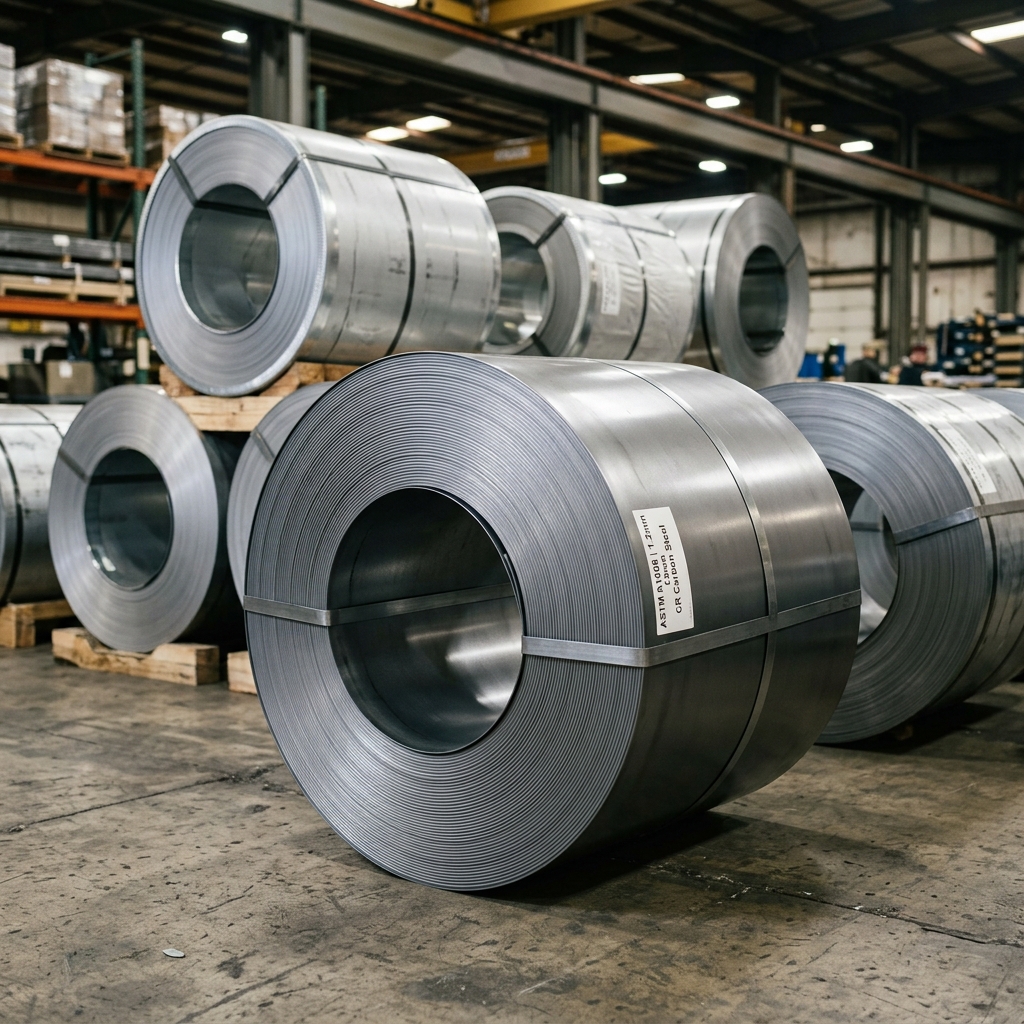
ASTM A1008 is the dominant specification for cold-rolled carbon steel coil in North American manufacturing. It defines thickness tolerances, mechanical properties, and surface finish requirements across multiple commercial grades.
Thickness Bands by Application Class
| Gauge (USS) | Thickness (mm) | Thickness (inch) | Typical Application |
|---|---|---|---|
| 28 | 0.38 | 0.015 | Precision shims, electronics enclosures |
| 24 | 0.64 | 0.025 | HVAC ductwork, lighting fixtures |
| 20 | 0.91 | 0.036 | Appliance panels, automotive interior |
| 18 | 1.27 | 0.050 | Structural brackets, cabinet frames |
| 16 | 1.52 | 0.060 | Automotive body panels, roofing |
| 14 | 1.90 | 0.075 | Heavy-duty enclosures, industrial frames |
| 12 | 2.67 | 0.105 | Load-bearing structural components |
| 10 | 3.40 | 0.134 | Heavy structural fabrication |
Key facts:
- Standard commercial range: 0.4 mm – 2.5 mm for most stamping and forming operations
- Ultra-thin precision range: 0.1 mm – 0.4 mm for specialty electronics and foil-grade applications
- ASTM A1008 covers grades CS (Commercial Steel), DS (Drawing Steel), DDS, and EDDS
Thickness Tolerance Standards
Under ASTM A1008, thickness tolerances vary by width and gauge:
- Width ≤ 1200 mm, gauge 16–20: ±0.05 mm
- Width > 1200 mm, gauge 14–18: ±0.08 mm
- Precision-rolled coil: tolerances tightened to ±0.025 mm
How Carbon Content Affects Gauge Formability Limits
Carbon percentage is the single most critical variable controlling how thin a coil can be rolled without cracking or surface defects.
Low Carbon Steel Coil (C ≤ 0.10%)
- Grades: CS Type B, DS, DDS, EDDS under ASTM A1008
- Achievable minimum gauge: 0.15 mm
- Elongation: 38–45%, enabling deep-draw stamping
- Low carbon steel coil dominates automotive skin panels and appliance casings
Medium Carbon Steel Coil (C 0.15% – 0.30%)
- Grades: CS Type C, structural grades
- Minimum practical gauge: 0.5 mm
- Yield strength: 280–380 MPa
- Reduced ductility limits deep-draw applications
High Carbon Steel Coil (C 0.30% – 0.80%)
- Grades: AISI 1035–1080 equivalents
- Minimum practical gauge: 0.8 mm
- High carbon steel coil is used in spring steel strips, saw blades, and precision cutting tools
- Work hardening is significant; intermediate annealing required below 1.0 mm
Formability decreases as carbon content rises. Attempting sub-0.5 mm gauges in high-carbon grades produces edge cracking and internal stress fractures.
Dimensional Tolerances: Precision vs. Standard Grade
Tolerance class distinguishes precision carbon steel coil from standard commercial product. This distinction is critical for stamping die design and automated feeding systems.
Tolerance Comparison Table
| Parameter | Standard Grade (ASTM A1008) | Precision Grade (DIN EN 10131) |
|---|---|---|
| Thickness tolerance | ±0.05 – ±0.10 mm | ±0.015 – ±0.030 mm |
| Width tolerance | +0 / −0.5 mm | ±0.1 mm |
| Camber (per 2000 mm) | ≤ 5 mm | ≤ 1.5 mm |
| Flatness deviation | ≤ 10 I-units | ≤ 3 I-units |
| Surface roughness Ra | 0.4 – 1.6 µm | 0.1 – 0.4 µm |
When Precision Grade Is Required
- Progressive die stamping with pitch tolerances < 0.05 mm
- Automotive Class A surfaces requiring Ra ≤ 0.4 µm
- Medical device enclosures with tight dimensional stack-up budgets
- Electrical lamination stacks where thickness variation causes core loss variance
Standard commercial coil suits general fabrication, HVAC, and structural applications where ±0.08 mm is acceptable.
Gauge Selection and Mechanical Performance
Gauge is not purely a dimensional choice — it directly governs the structural and mechanical behavior of the finished part.
Tensile Strength vs. Gauge for ASTM A1008 CS Grade
| Gauge (mm) | Yield Strength (MPa) | Tensile Strength (MPa) | Elongation (%) |
|---|---|---|---|
| 0.5 | 170–210 | 290–340 | 38–42 |
| 1.0 | 165–205 | 280–330 | 38–44 |
| 1.5 | 160–200 | 275–325 | 40–45 |
| 2.0 | 155–195 | 270–320 | 40–46 |
| 2.5 | 150–190 | 265–315 | 41–47 |
Observations:
- Thinner gauges exhibit slightly higher yield strength due to greater work hardening during rolling
- Elongation increases with thickness as residual rolling stress diminishes
- Below 0.5 mm, surface-to-volume ratio amplifies oxidation risk during annealing
Fatigue and Formability Implications
- Bend radius minimum = 0.5× material thickness for low-carbon grades
- Minimum bend radius rises to 1.5× thickness for high-carbon grades at 1.0 mm gauge
- Fatigue life in cyclic-load applications drops approximately 18–25% per 0.5 mm reduction in gauge below 1.5 mm (ASM Handbook, Vol. 1)
International Standard Equivalency: ASTM, EN, and JIS
Engineers sourcing cold-rolled carbon steel coil globally must map gauge specifications across three dominant systems.
Cross-Standard Equivalency Table
| ASTM A1008 Grade | EN 10130 Grade | JIS G3141 Grade | C Content (max) | Min YS (MPa) |
|---|---|---|---|---|
| CS Type A | DC01 | SPCC | 0.12% | 140 |
| DS | DC03 | SPCD | 0.10% | 140 |
| DDS | DC04 | SPCE | 0.08% | 140 |
| EDDS | DC06 | SPCEN | 0.02% | 120 |
| SS Grade 30 | S220GD | — | 0.20% | 220 |
Key Differences Between Systems
- ASTM A1008 specifies maximum carbon; mechanical properties are secondary minimums
- EN 10130 emphasizes forming class (DC01–DC06) with explicit r-value (Lankford coefficient) requirements
- JIS G3141 adds surface finish codes (D = dull, B = bright) as part of the grade designation
- Thickness ranges are nominally identical across all three systems for commercial gauges
Real-World Application Scenarios
Scenario 1: Automotive Body Panel Stamping
- Material: ASTM A1008 DDS / EN DC04
- Gauge selected: 0.7 mm – 0.8 mm
- Rationale: Minimum weight with sufficient dent resistance; DDS grade ensures r-value ≥ 1.6 for complex draw geometry
Scenario 2: HVAC Ductwork Fabrication
- Material: ASTM A1008 CS Type B / JIS SPCC
- Gauge selected: 0.5 mm – 1.0 mm (24–20 gauge)
- Rationale: Lock-seam forming requires ductility; 0.5 mm reduces coil weight for automated roll-forming lines
Scenario 3: Industrial Enclosure Manufacturing
- Material: ASTM A1008 CS Type A, precision-rolled
- Gauge selected: 1.2 mm – 1.5 mm (18–16 gauge)
- Rationale: Structural rigidity for equipment mounting; precision tolerance ensures consistent brake-press bend angles
FAQ: Cold-Rolled Carbon Steel Coil Gauge Specifications
Q1: What is the standard gauge range for cold-rolled carbon steel coil under ASTM A1008?
0.3 mm to 3.0 mm (28–10 USS gauge).
Q2: What is the thinnest gauge available in low carbon steel coil?
Commercially available down to 0.10 mm for precision foil grades.
Q3: Can high carbon steel coil be rolled to 0.5 mm gauge?
Not reliably; minimum practical gauge is 0.8 mm without intermediate annealing.
Q4: What tolerance defines precision carbon steel coil?
Thickness tolerance ±0.015–0.030 mm per DIN EN 10131.
Q5: Is ASTM A1008 CS equivalent to JIS G3141 SPCC?
Yes; both specify CS-type low-carbon cold-rolled coil with comparable mechanical minimums.
Q6: How does gauge affect yield strength in cold-rolled coil?
Thinner gauges show 5–10% higher yield strength due to residual work hardening.
Q7: What gauge is most common for appliance panel fabrication?
20–18 gauge (0.91–1.27 mm) dominates appliance OEM specifications.
Q8: Does EN 10130 use gauge numbers like ASTM? No; EN 10130 specifies thickness in millimeters only, without gauge numbering.
Conclusion
Cold-rolled carbon steel coil spans 0.3 mm to 3.0 mm across commercial production, with gauge selection governed by carbon content, forming requirements, and applicable standards (ASTM A1008, EN 10130, JIS G3141).
Core decision framework:
- Formability-critical applications → Select low carbon steel coil (C ≤ 0.10%), gauge 0.5–1.5 mm
- Strength-critical applications → Select medium-to-high carbon grades, gauge ≥ 0.8 mm
- Dimensional accuracy requirements → Specify precision carbon steel coil with EN 10131 tolerances
- Cross-border procurement → Use the equivalency table to align ASTM, EN, and JIS designations
Procurement specialists should request mill test reports (MTRs) confirming thickness, carbon content, yield strength, and surface finish class before finalizing coil orders for high-precision fabrication.
References and Standards
- ASTM A1008/A1008M-22: Standard Specification for Steel, Sheet, Cold-Rolled, Carbon, Structural, High-Strength Low-Alloy, High-Strength Low-Alloy with Improved Formability, Solution Hardened, and Baked Hardened
- EN 10130:2006: Cold Rolled Low Carbon Steel Flat Products for Cold Forming — Technical Delivery Conditions
- JIS G3141:2021: Cold Reduced Carbon Steel Sheet and Strip
- DIN EN 10131:2006: Cold Rolled Uncoated and Zinc or Zinc-Nickel Electrolytically Coated Low Carbon and High Yield Strength Steel Flat Products — Tolerances on Dimensions and Shape
- ASM Handbook, Volume 1: Properties and Selection: Irons, Steels, and High-Performance Alloys, ASM International
- ASM Handbook, Volume 14B: Metalworking: Sheet Forming, ASM International