

Quick Answer: Sourcing stainless pipe without a verified checklist exposes procurement teams to pressure failures, contamination risk, and audit non-compliance. This guide delivers the technical criteria—wall thickness schedules, Ra surface values, PREN ratings, and mill certifications—that define a defensible purchasing decision.
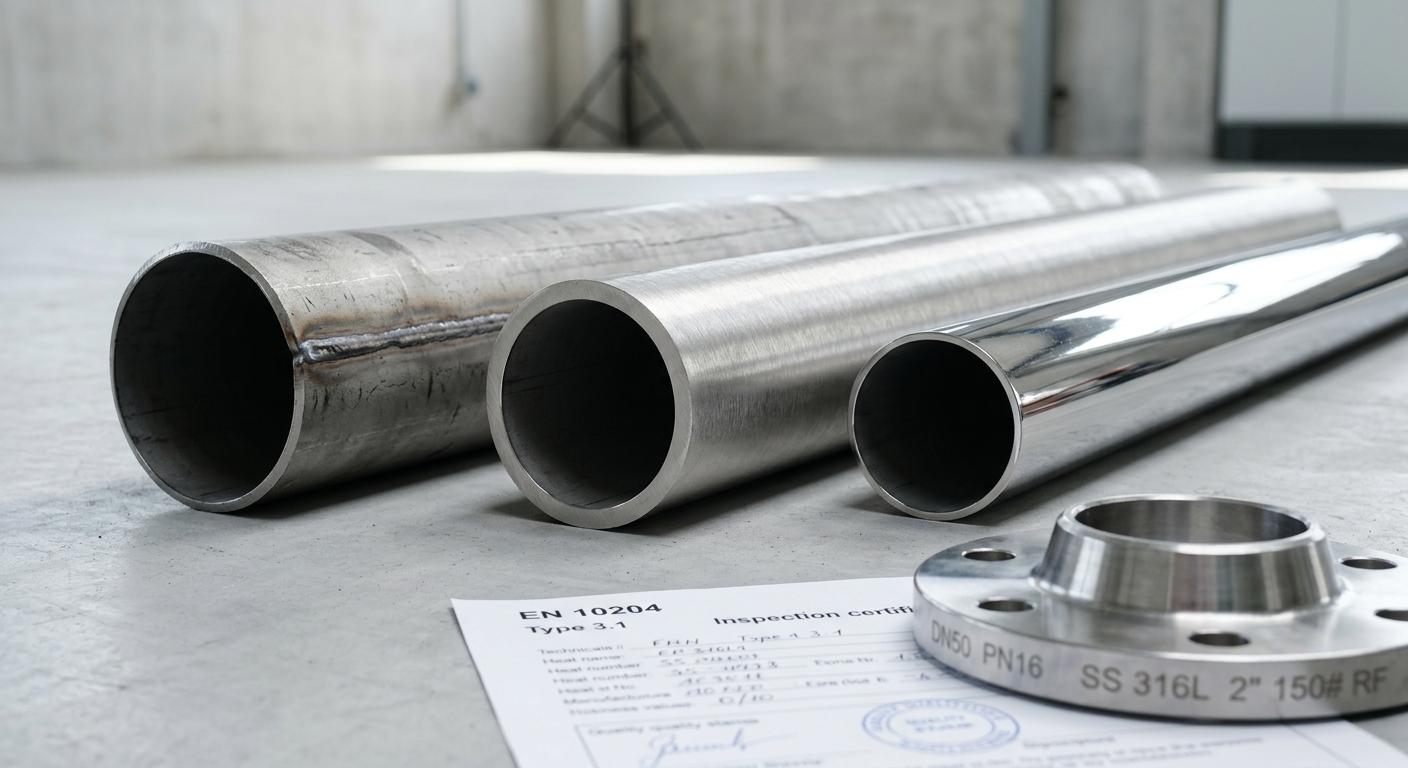
Wall Thickness and Schedule Standards Under ASME B36.19M
1. How Schedule Number Translates to Pressure Rating
Schedule number is not a wall thickness value—it is a pressure-temperature ratio expressed as:
Schedule = (P/S) × 1,000, where P = service pressure (psi) and S = allowable stress (psi).
Under ASME B36.19M, stainless pipe schedules run: 5S, 10S, 40S, 80S.
- Schedule 5S: Wall = 0.065 in (DN25); max working pressure ~315 psi at 100°F for 316L
- Schedule 10S: Wall = 0.109 in (DN25); ~530 psi
- Schedule 40S: Wall = 0.154 in (DN25); ~750 psi
- Schedule 80S: Wall = 0.219 in (DN25); ~1,070 psi
Pressure ratings drop non-linearly with temperature. At 600°F, 316L Schedule 40S loses ~35% of its room-temperature rating per ASME B31.3 allowable stress tables.
2. Tolerance Stack and Procurement Risk
ASME B36.19M permits ±12.5% wall thickness tolerance on seamless pipe. This means a nominal 0.154 in wall may deliver as thin as 0.135 in—directly reducing burst pressure margin.
Procurement checklist:
- Specify minimum wall (not nominal) in purchase orders
- Request ultrasonic thickness test (UTT) reports per ASTM E213
- Verify OD tolerance: ±0.031 in for pipe ≤1.5 in NPS
| Schedule | Nominal Wall (in) | Min Wall @−12.5% (in) | Approx. Burst Pressure (psi, 316L) |
|---|---|---|---|
| 5S | 0.065 | 0.057 | ~1,580 |
| 10S | 0.109 | 0.095 | ~2,650 |
| 40S | 0.154 | 0.135 | ~3,740 |
| 80S | 0.219 | 0.192 | ~5,320 |
Burst pressure estimated via Barlow’s formula; safety factor 4:1 not applied.
Surface Finish: Ra Values, Hygienic Compliance, and ASTM A270
1. Ra Surface Finish Value and Hygienic Risk
Ra (arithmetic mean roughness) measures peak-to-valley surface deviation in microinches or micrometers.
In food, pharma, and biotech applications governed by ASTM A270 and ASME BPE, Ra directly determines bacterial adhesion risk:
- Ra ≤ 32 µin (0.8 µm): Standard sanitary tubing; acceptable for most food-grade CIP systems
- Ra ≤ 15 µin (0.38 µm): Required for pharmaceutical WFI and USP purified water systems
- Ra ≤ 10 µin (0.25 µm): High-purity bioprocessing; electropolished finish mandatory
A 2019 study in Journal of Food Protection confirmed that biofilm formation rate on stainless surfaces increases 4× when Ra exceeds 0.8 µm, even under standard CIP protocols.
2. Finish Types by Application
| Finish Designation | Ra (µm) | Typical Process | Application |
|---|---|---|---|
| No. 1 (Hot-rolled) | 12–25 | Mill scale | Structural only |
| No. 2B | 0.1–0.5 | Cold-rolled + annealed | General industrial |
| No. 4 (Brushed) | 0.5–1.5 | Belt-ground | Food equipment exteriors |
| EP (Electropolished) | ≤0.25 | Electrochemical removal | Pharma, biotech |
| BA (Bright Annealed) | ≤0.1 | Controlled atmosphere anneal | Semiconductor, ultra-high purity |
Sourcing note: ASTM A270 mandates surface finish documentation. Require a profilometer report (per ASME B46.1) with each heat lot—not just a finish designation on the MTC.
Alloy Selection: PREN Values and Chloride Resistance
1. PREN Formula and What It Predicts
PREN (Pitting Resistance Equivalent Number) = %Cr + 3.3×%Mo + 16×%N
Higher PREN = greater resistance to chloride-induced pitting.
| Grade | Cr (%) | Mo (%) | N (%) | PREN | Chloride Threshold (ppm) |
|---|---|---|---|---|---|
| 304 / 304L | 18–20 | 0 | 0.10 | ~19–20 | <200 |
| 316 / 316L | 16–18 | 2–3 | 0.10 | ~24–26 | <1,000 |
| 317L | 18–20 | 3–4 | 0.10 | ~29–31 | <2,000 |
| 2205 Duplex | 22–23 | 3–3.5 | 0.14–0.20 | ~34–36 | <5,000 |
Decision rule:
- Seawater or coastal environments (Cl⁻ >1,000 ppm) → 316L minimum; duplex preferred
- Potable water systems (Cl⁻ <200 ppm) → 304L acceptable
- Chemical processing with acidic chlorides → PREN >35 mandatory
2. 304 vs. 316 in Real Procurement Scenarios
- Offshore platform brine lines: 304 stainless pipe failed by pitting in <18 months; 316L extended service life to 12+ years (NACE case study, 2017)
- Brewery CIP circuits: 316L specified universally due to caustic + chlorinated sanitizer combination
- HVAC condensate lines: 304 acceptable; chloride exposure minimal
Mill Certifications: EN 10204 3.1 vs. 3.2 and Procurement Traceability
1. What EN 10204 3.1 Actually Certifies
EN 10204 defines inspection document types for metallic products. For stainless pipe procurement:
- Type 2.2 (Test Report): Generic; based on non-specific testing. Not traceable to your heat.
- Type 3.1 (Inspection Certificate): Issued by manufacturer’s authorized inspector; heat-specific chemical and mechanical data
- Type 3.2 (Inspection Certificate): Countersigned by independent third party (TÜV, Bureau Veritas, Lloyd’s)
certificate must include:
- Heat/lot number
- Chemical composition (per ASTM A312 or equivalent)
- Tensile strength, yield strength, elongation
- Hydrostatic or nondestructive test confirmation
- Mill identity and authorized signatory
For procurement audits in regulated industries (nuclear, pharma, oil & gas), 3.1 is the minimum acceptable standard. A 2.2 certificate cannot support material traceability in ISO 9001 or ASME Section III audits.
Dual Certification: ASTM + EN
Many global suppliers offer dual-certified pipe (e.g., ASTM A312 TP316L / EN 10216-5 1.4404). This provides:
- US market compliance (ASME pressure vessel codes)
- EU market compliance (PED 2014/68/EU)
- Single MTC for cross-border procurement
Verification step: Cross-check heat number on MTC against physical pipe markings. Discrepancies indicate potential material substitution—a documented risk in low-cost supply chains.
Weld Seam Type and Fatigue Life Under ASTM A312
1. Seamless vs. Welded: Fatigue Performance Data
ASTM A312 covers seamless (S) and welded (W) austenitic stainless pipe. The weld seam introduces a heat-affected zone (HAZ) that alters grain structure and residual stress.
Under cyclic pressure loading:
- Seamless pipe: Fatigue life ~2× longer than welded at equivalent wall thickness (ASME fatigue curves, Section VIII Div. 2)
- ERW (Electric Resistance Welded): HAZ sensitization risk; requires solution anneal post-weld per ASTM A312 S1
- EFW (Electric Fusion Welded): Full-penetration weld; radiographic inspection mandatory per ASTM A312 for critical service
- Autogenous TIG welded (sanitary): Used in ASTM A270 tubing; weld bead ground flush to maintain Ra compliance
Cyclic pressure threshold (DN50, Schedule 10S, 316L):
- Seamless: 10⁷ cycles at ±300 psi without failure (ASME fatigue data)
- Welded (annealed): 10⁷ cycles at ±210 psi
- Welded (non-annealed): 10⁷ cycles at ±140 psi
2. Specifying Weld Seam for Your Application
| Application | Recommended Seam Type | ASTM Reference |
|---|---|---|
| High-cycle hydraulic | Seamless | A312 Grade TP316L |
| Pharmaceutical process | Autogenous TIG, electropolished | A270 / ASME BPE |
| Structural/low-pressure | EFW or ERW (annealed) | A312 W |
| Cryogenic service | Seamless, impact-tested | A312 + A1016 S7 |
Real-World Application Scenarios
Scenario 1 — Pharmaceutical Water System (WFI Loop) Specify: ASTM A270, 316L, Ra ≤ 0.38 µm (electropolished), Schedule 5S, autogenous TIG weld, EN 10204 3.2 certificate. Rationale: FDA 21 CFR Part 211 and ASME BPE compliance; full traceability for GMP audit.
Scenario 2 — Offshore Seawater Cooling Line: Specify: ASTM A312 TP316L seamless, Schedule 40S, PREN ≥ 25, EN 10204 3.1, hydrostatic test per ASTM A999. Rationale: Chloride concentration >1,000 ppm; cyclic thermal pressure from tidal variation.
Scenario 3 — Food Processing CIP Circuit: Specify: ASTM A270, 304L or 316L (depending on sanitizer chloride content), Ra ≤ 0.8 µm, Schedule 10S, 3-A Sanitary Standards Inc. compliance. Rationale: USDA/FDA sanitary design; minimize biofilm risk between cleaning cycles.
FAQ: Stainless Pipe Sourcing — Rapid Reference
Q: How does Schedule wall thickness affect stainless pipe pressure rating under ASME B36.19M?
Higher schedule = thicker wall = higher allowable working pressure per Barlow’s formula.
Q: How does Ra surface finish value impact hygienic compliance in ASTM A270 stainless pipe?
Ra >0.8 µm increases biofilm adhesion; pharma WFI requires Ra ≤0.38 µm.
Q: How does PREN value differentiate 304 versus 316 stainless pipe in chloride environments?
304 PREN ≈19–20; 316 PREN ≈24–26. Use 316L when Cl⁻ exceeds 200 ppm.
Q: How does EN 10204 3.1 mill certification ensure stainless pipe traceability for procurement audits?
3.1 links heat-specific chemistry and mechanical data to your exact pipe lot.
Q: How does weld seam type affect fatigue life in ASTM A312 stainless pipe under cyclic pressure?
Seamless delivers ~2× the fatigue life of welded pipe at equivalent wall thickness.
Q: What is the minimum certification for nuclear or pharma stainless pipe procurement?
EN 10204 3.2 (third-party countersigned) is required; 3.1 is the absolute minimum.
Q: Can 304 and 316 stainless pipe be dual-certified?
Yes. Dual ASTM A312 / EN 10216-5 certification is standard from major mills.
Q: What tolerance should I specify to prevent undersized wall thickness?
Specify minimum wall thickness; request UTT reports per ASTM E213.
Conclusion and Procurement Action Checklist
Sourcing stainless pipe correctly requires simultaneous evaluation across four technical dimensions: wall schedule, surface finish Ra, alloy PREN, and mill certification type.
Before issuing any purchase order, verify:
- Schedule specified as minimum wall, not nominal
- Ra value documented by profilometer report (ASME B46.1)
- PREN calculated against actual service chloride concentration
- EN 10204 3.1 (minimum) or 3.2 certificate required
- Weld seam type matched to cyclic pressure duty
- Heat number cross-checked between MTC and pipe marking
- Dual ASTM/EN certification confirmed for cross-border shipments
A single non-conforming heat lot—wrong wall thickness, inadequate surface finish, or missing traceability—can trigger production shutdown, regulatory non-compliance, or catastrophic pressure failure. The specifications above are not conservative preferences; they are the engineering minimums that define fit-for-purpose stainless pipe.
References and Standards
- ASME B36.19M — Stainless Steel Pipe (dimensional standard)
- ASTM A312 — Seamless, Welded, and Heavily Cold Worked Austenitic Stainless Steel Pipes
- ASTM A270 — Seamless and Welded Austenitic Stainless Steel Sanitary Tubing
- ASME BPE — Bioprocessing Equipment Standard (surface finish and weld requirements)
- EN 10204:2004 — Metallic Products — Types of Inspection Documents
- ASME B31.3 — Process Piping (pressure-temperature ratings)
- NACE International — Corrosion Case Studies: Stainless Steel in Chloride Service (2017)
- ASME Section VIII Div. 2 — Fatigue Design Curves for Pressure Vessels
- ASME B46.1 — Surface Texture (Surface Roughness, Waviness, and Lay)