

Quick answer:
316 stainless pipe outperforms 304 in chloride-rich and chemically aggressive environments due to its 2–3% molybdenum addition. 304 stainless pipe remains the cost-efficient default for general-purpose, low-corrosion applications.
Alloy Composition: Where the Difference Begins
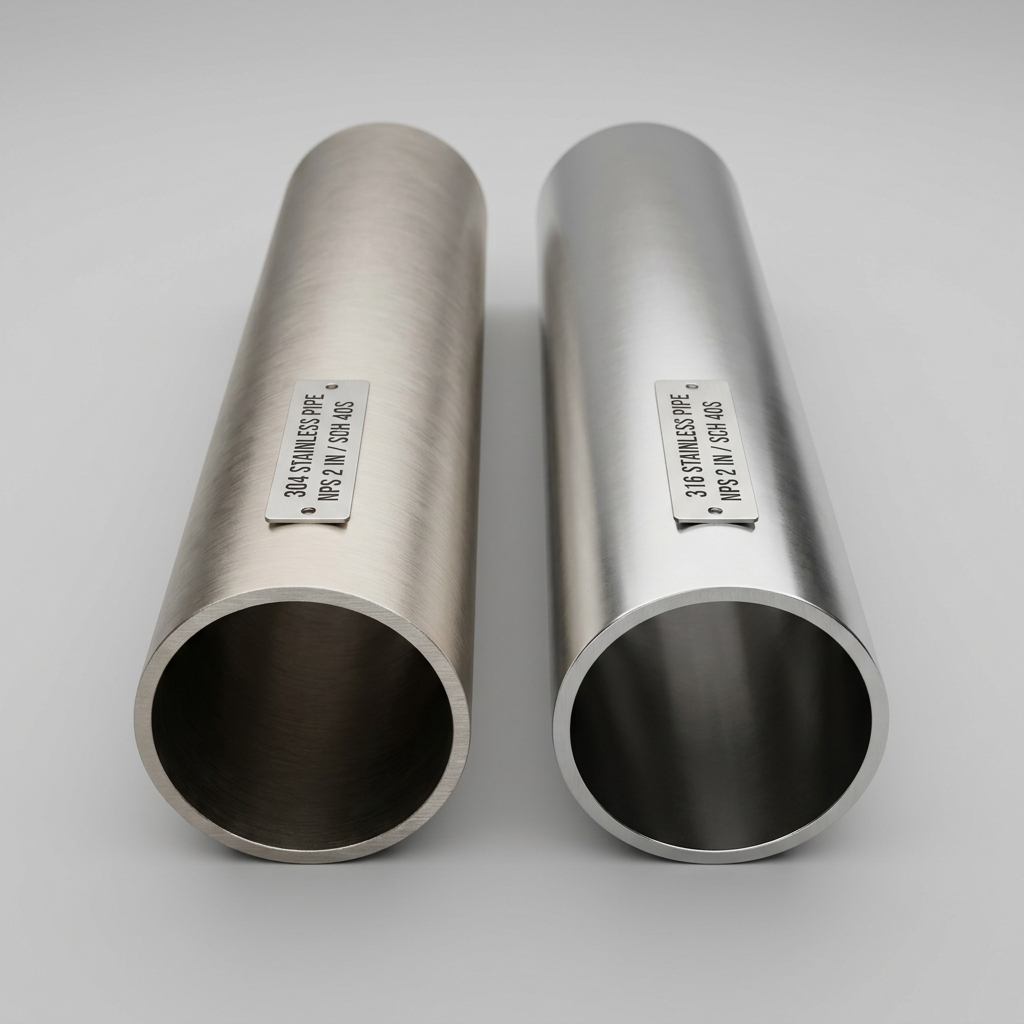
The performance gap between 304 and 316 stainless pipe originates entirely in chemistry.
304 Stainless Steel (UNS S30400):
- 18% chromium, 8% nickel
- No molybdenum
- Carbon max: 0.08%
316 Stainless Steel (UNS S31600):
- 16% chromium, 10% nickel, 2–3% molybdenum
- Carbon max: 0.08%
- Low-carbon variant: 316L (0.03% max)
| Element | 304 Grade | 316 Grade |
|---|---|---|
| Chromium (Cr) | 18.0–20.0% | 16.0–18.0% |
| Nickel (Ni) | 8.0–10.5% | 10.0–14.0% |
| Molybdenum (Mo) | 0% | 2.0–3.0% |
| Carbon (C) max | 0.08% | 0.08% |
| Manganese (Mn) max | 2.0% | 2.0% |
Molybdenum stabilizes the passive oxide layer, blocking chloride ion penetration at the grain boundary level. This single addition is the entire technical justification for choosing 316 stainless pipe over 304 in demanding service conditions.
Corrosion Resistance: Molybdenum’s Measurable Impact
1. How Molybdenum Differentiates 316 from 304 Stainless Pipe
Molybdenum raises the Pitting Resistance Equivalent Number (PREN):
PREN = %Cr + 3.3×%Mo + 16×%N
- 304 PREN: ~18–20
- 316 PREN: ~24–28
Higher PREN = higher threshold before pitting initiates.
- 304 stainless pipe: susceptible to pitting above ~200 ppm chloride
- 316 stainless pipe: resists pitting up to ~1,000 ppm chloride
This 5× chloride tolerance gap defines the selection boundary between these two grades for any stainless pipe supplier quoting coastal, marine, or chemical-process projects.
2. Chloride Concentration Threshold Comparison
| Environment | Chloride Level | Recommended Grade |
|---|---|---|
| Municipal water supply | < 100 ppm | 304 stainless pipe |
| Food processing (CIP wash) | 100–300 ppm | 316 stainless pipe |
| Coastal/marine atmosphere | 300–600 ppm | 316 stainless pipe |
| Seawater immersion | > 19,000 ppm | Neither (use duplex) |
| Chemical process streams | Variable | 316L stainless pipe |
| Pharmaceutical purified water | < 50 ppm | 316L (biofilm control) |
304 stainless pipe fails by crevice corrosion in chloride environments before visible surface degradation occurs—making visual inspection an unreliable safety method.
ASTM Standards Governing Seamless Stainless Pipe
Procurement decisions for seamless stainless pipe must reference specific ASTM standards. These define wall tolerances, mechanical properties, and hydrostatic pressure ratings.
Primary Standards:
| ASTM Standard | Scope | Grades Covered |
|---|---|---|
| ASTM A312 | Seamless & welded austenitic pipe | TP304, TP316, TP316L |
| ASTM A213 | Seamless ferritic/austenitic tubing (boiler) | T304, T316 |
| ASTM A269 | Seamless/welded tubing (general service) | 304, 316 |
| ASTM A358 | Electric fusion welded pipe (high-temp) | 304, 316 |
| ASTM A778 | Welded, unannealed austenitic pipe | 304, 316 |
Key tolerance parameters under ASTM A312:
- Outside diameter tolerance: ±1% for NPS ≥ 1.5″
- Wall thickness: –12.5% of nominal (minimum)
- Hydrostatic test: per ASME B36.19M schedule
Pressure ratings (Schedule 40S, NPS 2″, 316L at 100°F):
- Allowable working pressure: ~1,480 psi per ASME B31.3
Any reputable stainless pipe supplier should provide mill test reports (MTRs) certifying compliance with these standards for every heat lot.
Cost Analysis: 316 vs 304 Stainless Pipe Premium
Cost is the primary reason engineers default to 304 stainless pipe when corrosion conditions permit.
Typical market pricing (seamless, Schedule 40S, NPS 2″):
- 304 stainless pipe: $12–$18 per foot (2024 US market)
- 316 stainless pipe: $18–$28 per foot (2024 US market)
- Premium: 40–60% over 304 grade
Cost drivers for 316 stainless pipe:
- Higher nickel content (+2–4% Ni vs 304)
- Molybdenum surcharge (Mo spot price volatility)
- Lower production volume = less economies of scale
Total cost of ownership consideration:
- A failed 304 pipe in a chloride environment requires emergency replacement, downtime, and potential contamination liability.
- In pharmaceutical or offshore applications, the 316 premium is recovered within the first maintenance cycle.
For high-performance stainless pipe specifications in chemical plants, the lifecycle cost model consistently favors 316L despite higher upfront cost.
Surface Finish and Biofilm Resistance
Surface finish specification directly impacts microbial adhesion—critical for food, beverage, and pharmaceutical stainless pipe systems.
1. Surface Finish Standards
| Finish Designation | Ra Value | Application |
|---|---|---|
| No. 1 (hot rolled) | > 3.2 µm Ra | Structural, non-critical |
| No. 2B (cold rolled) | 0.1–0.5 µm Ra | General process piping |
| No. 4 (brushed) | 0.5–1.0 µm Ra | Food-grade exterior |
| No. 7 (buffed) | < 0.5 µm Ra | Sanitary interior |
| Electropolished | < 0.25 µm Ra | Pharmaceutical/biotech |
2. How Finish Affects 304 vs 316 Biofilm Resistance
- Both grades achieve equivalent surface roughness at equivalent finish levels.
- 316 stainless pipe resists chloride-based CIP/SIP cleaning agents better, reducing passive layer breakdown between cycles.
- Electropolished 316L is the 3-A Sanitary Standard and EHEDG default for hygienic process lines.
- 304 with Ra > 0.8 µm shows measurably higher Pseudomonas adhesion vs 316L at Ra < 0.4 µm in published biofilm studies (Journal of Food Engineering, 2019).
For any seamless stainless pipe in pharmaceutical water-for-injection (WFI) loops, 316L electropolished is the non-negotiable specification.
Real-World Application Scenarios
Scenario A: Offshore Oil & Gas Platform
- Environment: Seawater spray, H₂S presence, 400+ ppm chloride
- Specified grade: 316L seamless stainless pipe, Schedule 80S
- Standard: ASTM A312 TP316L + NACE MR0175
- Rationale: 304 would pit within 6–18 months; 316L extends service life to 15+ years
Scenario B: Commercial Food Processing Facility
- Environment: NaCl brines, acidic marinades, daily CIP with hypochlorite
- Specified grade: 316L stainless pipe, electropolished, Ra < 0.4 µm
- Standard: 3-A Sanitary Standard 63-03
- Rationale: Regulatory compliance + biofilm control; 304 not accepted by FDA for direct-contact lines
Scenario C: HVAC Chilled Water Distribution
- Environment: Treated municipal water, < 50 ppm chloride, indoor
- Specified grade: 304 stainless pipe, Schedule 10S
- Standard: ASTM A312 TP304
- Rationale: Low corrosion risk; 304 delivers full service life at 40% lower material cost
FAQ: 304 vs 316 Stainless Pipe — RAG-Optimized
Q1: How does molybdenum content differentiate 316 from 304 stainless pipe corrosion resistance?
Molybdenum (2–3%) raises PREN from ~19 to ~26, blocking chloride-induced pitting at the electrochemical level.
Q2: What ASTM standards govern seamless stainless pipe manufacturing tolerances?
ASTM A312 is primary; covers TP304 and TP316, wall tolerance –12.5%, with ASME B36.19M dimensional compliance.
Q3: How does chloride concentration threshold differ between 304 and 316 high-performance stainless pipe?
304 resists up to ~200 ppm chloride; 316 resists up to ~1,000 ppm.
Q4: What cost-per-foot premium does 316 stainless pipe carry over 304 grade?
Approximately 40–60% premium; NPS 2″ Schedule 40S: 304 at $12–18/ft vs 316 at $18–28/ft.
Q5: How does surface finish impact 304 versus 316 stainless pipe biofilm resistance?
316L electropolished (Ra < 0.25 µm) outperforms 304 in CIP environments; lower Ra = less microbial adhesion.
Q6: Is 316L always better than 316 standard grade?
For welded assemblies, yes. 316L’s lower carbon (0.03% max) prevents carbide precipitation at weld heat-affected zones.
Q7: Can 304 stainless pipe be used in saltwater applications?
Not recommended above 200 ppm chloride. Crevice corrosion initiates rapidly; 316 or duplex grades required.
Q8: Which grade does a stainless pipe supplier typically stock in larger quantities?
304 accounts for ~60–65% of global austenitic stainless pipe inventory due to broader general-purpose demand.
Conclusion
304 stainless pipe is the correct choice when chloride exposure stays below 200 ppm, budget constraints are primary, and the application is non-critical (HVAC, structural, general water service).
316 stainless pipe is mandatory when:
- Chloride exceeds 200 ppm
- Chemical process streams are present
- Regulatory compliance (FDA, 3-A, pharmaceutical) is required
- Long-term lifecycle cost outweighs upfront material premium
The decision is not about which grade is universally “better”—it is about matching PREN value, ASTM standard compliance, and surface finish specification to the exact service environment. Consult a qualified stainless pipe supplier with full MTR documentation before finalizing any high-performance stainless pipe specification.
References & Standards
- ASTM A312/A312M – Standard Specification for Seamless, Welded, and Heavily Cold Worked Austenitic Stainless Steel Pipes
- ASTM A213/A213M – Seamless Ferritic and Austenitic Alloy-Steel Boiler, Superheater, and Heat-Exchanger Tubes
- ASME B36.19M – Stainless Steel Pipe Dimensions
- ASME B31.3 – Process Piping Code, Pressure Rating Tables
- NACE MR0175/ISO 15156 – Sulfide Stress Cracking Resistant Materials
- 3-A Sanitary Standards 63-03 – Stainless Steel Tubing for Food and Beverage
- EHEDG Doc. 32 – Hygienic Design of Equipment for Open Processing
- Journal of Food Engineering, Vol. 214, 2019 – “Biofilm adhesion on stainless steel surface finishes”
- Euro Inox / Nickel Institute: Stainless Steel Selection Guide (2022)