

Steel profiles are among the most versatile and load-critical components in modern infrastructure. From high-rise building frames to industrial conveyor systems, the structural geometry of a steel profile directly determines how forces are distributed, how connections are fabricated, and how long a structure performs under dynamic or static loads.
For procurement engineers and project managers, selecting the right steel profile means navigating a matrix of cross-section types, material grades, dimensional standards, and supplier certifications. A misjudged specification—wrong grade, incorrect tolerance class, or unverified mill certificate—can compromise structural integrity or trigger costly rework.
This article provides a technically grounded overview of steel profile types, their mechanical property benchmarks, applicable international standards, and real-world application logic across construction and industrial sectors. Whether you are sourcing structural steel profiles for a warehouse frame, a bridge girder, or a precision machine base, the following sections deliver the specification clarity and supplier evaluation criteria needed to make confident procurement decisions.
Understanding Steel Profile Types and Their Structural Logic
1. Common Steel Profile Geometries and Classifications
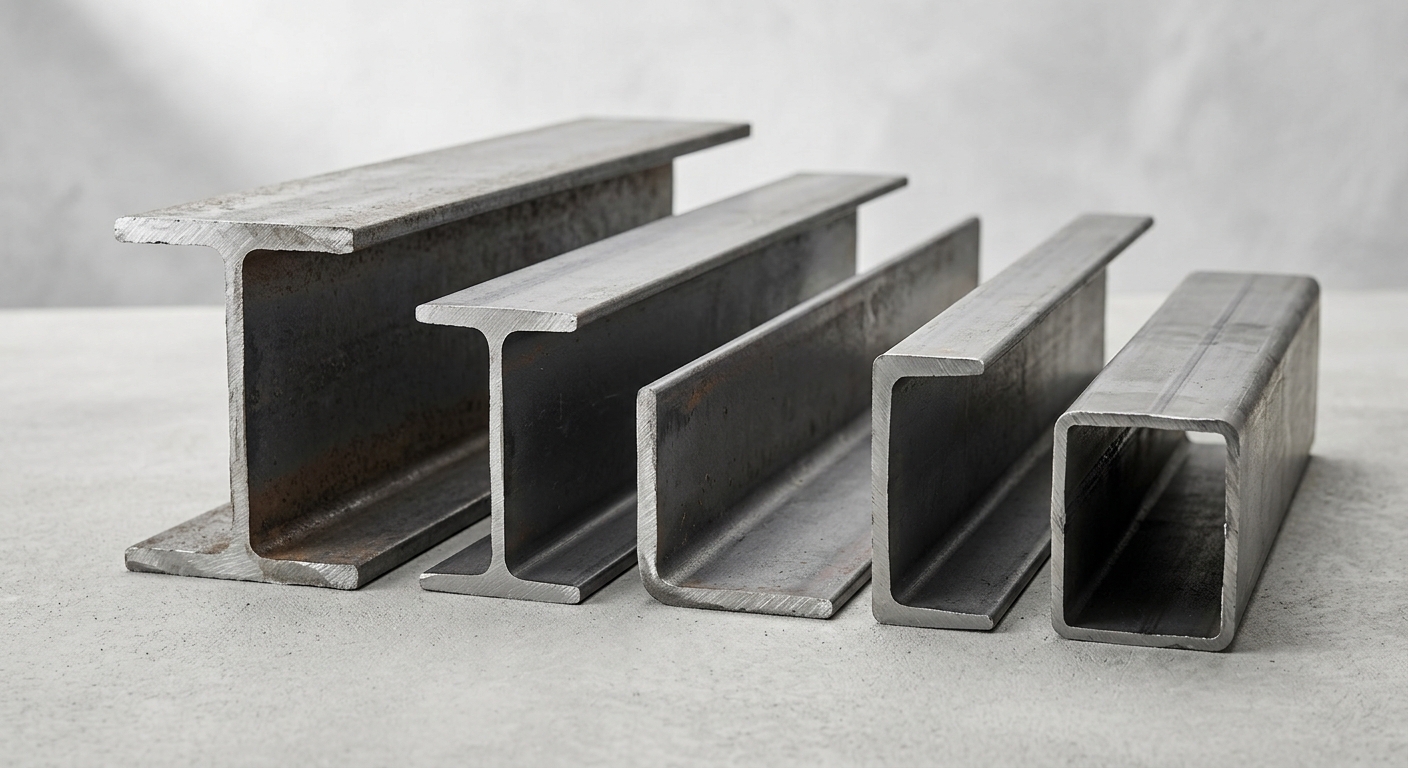
Steel profiles are categorized primarily by their cross-sectional geometry, which governs how each profile resists bending, shear, torsion, and axial compression. The most commercially significant types include:
- H-Beam (Wide Flange): Parallel flanges and a thick web deliver superior bending resistance along both axes. Ideal for primary structural columns and heavy-span beams where biaxial loading occurs.
- I-Beam (Standard/Universal Beam): Tapered flanges optimize material efficiency for uniaxial bending. Widely used in floor joists, crane rails, and secondary framing elements.
- Angle Steel (L-Section): Equal and unequal leg variants serve as bracing members, connection brackets, and lightweight frame components. High versatility at low unit cost.
- Channel Steel (U/C-Section): Open cross-section with good bending resistance in one plane. Common in purlins, lintels, vehicle chassis, and rack framing.
- Flat Bar: Rectangular solid section used for ties, stiffeners, and fabricated assemblies where welding simplicity matters more than section efficiency.
- Hollow Sections (RHS/SHS/CHS): Rectangular, square, and circular hollow sections offer excellent torsional rigidity and a clean aesthetic. Preferred for exposed architectural structures, columns under combined loading, and modular frameworks.
The choice between open sections (H, I, angle, channel) and closed sections (hollow profiles) is determined by load type, connection method, and corrosion exposure. Open sections are easier to connect and inspect; hollow sections provide superior resistance to torsion and lateral buckling.
2. Hot Rolled vs. Cold Formed Steel Profiles
Hot rolled steel profiles are produced by passing heated steel billets through rolling mills at temperatures above 900°C. This process yields larger section sizes, tighter residual stress distribution, and superior weldability—making hot rolled profiles the standard choice for primary structural applications. Dimensional tolerances follow EN 10034 or ASTM A6, with typical web height tolerances of ±2–3 mm depending on section class.
Cold-formed profiles are manufactured at ambient temperature by bending or roll-forming steel sheet or strip. The cold-working process increases yield strength through strain hardening but introduces tighter dimensional constraints on material thickness (typically ≤6 mm). Cold-formed sections are preferred in light-gauge steel framing, cladding rails, and secondary structural members where weight reduction is prioritized.
For heavy construction—columns, primary beams, bridge girders—hot-rolled profiles remain the dominant specification due to their depth range, mechanical consistency, and established weld procedure compatibility.
Key Technical Specifications and Material Standards
1. Mechanical Properties and Grade Reference
Structural performance begins with material grade. The three dominant standards governing steel profile grades are:
- EN 10025 (European): S235 (yield ≥235 MPa), S355 (yield ≥355 MPa), S460 (yield ≥460 MPa). S355 is the benchmark grade for most European structural projects.
- ASTM A36/A572 (North American): A36 provides a minimum yield of 250 MPa; A572 Grade 50 delivers 345 MPa with improved weldability for high-load applications.
- GB/T 706 (Chinese Standard): Q235 (yield ≥235 MPa) and Q345/Q355 (yield ≥345 MPa) are the primary grades for domestic and export structural profiles.
Key mechanical parameters that must be verified against mill test certificates:
| Parameter | S235 | S355 | A572 Gr.50 | Q355 |
|---|---|---|---|---|
| Yield Strength (MPa) | ≥235 | ≥355 | ≥345 | ≥355 |
| Tensile Strength (MPa) | 360–510 | 470–630 | 450–620 | 470–630 |
| Elongation (%) | ≥26 | ≥22 | ≥21 | ≥22 |
2. Dimensional Tolerances, Surface Conditions, and Profile Comparison
Dimensional accuracy directly affects fabrication fit-up and connection integrity. EN 10034 governs tolerances for H and I beams; EN 10056 covers angle steel; EN 10219/10210 applies to hollow sections. ASTM A6 provides equivalent coverage for North American procurement.
Surface condition options impact corrosion protection strategy and downstream coating adhesion:
- Mill finish (as-rolled): Standard delivery; requires blast cleaning and primer before service in corrosive environments.
- Hot-dip galvanized: Zinc coating of 45–85 µm; suitable for outdoor structures, bridges, and coastal infrastructure.
- Epoxy or polyurethane painted: Specified thickness and adhesion class per ISO 12944 for aggressive industrial environments.
| Profile Type | Typical Grade | Yield Strength (MPa) | Standard | Section Size Range | Common Application |
|---|---|---|---|---|---|
| H-Beam | S355 / Q355 | ≥355 | EN 10025 / GB/T 706 | HW100×100 – HW400×400 | Columns, heavy frames |
| I-Beam | S235 / A36 | ≥235 | EN 10025 / ASTM A6 | IPE80 – IPE600 | Floor beams, crane rails |
| Angle Steel | S235 / Q235 | ≥235 | EN 10056 / GB/T 706 | L20×3 – L200×20 | Bracing, brackets |
| Channel Steel | S355 / Q355 | ≥355 | EN 10279 / GB/T 706 | UPN80 – UPN400 | Purlins, chassis |
| Hollow Section (RHS) | S355J2H | ≥355 | EN 10219 | 40×20×2 – 400×200×16 | Columns, trusses |
Steel Profiles Applications: Construction & Industrial Use Cases
1. Structural Steel Profiles for Building and Civil Engineering
Steel beam profiles for buildings constitute the dominant application segment globally. In commercial and industrial construction, hot-rolled H-beams and I-beams form the primary load-bearing skeleton—transferring gravity loads from floor slabs through columns to foundations. Key application scenarios include:
- Multi-story and high-rise frames: H-beams in S355 or Q355 provide the column-and-beam grid that resists both gravity and lateral wind/seismic forces. Moment connections at beam-column joints are fabricated using standardized end-plate or welded flange details.
- Single-span industrial warehouses and logistics centers: Portal frame systems using tapered or parallel-flange I-beams achieve clear spans of 20–60 m with minimal internal columns—maximizing usable floor area.
- Bridge and civil infrastructure: Wide-flange sections and plate girders carry dynamic vehicle loads across spans where concrete alone is insufficient. S460 and A572 Gr.65 grades reduce section weight without sacrificing load capacity.
- Mezzanine and elevated platforms: Channel and angle steel profiles frame secondary deck structures within warehouses, enabling vertical space utilization without full structural rebuilds.
Span capability is a critical procurement variable: a 500 mm deep H-beam in S355 can span approximately 12–18 m under typical office floor loading, while equivalent spans in S235 would require a significantly deeper or heavier section.
2. Industrial Steel Profiles in Manufacturing and Infrastructure
Beyond construction, industrial steel profiles underpin the physical infrastructure of manufacturing operations:
- Machine bases and equipment frames: Hollow sections (SHS/RHS) provide the torsional rigidity needed for CNC machine beds and press frames, where vibration damping and dimensional stability are critical.
- Conveyor and material handling systems: C-channel and angle profiles form the structural spine of conveyor frames, roller supports, and overhead monorail systems in automotive, food processing, and logistics facilities.
- Energy sector support structures: Offshore platforms, wind turbine towers, and substation frames rely on high-strength hollow sections and H-profiles in grades up to S460 or API 2H to withstand fatigue loading and marine corrosion.
- Modular industrial racking and shelving: Cold-formed channel and angle profiles enable rapid assembly of adjustable storage systems, where bolt-connected joints must meet load ratings without permanent welding.
Weldability is a non-negotiable requirement across all industrial applications. Carbon equivalent (CE) values below 0.43 (per EN 1011-2) ensure reliable fusion welding without preheat requirements for sections up to 40 mm thick.
Compliance, Sourcing Criteria, and Supplier Evaluation
1. International Certifications and Quality Compliance
Structural steel profiles used in regulated construction projects must be accompanied by verifiable documentation:
- Mill Test Certificate (MTC): Issued per EN 10204 Type 3.1 (mill-certified) or 3.2 (third-party witness). The MTC confirms heat number traceability, chemical composition, and mechanical test results for each production batch.
- CE Marking: Mandatory for structural steel products sold within the EU under EN 1090-1. Requires Factory Production Control (FPC) audited by a Notified Body.
- ISO 9001:2015: Demonstrates a supplier’s quality management system covers raw material procurement, rolling process control, dimensional inspection, and documentation integrity.
- Third-Party Inspection Reports: SGS, Bureau Veritas, or TÜV inspection at source is increasingly specified by international EPC contractors to independently verify grade, dimensions, and surface condition before shipment.
2. Evaluating a Hot Rolled Steel Profiles Supplier
When qualifying a supplier for structural or industrial steel profiles, the following criteria determine supply chain reliability:
- MOQ and stock availability: Reputable suppliers maintain rolling stock of standard sections in common grades, enabling partial orders without full production run commitments.
- Lead time transparency: Hot rolled profiles require 2–6 weeks for non-stock sizes; galvanized or painted finishes add 1–2 weeks. Confirmed production schedules should be contractually binding.
- Dimensional and grade traceability: Each bundle or lift should carry heat number markings traceable to the corresponding MTC. Color coding or stenciling by grade is standard practice.
- Export packaging standards: Seaworthy bundling with steel strapping, moisture-barrier wrapping, and wooden dunnage protects profiles during ocean freight. Confirm compliance with ISPM-15 for wooden packaging.
- Technical support capability: Suppliers who provide section property tables, connection design guidance, and cut-to-length processing services reduce downstream fabrication costs significantly.
Conclusion
Steel profiles serve as the structural backbone of modern construction and industrial infrastructure—their geometry, grade, and surface specification collectively determine whether a structure meets its load, durability, and compliance requirements. Selecting the correct profile type—H-beam for heavy columns, hollow sections for torsion-critical frames, channel steel for secondary members—is the first engineering decision. Verifying material grades against EN, ASTM, or GB standards through traceable mill certificates is the second. Partnering with a certified, export-capable supplier who provides documentation integrity, dimensional traceability, and responsive technical support is the third.
Together, these three steps translate material specification into structural performance, ensuring that every steel profile delivered to site contributes to a safe, code-compliant, and cost-efficient outcome.