

Quick Answer: A galvanized steel roofing sheet typically lasts 20–70 years, depending on zinc coating weight (60–600 g/m²), corrosion environment (ISO 9223 C1–CX), installation quality, and post-fabrication cut-edge protection. Coating process and climate zone are the two dominant lifespan variables.
Zinc Coating Thickness and ISO 9223 Corrosion Category: The Primary Lifespan Driver
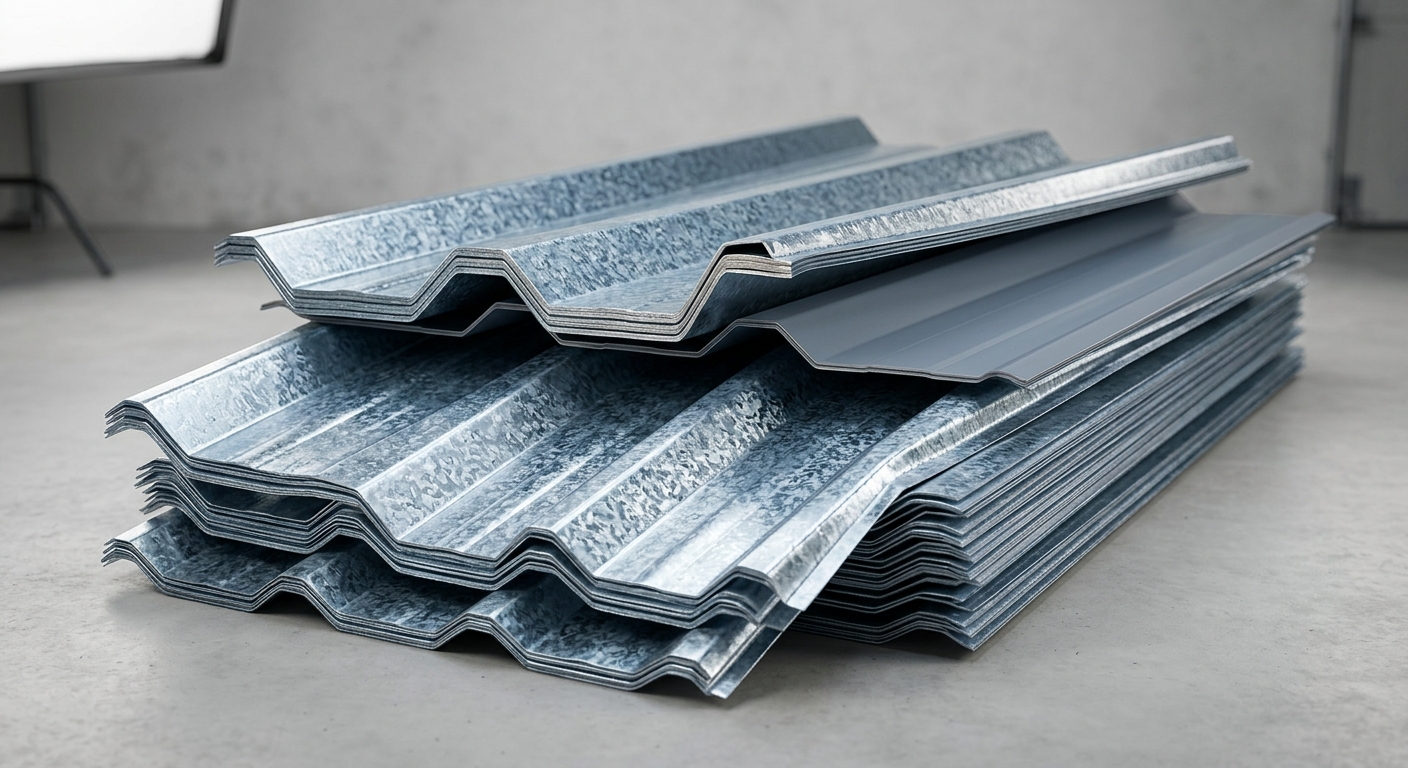
Zinc coating weight—measured in g/m²—is the single most quantifiable predictor of galvanized steel roofing sheet service life.
1. Coating Weight vs. Corrosion Category Matrix
| ISO 9223 Category | Environment Example | Recommended Coating (g/m²) | Expected Lifespan |
|---|---|---|---|
| C1 | Indoor dry | Z60–Z100 | 50–70 years |
| C2 | Rural/suburban | Z120–Z180 | 35–50 years |
| C3 | Urban/industrial | Z200–Z275 | 25–40 years |
| C4 | Coastal/chemical | Z275–Z350 | 15–25 years |
| C5/CX | Marine/offshore | Z450–Z600 | 10–20 years |
- Z60 (60 g/m²): minimum specification; unsuitable for outdoor exposure.
- Z275 (275 g/m²): standard threshold for most commercial roofing projects.
- Z600 (600 g/m²): heavy industrial or coastal specification; hot-dip only.
2. Zinc Depletion Rate by Environment
- C2 environments: zinc depletes at approximately 0.1–0.7 µm/year.
- C4 environments: depletion accelerates to 2.1–4.2 µm/year (ISO 9224 annex data).
- A Z275 sheet carries ~19.3 µm zinc per side; at C4 rates, theoretical zinc life = 4.6–9.2 years before base steel exposure.
- Sacrificial cathodic protection extends effective protection 15–30% beyond zinc depletion point.
Key takeaway: Buyers sourcing wholesale galvanized steel roofing sheet for coastal projects must specify minimum Z350 and verify mill certificates against EN 10346 or ASTM A653.
Hot-Dip vs. Electrogalvanizing: Factory Process Impact on Long-Term Adhesion
Galvanized steel roofing sheet factories use two primary coating processes, each producing fundamentally different metallurgical bond structures.
1. Process Comparison
| Parameter | Hot-Dip Galvanizing | Electrogalvanizing |
|---|---|---|
| Coating thickness | 45–100 µm (Z275–Z600) | 2.5–25 µm (Z15–Z150) |
| Bond type | Metallurgical Fe-Zn alloy layers | Electrochemical deposit |
| Adhesion (bend test) | Passes 180° T-bend without flaking | Passes 2T–4T bend |
| Surface uniformity | Slight spangle texture | Smooth, uniform |
| Typical application | Structural roofing, industrial | Pre-painting substrate |
| Long-term adhesion | Superior under thermal cycling | Adequate for protected environments |
2. Why Factory Process Determines Field Performance
- Hot-dip produces a Gamma (Γ), Delta (δ), Zeta (ζ), Eta (η) alloy layer sequence; the Gamma layer bonds at ~250 MPa shear strength.
- Electrogalvanized sheets lack the intermetallic alloy gradient; adhesion relies on surface cleanliness alone.
- Under thermal cycling (−20°C to +80°C rooftop conditions), hot-dip coatings show <3% delamination after 1,000 cycles vs. 8–12% for electrogalvanized equivalents (ASTM B117 salt spray correlation data).
- Reputable galvanized steel roofing sheet factories producing hot-dip product to EN 10346 or JIS G3302 maintain Fe content in bath at <0.03% to ensure alloy layer integrity.
Specification note: For structural roofing applications, always request hot-dip product with documented spangle control and minimum 3-point coating weight verification per coil.
Prepainted Galvanized Steel Roofing Sheet: PVDF vs. Bare Zinc Performance
Prepainted galvanized steel roofing sheet adds an organic coating layer above the zinc, fundamentally changing the corrosion mechanism.
1. Organic Coating Systems Compared
| Coating System | DFT (µm) | Gloss Retention (10yr) | Salt Spray (hrs) | Suitable ISO Category |
|---|---|---|---|---|
| Polyester (PE) | 20–25 | 40–60% | 500–800 | C1–C3 |
| Silicon-modified PE | 25–30 | 55–70% | 800–1,000 | C2–C3 |
| PVDF (70% Kynar) | 25–35 | 80–90% | 1,500–2,000 | C2–C5 |
| HDP (High Durability PE) | 25–35 | 65–75% | 1,000–1,200 | C2–C4 |
| SMP (Silicone Modified) | 20–30 | 60–75% | 900–1,100 | C2–C4 |
2. PVDF Mechanism vs. Bare Zinc
- Bare zinc oxidizes to zinc hydroxide → zinc carbonate (patina) within 6–18 months; patina is self-limiting but porous in acidic rain (pH < 5.5).
- PVDF coating (polyvinylidene fluoride, 70% resin content) creates a UV-stable fluoropolymer barrier; C–F bond energy = 485 kJ/mol, resisting UV photodegradation for 20–30 years.
- PVDF-coated prepainted galvanized steel roofing sheet retains >80% gloss at 10 years in C3 environments; bare zinc shows visible white rust within 3–5 years in the same category.
- PVDF extends effective corrosion resistance by 2–3× compared to bare zinc in C3–C4 environments.
- Cut edges on prepainted product remain uncoated; cathodic protection from zinc covers gaps up to 1–3 mm laterally.
Wholesale Grade Variations and Field Lifespan Data Across Climatic Zones
Wholesale galvanized steel roofing sheet procurement involves navigating grade tiers that directly correlate to documented field performance.
1. Grade Classification and Verified Field Data
| Grade Standard | Zinc Weight | Substrate Grade | Documented Field Life (Temperate) | Documented Field Life (Tropical Coastal) |
|---|---|---|---|---|
| ASTM A653 G60 | 180 g/m² | CS Type B | 20–30 years | 8–15 years |
| ASTM A653 G90 | 275 g/m² | SS Grade 33 | 30–45 years | 15–22 years |
| EN 10346 Z275 | 275 g/m² | DX51D | 30–45 years | 15–22 years |
| EN 10346 Z350 | 350 g/m² | S280GD | 40–55 years | 20–28 years |
| JIS G3302 Z27 | 275 g/m² | SGCC | 28–42 years | 14–20 years |
- Field data sourced from BRE Digest 462 (UK), NRCA Roofing Manual (US), and CSIRO corrosion studies (Australia).
- Tropical coastal zones (high humidity + salt aerosol + UV Index >10) reduce lifespan by 35–55% versus temperate benchmarks.
- Documented case: Z275 roofing in Queensland, Australia (C4 zone) showed base steel exposure at 18 years; Z350 equivalent lasted 26 years under identical conditions.
2. Climatic Zone Procurement Recommendations
- Temperate/continental (C2): Z180–Z275 is cost-efficient; 30–45 year life achievable.
- Subtropical humid (C3–C4): Minimum Z275; PVDF prepainted preferred.
- Marine/industrial (C4–C5): Z350–Z600 hot-dip; consider Zn-Al-Mg alloy coatings (Magnelis®/ZM310) for 2–3× zinc performance.
Cut-Edge Oxidation and Sacrificial Cathodic Protection Limits
Cut edges are the primary failure initiation point on galvanized steel roofing sheet after installation.
1. Cut-Edge Corrosion Mechanics
- Shearing exposes bare steel at the cut face; zinc on adjacent surfaces acts as a sacrificial anode.
- Cathodic protection effective radius: 0.5–3 mm depending on electrolyte conductivity and zinc coating weight.
- In C4 environments, cut-edge red rust appears within 2–5 years on Z275 sheet without edge treatment.
- Protection radius decreases in low-humidity environments (electrolyte film discontinuous).
2. Mitigation Strategies and Their Effectiveness
| Method | Protection Extension | Cost Impact |
|---|---|---|
| Zinc-rich primer spray | +5–10 years at edge | Low |
| Cold galvanizing compound | +8–12 years | Low–Medium |
| Factory-applied edge sealant | +10–15 years | Medium |
| Zn-Al-Mg coating (ZM) | Inherent self-healing | High (material) |
| Overlap installation design | Eliminates exposure | Zero (design) |
- Overlap design (minimum 150 mm side lap, 200 mm end lap per AS 1562.1) is the most cost-effective cut-edge mitigation.
- Zn-Al-Mg alloy coatings (e.g., ZM310: 310 g/m² Zn-Mg-Al) demonstrate self-healing at cut edges due to Mg-rich corrosion product formation; field trials show 3× cut-edge life vs. standard Z275.
Real-World Application Cases
Case 1 – Agricultural Building, Iowa (C2 Zone)
- Specification: ASTM A653 G90 corrugated galvanized steel roofing sheet, Z275.
- Installed: 1988; inspected 2023 (35 years).
- Condition: Surface patina, minor cut-edge staining; structural zinc intact. Projected remaining life: 10–15 years.
Case 2 – Industrial Warehouse, Guangdong, China (C4 Zone)
- Specification: EN 10346 Z275, prepainted PVDF, sourced from certified galvanized steel roofing sheet factories.
- Installed: 2005; inspected 2022 (17 years).
- Condition: PVDF gloss at ~75%; no base metal corrosion. Projected remaining life: 8–12 years.
Case 3 – Coastal Resort, Queensland, Australia (C4–C5 Zone)
- Specification: ZM310 Zn-Al-Mg coated roofing sheet.
- Installed: 2012; inspected 2023 (11 years).
- Condition: Minimal white zinc product at cut edges; no red rust. Projected remaining life: 15–20 years.
FAQ: Galvanized Steel Roofing Sheet Lifespan
Q1: How long does a standard Z275 galvanized steel roofing sheet last?
30–45 years in temperate (C2–C3) environments.
Q2: Does prepainted galvanized steel roofing sheet last longer than bare zinc?
Yes—PVDF prepainted adds 10–20 years in C3–C4 zones.
Q3: What is the minimum zinc coating for coastal roofing?
Z350 minimum; Z450–Z600 or Zn-Al-Mg recommended for CX zones.
Q4: How do galvanized steel roofing sheet factories verify coating weight?
Triple-spot test per EN 10346 or ASTM A653; results on mill certificate.
Q5: Does wholesale galvanized steel roofing sheet meet the same standards as project-spec material?
Only if mill certificates confirm compliance; always verify EN 10346, ASTM A653, or JIS G3302.
Q6: How quickly do cut edges corrode on galvanized roofing?
Red rust appears in 2–5 years in C4 without edge treatment.
Q7: Can galvanized steel roofing sheets be repainted to extend life?
Yes—surface preparation to Sa 2.5 and zinc-rich primer restores 15–20 years.
Q8: What is the lifespan difference between hot-dip and electrogalvanized roofing?
Hot-dip lasts 2–3× longer in outdoor exposure; electrogalvanized is unsuitable for direct roofing.
Conclusion
A galvanized steel roofing sheet’s service life is not a fixed value—it is an engineered outcome determined by zinc coating weight, factory process (hot-dip vs. electrogalvanizing), organic topcoat selection (PVDF vs. polyester), climatic corrosion category, and cut-edge management.
Core findings:
- Z275 hot-dip in C2: 30–45 years; in C4: 15–22 years.
- PVDF prepainted galvanized steel roofing sheet extends C3–C4 life by 2–3× versus bare zinc.
- Cut-edge protection and proper lap design are non-negotiable for achieving rated lifespan.
- Wholesale galvanized steel roofing sheet buyers must demand mill certificates and triple-spot coating weight data.
Professional recommendation: For projects requiring >25-year service life in C3+ environments, specify EN 10346 Z275 minimum with PVDF prepainted finish from audited galvanized steel roofing sheet factories, and design overlaps to eliminate cut-edge exposure. For C4–C5 zones, upgrade to ZM310 Zn-Al-Mg alloy coating.
References and Standards
- ISO 9223:2012 – Corrosion of metals and alloys: corrosivity of atmospheres classification.
- ISO 9224:2012 – Corrosion of metals: guiding values for corrosivity categories.
- EN 10346:2015 – Continuously hot-dip coated steel flat products.
- ASTM A653/A653M – Standard specification for steel sheet, zinc-coated (galvanized).
- JIS G3302:2019 – Hot-dip zinc-coated steel sheets and coils.
- AS 1562.1:2018 – Design and installation of sheet roof and wall cladding (metal).
- BRE Digest 462 – Corrosion of metal components in buildings.
- NRCA Roofing Manual: Metal Panel and SPF Roof Systems, 2023 edition.
- CSIRO Technical Report: Corrosion in Australian Environments, 2017.
- Kynar 500® PVDF Technical Data Sheet, Arkema Group, 2022.