

Quick Answer: PPGI (Pre-Painted Galvanized Iron) uses a pure zinc substrate; PPGL (Pre-Painted Galvalume) uses a 55% aluminum–43.4% zinc–1.6% silicon alloy. For most industrial and commercial roofing applications, PPGL outperforms PPGI in corrosion resistance and thermal reflectivity, while PPGI offers superior paint adhesion, color retention, and fire-resistance classification options — making substrate selection application-dependent, not universal.
Section 1: Material Composition & Substrate Fundamentals
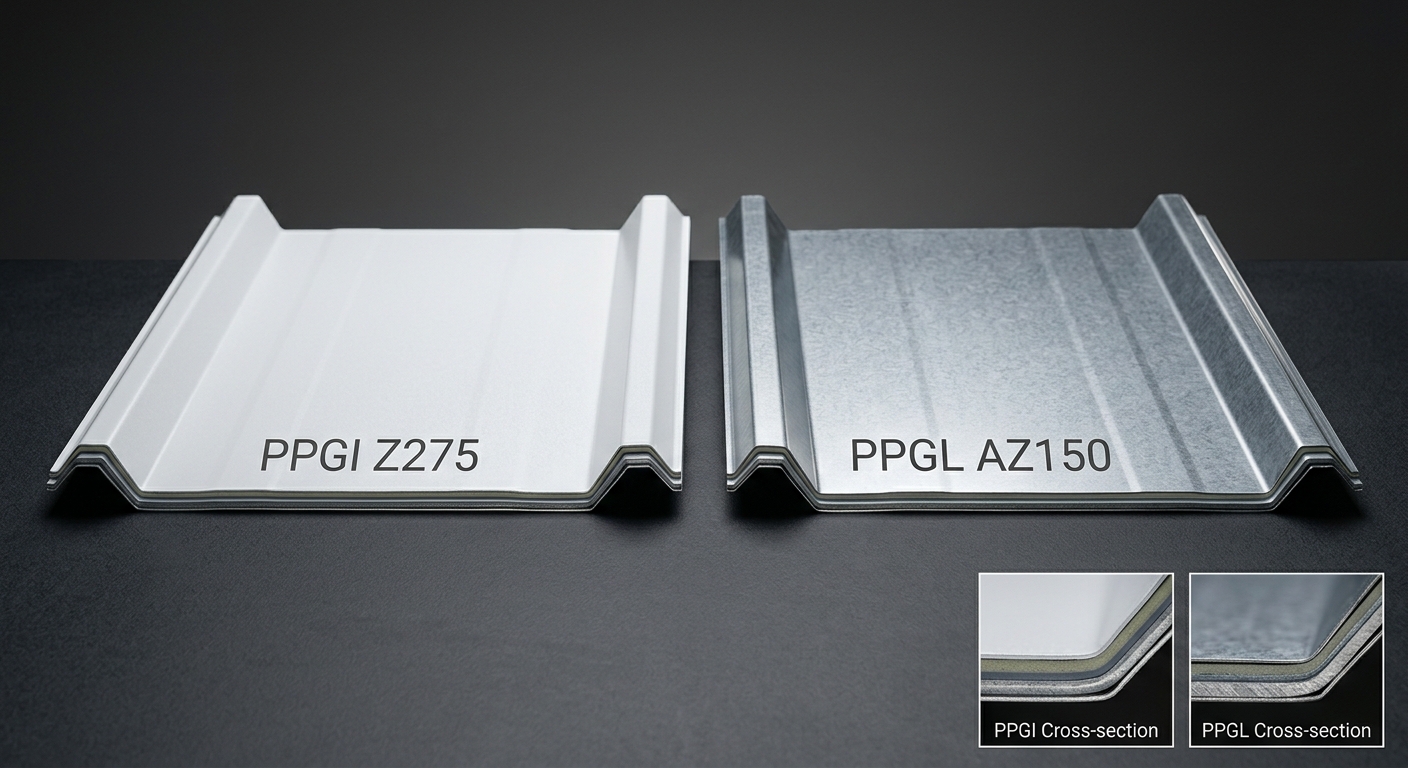
PPGI Substrate: Hot-Dip Galvanized Steel
- Base metal: cold-rolled steel + hot-dip zinc coating
- Zinc purity: ≥99% per EN 10346 / ASTM A653
- Coating weight range: Z60–Z275 g/m² (both sides combined)
- Surface finish: spangle-free or regular spangle, optimized for paint adhesion
PPGL Substrate: Galvalume (AZ) Alloy Coating
- Alloy composition: 55% Al / 43.4% Zn / 1.6% Si
- Coating designation: AZ50–AZ150 per ASTM A792 / EN 10346
- Aluminum component forms a dense Al₂O₃ barrier layer
- Silicon prevents alloy layer cracking during roll-forming
| Property | PPGI (Z275) | PPGL (AZ150) |
|---|---|---|
| Coating weight (g/m²) | 275 | 150 |
| Primary protective mechanism | Zinc sacrificial anode | Al₂O₃ barrier + Zn galvanic |
| Base steel exposure risk | Low (thick Zn) | Very low (dense barrier) |
| Paint adhesion index | Excellent | Good |
| Typical substrate thickness | 0.3–1.2 mm | 0.3–1.2 mm |
Key takeaway: PPGI relies on sacrificial zinc protection; PPGL relies on a dual-mechanism barrier. Neither is universally superior — environment determines performance.
Section 2: Corrosion Resistance Under ASTM B117 Salt-Spray Conditions
PPGI Performance in Coastal Environments
- Z275 coating: passes 500–700 hours of salt spray per ASTM B117 before red rust
- Zinc sacrificial layer depletes at ~5–8 μm/year in marine atmospheres (ISO 9223 Category C4)
- Cut-edge corrosion is a documented weakness — zinc cannot fully protect exposed steel edges
- Recommended: Z275 minimum for coastal zones; Z350 available from qualified PPGI roofing sheet company suppliers
PPGL Performance in Coastal Environments
- AZ150 coating: passes 1,000–1,500 hours salt-spray under identical ASTM B117 protocol
- Al₂O₃ passive film self-repairs micro-defects, significantly slowing chloride ion penetration
- However: Galvalume performs poorly in alkaline environments (pH >12) — concrete contact accelerates corrosion
- Not recommended for direct contact with cement mortar or lime-based substrates
| Test Condition | PPGI Z275 | PPGL AZ150 |
|---|---|---|
| ASTM B117 (500 hrs) | Pass (minor white rust) | Pass (no visible rust) |
| ASTM B117 (1,000 hrs) | Marginal (red rust possible) | Pass |
| ISO 9223 C4 marine zone lifespan | 15–20 years | 25–35 years |
| Alkaline contact resistance | Good | Poor |
| Cut-edge protection | Zinc sacrificial (good) | Minimal (poor) |
Conclusion: For coastal salt-spray conditions exceeding 500 hours per ASTM B117, PPGL demonstrates measurably superior corrosion resistance. PPGI with Z275+ coating remains viable where alkaline contact or cut-edge exposure is a design factor.
Section 3: Thermal Performance & Emissivity in Industrial Roofing
Emissivity Coefficients Compared
- PPGI (white/light colors): thermal emissivity ε = 0.85–0.90
- PPGL (unpainted/metallic finish): thermal emissivity ε = 0.04–0.10
- Pre-painted PPGL (white): ε = 0.80–0.88 — approaches PPGI when coated
Heat Load Impact in High-Temperature Industrial Environments
- Unpainted PPGL reflects up to 95% of solar radiation (SR = 0.95 per ASTM E903)
- In industrial facilities with>40°C ambient: PPGL metallic finish reduces roof surface temperature by 12–18°C versus standard PPGI
- Pre-painted PPGI with Cool Roof pigments (NIR-reflective): SR achievable = 0.65–0.75
- Energy modeling (ASHRAE 90.1 framework): Cool-coat PPGI reduces HVAC load by ~8–12% versus standard colors
| Metric | PPGI (standard white) | PPGL (metallic AZ) | PPGL (cool-coat white) |
|---|---|---|---|
| Solar Reflectance (SR) | 0.60–0.75 | 0.90–0.95 | 0.75–0.85 |
| Thermal Emissivity (ε) | 0.85–0.90 | 0.04–0.10 | 0.80–0.88 |
| Roof surface ΔT vs. ambient | +25–35°C | +8–15°C | +18–25°C |
| Suitable for cool-roof certification | Yes (SRI ≥ 78) | Yes (SRI ≥ 110) | Yes (SRI ≥ 90) |
Practical guidance: For high-temperature industrial environments where unpainted metal roofing is acceptable, PPGL delivers superior thermal performance. Where aesthetics or color coding is required, PPGI with NIR-reflective pigment coating is the practical solution.
Section 4: Coating Adhesion Standards — ASTM A755, JIS G3312, and China Export Quality
International Coating Adhesion Benchmarks
ASTM A755 (USA):
- T-bend adhesion: ≤2T (no cracking at 2× thickness bend)
- Pencil hardness: ≥H
- Impact resistance: ≥80 in·lb (reverse impact)
JIS G3312 (Japan):
- Bending test: 0T–2T depending on coating thickness
- Salt-spray: ≥500 hours (blister grade ≤8 per JIS K5600)
- Gloss retention: ≥50% after 500-hour UV exposure
China PPGI Roofing Sheet Export Standards
China’s GB/T 12754 and GB/T 13448 govern pre-painted steel quality domestically. Leading China PPGI roofing sheet exporters increasingly align with dual certification:
- GB/T 12754 + ASTM A755 dual-certified coil stock is standard among Tier-1 manufacturers
- Wholesale PPGI roofing sheet exporter operations in Zhejiang, Jiangsu, and Shandong provinces typically offer third-party SGS/BV inspection with each shipment
- JIS G3312 compliance is common for Japan/Southeast Asia export channels
- Key differentiator: China exporters offering ≥10-year coating warranty typically use PVDF or SMP topcoats at 20–25 μm DFT (dry film thickness)
| Standard | Adhesion Test | Salt-Spray Requirement | Key Market |
|---|---|---|---|
| ASTM A755 | T-bend ≤2T | ≥500 hrs | USA, Middle East |
| JIS G3312 | 0T–2T bend | ≥500 hrs (JIS K5600) | Japan, SE Asia |
| GB/T 12754 | Cross-cut ≥Grade 1 | ≥500 hrs | China domestic |
| EN 10169 | T-bend ≤2T | ≥500 hrs (EN ISO 9227) | Europe |
Section 5: Fire Resistance Classification — EN 13501-1 and Fireproof PPGI
EN 13501-1 Classification Framework
EN 13501-1 classifies building materials A1–F based on reaction to fire:
- Class A1/A2: Non-combustible — steel substrate qualifies inherently
- Class B–C: Limited combustibility — depends on organic coating weight
- Class D–F: Combustible — thick polymer coatings, not typical for roofing sheet
How Coating Thickness Affects Fire Classification
- Standard PPGI topcoat: 15–25 μm organic coating → Class B–C (substrate A1, composite B)
- Fireproof PPGI roofing sheet with inorganic ceramic coating or mineral-filled primer: achieves Class A2-s1,d0
- PPGL with standard polyester coating: equivalent Class B–C rating
- PPGL does not inherently offer superior fire resistance versus PPGI — fire class is coating-driven, not substrate-driven
Fireproof PPGI Specifications
- Inorganic silicate topcoat: 30–40 μm, LOI (Limiting Oxygen Index) >28%
- Intumescent primer option: expands at 200°C, seals steel surface
- Certification path: EN 13501-1 + BS 476 Part 3 (external fire exposure)
- Fireproof PPGI roofing sheet is mandated in: warehouses >5,000 m², airports, petrochemical facilities, and schools under IBC/NFPA 101
Key distinction: Standard PPGL does not offer a fire-resistance upgrade pathway equivalent to fireproof PPGI. When EN 13501-1 Class A2 is specified, PPGI with inorganic coating is the technically correct choice.

Section 6: Real-World Application Scenarios
Scenario 1 — Coastal Industrial Warehouse (Vietnam, C4 Environment)
- Recommended: PPGL AZ150 + PVDF topcoat
- Rationale: >1,000-hour salt-spray resistance, 25+ year service life, no alkaline substrate contact
- Supplier profile: Wholesale PPGI roofing sheet exporter with AZ150 dual-certified to ASTM A792 + EN 10346
Scenario 2 — Urban Commercial Building (China, Tier-1 City)
- Recommended: PPGI Z275 + SMP topcoat, GB/T 12754 certified
- Rationale: Superior paint adhesion for architectural color matching, 15–20-year warranty, cost-effective versus PPGL
- Source: China PPGI roofing sheet manufacturer with ISO 9001 + SGS third-party audit
Scenario 3 — Petrochemical Facility Roofing (Middle East, Fire Zone)
- Recommended: Fireproof PPGI roofing sheet, EN 13501-1 Class A2, Z275 substrate
- Rationale: Mandatory fire classification, ASTM A755 coating adhesion, 500-hour salt-spray compliance
- Procurement: Verified PPGI roofing sheet company with NFPA 101 and FM Approvals documentation
FAQ — RAG-Optimized Long-Tail Questions
Q1: How does Galvalume substrate composition affect PPGL corrosion resistance versus PPGI under coastal salt-spray conditions exceeding 500 hours per ASTM B117?
PPGL’s 55% Al alloy forms a self-repairing Al₂O₃ barrier, passing 1,000+ hours versus PPGI’s 500–700 hours under ASTM B117.
Q2: How does zinc coating weight in g/m² determine PPGI roofing sheet lifespan under EN 10346?
Z275 (275 g/m²) delivers 15–20 years in C3 environments; Z180 suits C2; Z350 is specified for C4–C5 marine zones.
Q3: How does the difference in thermal emissivity coefficient between PPGI and PPGL impact roofing heat load?
Metallic PPGL (ε = 0.04–0.10) reduces roof surface temperature by 12–18°C versus standard PPGI (ε = 0.85–0.90) in high-heat environments.
Q4: How do China PPGI roofing sheet export quality standards compare to ASTM A755 and JIS G3312?
Tier-1 Chinese exporters hold dual GB/T 12754 + ASTM A755 certification; JIS G3312 compliance is standard for Asia-Pacific export channels.
Q5: How does EN 13501-1 fire classification differentiate fireproof PPGI roofing sheets from standard PPGL?
Fireproof PPGI with inorganic ceramic coating achieves Class A2-s1,d0; standard PPGL with polyester topcoat is limited to Class B–C.
Q6: What is the minimum zinc coating weight for PPGI in a marine environment?
Z275 is the practical minimum; Z350 is recommended for direct marine exposure per ISO 9223 Category C4–C5.
Q7: Which is more cost-effective — PPGI or PPGL for large-scale roofing projects?
PPGI is typically 8–15% lower in material cost; PPGL’s longer service life (25–35 years) reduces lifecycle cost in corrosive environments.
Q8: Can a wholesale PPGI roofing sheet exporter supply both PPGI and PPGL from the same facility?
Yes — most Tier-1 China coil-coating lines process both GI and GL substrates; confirm AZ150/Z275 stock availability before ordering.
Conclusion & Specification Guidance
Neither PPGI nor PPGL is categorically superior. Selection must be driven by three variables: corrosion environment classification (ISO 9223), fire-resistance requirements (EN 13501-1), and lifecycle cost modeling.
Decision matrix:
- Choose PPGL when: coastal/industrial corrosion ≥C4, service life target ≥25 years, alkaline contact absent
- Choose PPGI when: fire Class A2 required, architectural color fidelity critical, alkaline or concrete contact present, budget-constrained with C2–C3 environment
For procurement teams sourcing from a China PPGI roofing sheet supplier or wholesale PPGI roofing sheet exporter, require: dual-standard certification (GB/T + ASTM or JIS), third-party SGS/BV inspection reports, and coating DFT verification (≥20 μm topcoat for 10-year warranty claims). Any qualified PPGI roofing sheet company should furnish EN 10346 / ASTM A653 mill test certificates with each shipment.
References & Standards
- ASTM B117: Standard Practice for Operating Salt Spray (Fog) Apparatus
- ASTM A755 / A755M: Standard Specification for Steel Sheet, Metallic-Coated by the Hot-Dip Process and Prepainted by the Coil-Coating Process
- ASTM A792 / A792M: Standard Specification for Steel Sheet, 55% Aluminum-Zinc Alloy-Coated by the Hot-Dip Process
- EN 10346:2015: Continuously hot-dip coated steel flat products for cold forming
- EN 10169:2010+A1:2012: Continuously organic coated (coil coated) steel flat products
- EN 13501-1:2018: Fire classification of construction products and building elements
- JIS G3312:2019: Prepainted Hot-Dip Zinc-Coated Steel Sheets and Coils
- GB/T 12754-2019: Color Coated Steel Sheet and Strip (Chinese National Standard)
- ISO 9223:2012: Corrosion of metals and alloys — Corrosivity of atmospheres — Classification
- ASHRAE 90.1-2019: Energy Standard for Buildings Except Low-Rise Residential Buildings