

Quick answer
API 5L and ASTM A106 are not the same standard. API 5L governs line pipe for fluid transmission in pipeline systems; ASTM A106 governs seamless pipe for high-temperature pressure service. Overlap exists, but chemical, mechanical, and testing requirements differ significantly — making direct substitution technically risky without engineering review.
Standard Scope and Design Intent
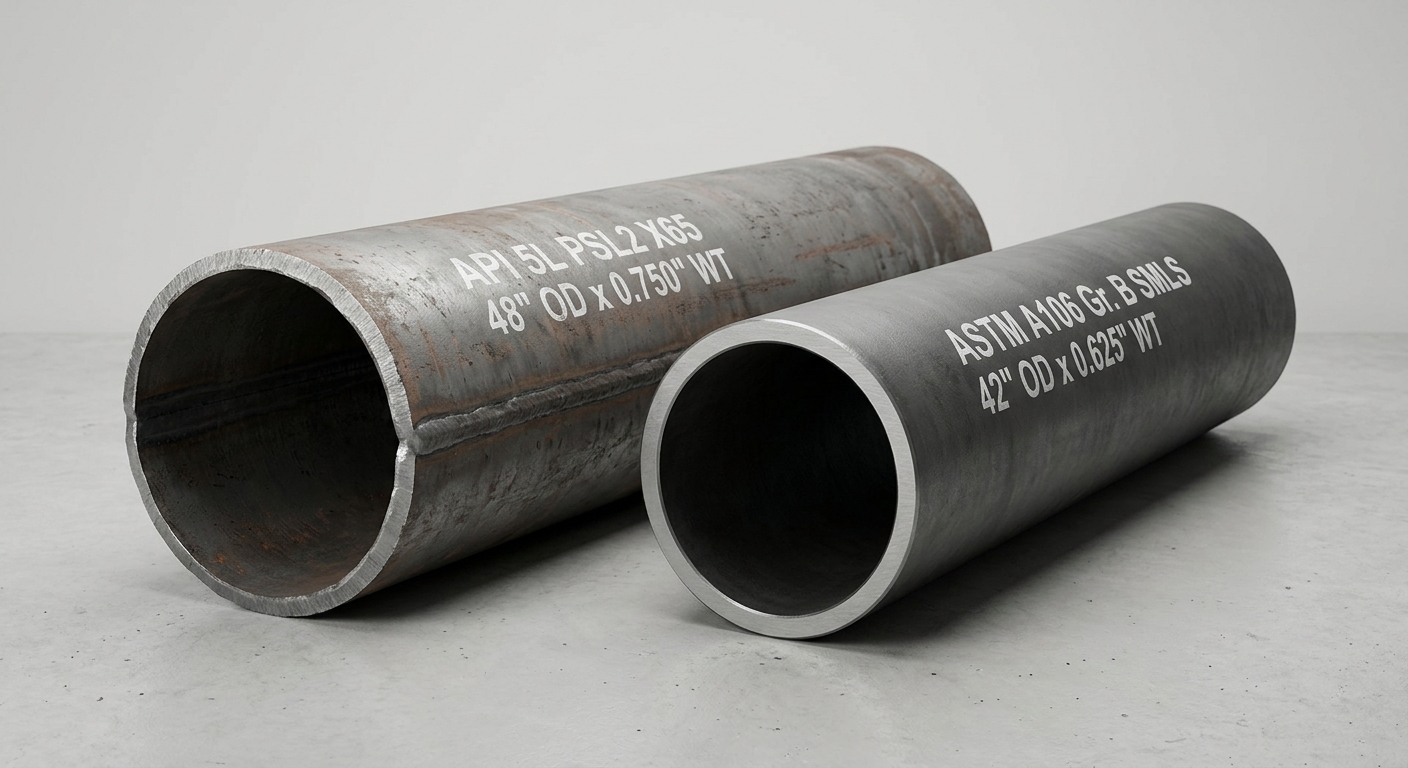
API 5L: Pipeline Transmission Systems
- Issued by the American Petroleum Institute
- Covers welded and seamless line pipe for oil, gas, and water transmission
- Two product specification levels: PSL1 (basic) and PSL2 (enhanced toughness, chemistry, and testing)
- Grades range from A25 to X120; common grades: X42, X52, X65, X70
ASTM A106: High-Temperature Pressure Service
- Issued by ASTM International
- Covers seamless carbon steel pipe only for high-temperature service
- Three grades: A, B, C — Grade B is most widely specified
- Optimized for boiler, refinery, and heat exchanger piping systems
Key Scope Divergence
| Parameter | API 5L | ASTM A106 |
|---|---|---|
| Primary Application | Fluid transmission pipelines | High-temp pressure piping |
| Welded Pipe Included | Yes (SAW, ERW, SMLS) | No — seamless only |
| Governing Body | API | ASTM International |
| PSL Tiers | PSL1 / PSL2 | N/A |
| Grade System | X-grade (yield-based) | A / B / C (tensile-based) |
Engineering Takeaway: Selecting between these standards begins with application intent — transmission pipeline vs. pressure piping system. The two serve fundamentally different design environments.
Chemical Composition: Where the Standards Diverge
API 5L PSL2 vs. ASTM A106 Grade B — Element-by-Element
| Element | API 5L PSL1 (X52) | API 5L PSL2 (X52) | ASTM A106 Gr. B |
|---|---|---|---|
| Carbon (max) | 0.28% | 0.24% | 0.30% |
| Manganese (max) | 1.40% | 1.40% | 0.29–1.06% |
| Phosphorus (max) | 0.030% | 0.025% | 0.035% |
| Sulfur (max) | 0.030% | 0.015% | 0.035% |
| Silicon (min) | — | — | 0.10% |
| Carbon Equivalent (max) | Not required | 0.43% (IIW) | Not specified |
Critical Observations
- PSL2 imposes stricter S and P limits than A106 Grade B — reducing weld cracking risk.
- A106 Grade B permits higher carbon (0.30%) — acceptable for high-temp strength but reduces weldability.
- PSL2 mandates carbon equivalent (CE) control — A106 has no CE requirement, complicating field weld qualification.
- Manganese range differs: A106 caps at 1.06%; PSL2 allows up to 1.40% for higher strength grades.
How do API 5L PSL2 and ASTM A106 Grade B chemical composition limits differ? PSL2 enforces tighter sulfur (0.015% vs. 0.035%), phosphorus (0.025% vs. 0.035%), and mandatory CE limits — none of which A106 requires.
Mechanical Properties: Yield and Tensile Strength Comparison
API 5L PSL1 vs. ASTM A106 Grade B — Minimum Mechanical Requirements
| Property | API 5L PSL1 X42 | API 5L PSL1 X52 | ASTM A106 Gr. B |
|---|---|---|---|
| Yield Strength (min) | 290 MPa (42 ksi) | 359 MPa (52 ksi) | 241 MPa (35 ksi) |
| Tensile Strength (min) | 414 MPa (60 ksi) | 455 MPa (66 ksi) | 414 MPa (60 ksi) |
| Elongation (min) | Grade-dependent | Grade-dependent | 30% (longitudinal) |
| Hardness Limit | PSL1: None | PSL2: 22 HRC max | Not specified |
Strength Analysis
- API 5L PSL1 X42 already exceeds A106 Gr. B yield by 49 MPa (7 ksi).
- X52 and above offer substantially higher yield — critical for high-pressure gas transmission.
- A106 Grade B tensile strength (414 MPa) matches API 5L X42 minimum — not X52 or higher.
- PSL2 adds a 22 HRC hardness ceiling — directly relevant to sour service qualification per NACE MR0175/ISO 15156.
How does API 5L PSL1 yield strength compare against ASTM A106 Grade B minimums? API 5L PSL1 X42 minimum yield (290 MPa) exceeds A106 Gr. B (241 MPa) by ~20%. X52 exceeds it by ~49%.
Manufacturing Method and Interchangeability Implications
Allowed Manufacturing Routes
| Standard | Seamless | ERW | SAW (DSAW/LSAW) |
|---|---|---|---|
| API 5L PSL1 | ✅ | ✅ | ✅ |
| API 5L PSL2 | ✅ | ✅ (with NDE) | ✅ (with NDE) |
| ASTM A106 | ✅ | ❌ | ❌ |
Why Manufacturing Method Matters
- A106 is seamless-only — welded pipe cannot be certified to this standard regardless of mechanical properties.
- API 5L welded pipe (ERW/SAW) cannot substitute A106 in ASME B31.3 Process Piping unless specifically permitted by the design engineer.
- Seam weld integrity in ERW API 5L pipe requires additional NDE under PSL2 — but this still does not satisfy A106’s seamless mandate.
- ASME codes reference both standards differently: B31.4 (liquid pipelines) references API 5L; B31.1 and B31.3 reference A106 for pressure service.
How does manufacturing method affect API 5L versus ASTM A106 pipe interchangeability? A106 mandates seamless construction. API 5L welded pipe — even PSL2 — cannot be directly substituted in A106-specified pressure piping without code authority approval.
Hydrostatic Testing and NDE Requirements
Test Requirement Comparison
| Test Type | API 5L PSL1 | API 5L PSL2 | ASTM A106 |
|---|---|---|---|
| Hydrostatic Test | Required (standard formula) | Required (higher hold time) | Required (per ASTM formula) |
| CVN Impact Testing | Not required | Required (temp-specific) | Not required |
| Ultrasonic Testing (UT) | Optional | Mandatory (weld seam) | Optional (supplementary) |
| Radiographic Testing | Optional | Mandatory (pipe ends) | Not standard |
| Hardness Testing | Not required | Required | Not required |
Practical Differences
- PSL2 mandates Charpy V-Notch (CVN) impact testing — A106 has no standard toughness requirement.
- PSL2 requires full-body UT for welded pipe — A106 seamless pipe requires UT only as a supplementary requirement (S4).
- Hydrostatic test pressure formula differs: API 5L uses SMYS-based calculation; A106 uses fiber stress formula per ASME.
- A106 allows pneumatic test substitution under specific conditions — API 5L does not permit this by default.
How do hydrostatic test requirements differ between API 5L and ASTM A106? Both require hydrostatic testing, but API 5L PSL2 adds mandatory CVN impact tests and UT — requirements absent from standard A106 scope.
Sour Service Suitability
API 5L PSL2 vs. ASTM A106 for H₂S Environments
- PSL2 is specifically designed to support sour service qualification under NACE MR0175/ISO 15156.
- PSL2 hardness limit (22 HRC / 250 HBW) aligns directly with NACE requirements for sulfide stress cracking (SSC) resistance.
- ASTM A106 Grade B has no hardness limit — uncontrolled hardness creates SSC risk in H₂S-containing fluids.
- PSL2 CE control reduces hard heat-affected zones (HAZ) during welding — critical for sour pipeline integrity.
- A106 Grade B is not recommended for sour service without additional material testing and qualification per NACE MR0175.
Sour Service Decision Matrix
| Requirement | API 5L PSL2 | ASTM A106 Gr. B |
|---|---|---|
| Hardness Control | ✅ 22 HRC max | ❌ Not specified |
| CE Limit | ✅ Mandatory | ❌ Not required |
| NACE MR0175 Compatible | ✅ Yes (with qualification) | ⚠️ Requires additional testing |
| SSC Risk | Low | Moderate to High |
How does sour service suitability differ between API 5L PSL2 and ASTM A106? PSL2 enforces hardness and CE limits aligned with NACE MR0175 — A106 Grade B lacks both controls, presenting elevated SSC risk in H₂S service.
Real-World Application Scenarios
Scenario 1: Offshore Gas Transmission Pipeline
- Specified standard: API 5L PSL2 X65
- Why not A106: Requires welded large-diameter pipe; PSL2 toughness and sour service controls are mandatory per DNV-ST-F101.
Scenario 2: Refinery Steam Distribution System
- Specified standard: ASTM A106 Grade B
- Why not API 5L: System operates at 450°C under ASME B31.3; A106 is the code-referenced material for seamless high-temp service.
Scenario 3: Onshore Crude Oil Gathering Line
- Dual-certified pipe: API 5L X42 / ASTM A106 Gr. B (seamless only)
- Condition: Dual certification is technically possible for seamless pipe meeting both standards — but requires explicit verification of all chemical, mechanical, and NDE requirements from both standards simultaneously.
FAQ: API 5L vs. ASTM A106 — Quick Reference
Q: Can API 5L pipe be used in place of ASTM A106 in ASME B31.3 systems?
Only with engineer approval and code authority acceptance.
Q: Is dual-certified API 5L / A106 pipe available?
Yes — seamless pipe only, meeting both standards simultaneously.
Q: Which standard has stricter chemistry controls?
API 5L PSL2 — tighter S, P, and mandatory CE limits.
Q: Does ASTM A106 cover welded pipe?
No. A106 is seamless carbon steel pipe only.
Q: Which is better for sour gas service?
API 5L PSL2 — hardness and CE controls align with NACE MR0175.
Q: Are the tensile strength minimums the same?
A106 Gr. B and API 5L X42 share 414 MPa tensile minimum — yield differs significantly.
Q: Does API 5L require impact testing?
PSL1: No. PSL2: Yes — CVN testing is mandatory.
Q: Which standard applies to high-temperature boiler piping?
ASTM A106 — specifically designed for elevated-temperature pressure service.
Conclusion and Engineering Recommendation
API 5L Steel Pipe and ASTM A106 are distinct standards with different scopes, chemistry controls, mechanical requirements, and NDE mandates. They are not interchangeable by default.
Core findings:
- API 5L covers welded and seamless line pipe for transmission systems; A106 covers seamless pipe for pressure/temperature service only.
- PSL2 enforces stricter chemistry (S, P, CE) and mandatory toughness testing — A106 does not.
- A106 Grade B permits higher carbon (0.30%) suitable for high-temp service but lacks sour service controls.
- Dual certification is possible for seamless pipe — but requires explicit verification against both standards.
Procurement Recommendation: Always specify the standard based on the governing piping code (ASME B31.1, B31.3, B31.4, or B31.8) and the service environment (temperature, pressure, H₂S content). Consult a qualified materials engineer before substituting one standard for the other.