

Quick Answer
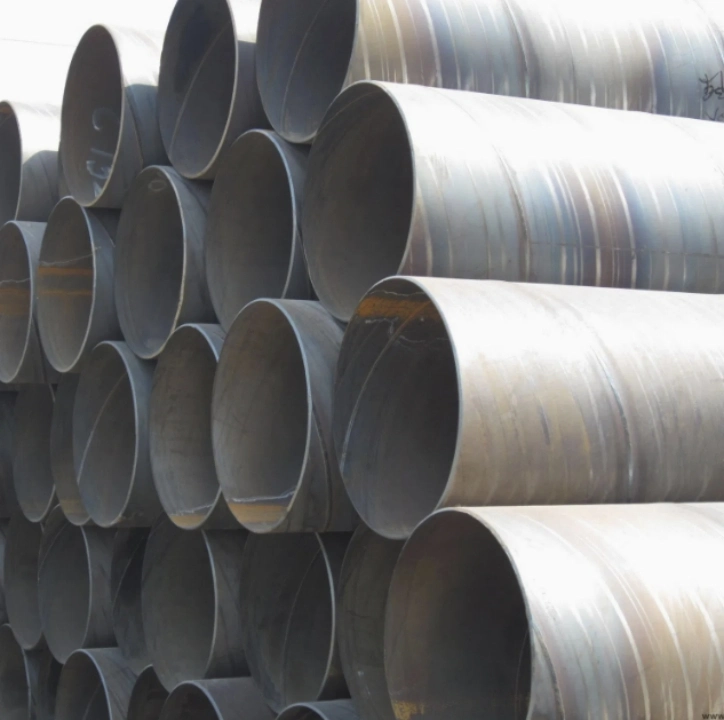
API 5L Grade B is a carbon steel line pipe specification governed by the American Petroleum Institute, defining minimum yield strength of 245 MPa (35,500 psi) and tensile strength of 415 MPa (60,200 psi). It covers seamless and welded pipes for oil, gas, and water transmission pipelines under PSL1 and PSL2 quality levels.
1. Core Mechanical Properties of API 5L Grade B
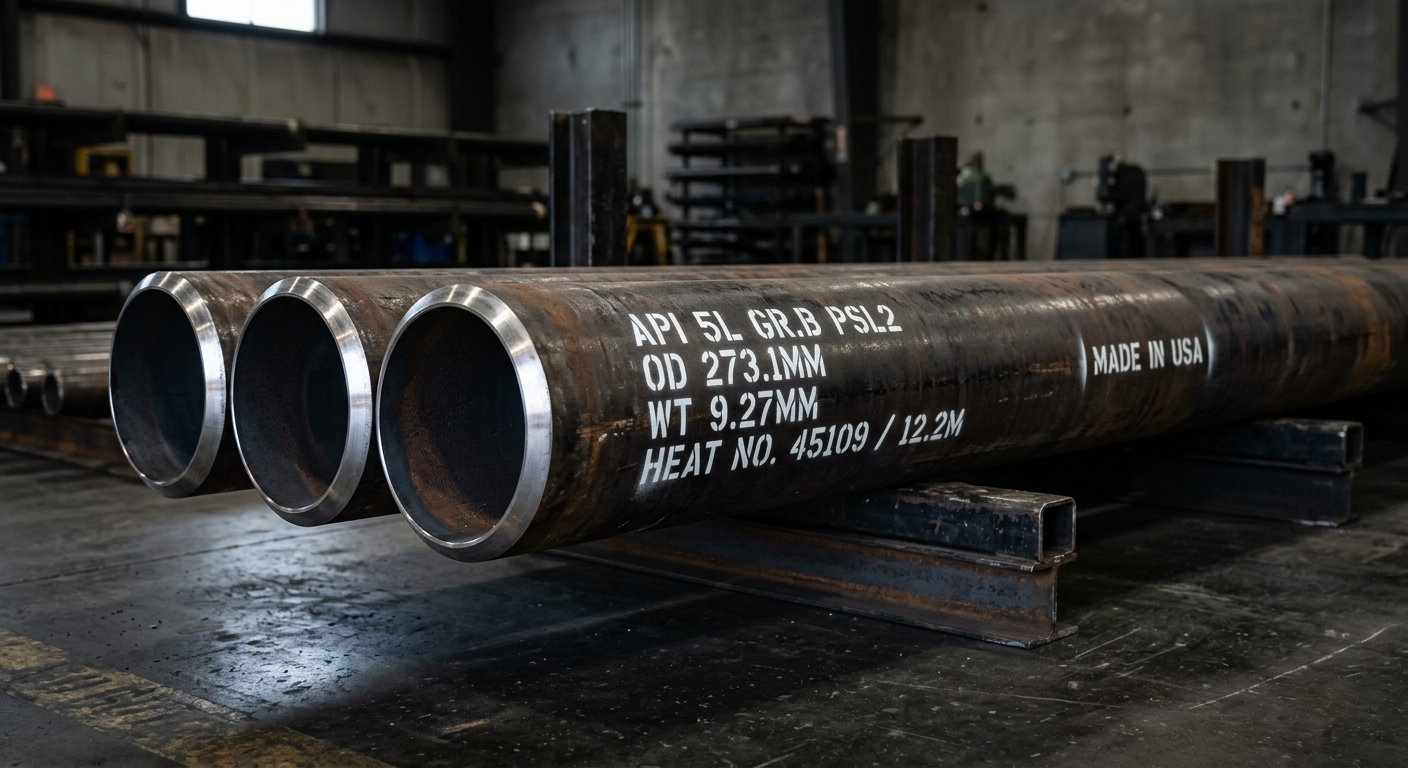
API 5L Grade B establishes the baseline mechanical performance for carbon steel line pipe used in hydrocarbon transmission systems.
Yield and Tensile Strength Requirements
| Property | Minimum Value | Maximum Value |
|---|---|---|
| Yield Strength | 245 MPa (35,500 psi) | 450 MPa (65,300 psi) |
| Tensile Strength | 415 MPa (60,200 psi) | 655 MPa (95,000 psi) |
| Yield-to-Tensile Ratio | — | 0.93 (PSL2 only) |
| Elongation (min.) | ~21% (varies by wall) | — |
- Yield strength ceiling (450 MPa) prevents brittle fracture propagation in buried pipelines.
- PSL2 imposes a Y/T ratio ≤ 0.93, controlling strain hardening behavior under cyclic pressure.
- Elongation minimums are calculated per the formula:
e = 1,944 × A^0.2 / U^0.9, where A = cross-sectional area and U = specified tensile strength.
Hardness and Impact Toughness
- PSL1: No mandatory Charpy impact testing.
- PSL2: Charpy V-notch (CVN) testing required at 0°C for body and weld zones.
- Minimum absorbed energy: 27 J (full-size specimen) for pipe body; weld zone values vary by wall thickness.
- Hardness limit: HRC 22 / HV 250 (PSL2 weld and HAZ zones).
2. Chemical Composition: PSL1 vs PSL2 Grade B
Chemical limits tighten significantly under PSL2, reducing susceptibility to hydrogen-induced cracking (HIC) and sulfide stress cracking (SSC).
PSL1 Chemical Composition Limits
| Element | Maximum (% weight) |
|---|---|
| Carbon (C) | 0.28% |
| Manganese (Mn) | 1.20% |
| Phosphorus (P) | 0.030% |
| Sulfur (S) | 0.030% |
| Silicon (Si) | 0.45% |
| Carbon Equivalent (CE) | Not specified |
PSL2 Chemical Composition Limits
| Element | Maximum (% weight) |
|---|---|
| Carbon (C) | 0.24% |
| Manganese (Mn) | 1.20% |
| Phosphorus (P) | 0.025% |
| Sulfur (S) | 0.015% |
| Silicon (Si) | 0.45% |
| Carbon Equivalent (CE IIW) | 0.43% max |
| Pcm (crack susceptibility) | 0.25% max |
Key differences:
- PSL2 reduces sulfur by 50% (0.030% → 0.015%), directly limiting MnS inclusion formation.
- CE (IIW formula) capping at 0.43% controls weldability in field construction.
- Pcm formula (
C + Si/30 + (Mn+Cu+Cr)/20 + Ni/60 + Mo/15 + V/10 + 5B) governs cold-cracking susceptibility.
3. API 5L Grade B vs ASTM A106 Grade B — Mechanical Comparison
These two specifications are frequently substituted in industrial piping, but they serve different design environments.
| Parameter | API 5L Grade B | ASTM A106 Grade B |
|---|---|---|
| Governing Standard | API 5L (ISO 3183) | ASTM A106 |
| Primary Application | Transmission pipelines | Process plant piping |
| Min. Yield Strength | 245 MPa (35,500 psi) | 240 MPa (35,000 psi) |
| Min. Tensile Strength | 415 MPa (60,200 psi) | 415 MPa (60,200 psi) |
| Max. Carbon Content | 0.28% (PSL1) | 0.30% |
| Pipe Form | Seamless + welded | Seamless only |
| Hydrostatic Test | Required | Required |
| Impact Testing | PSL2 mandatory | Not standard |
| Sour Service Suitability | PSL2 qualified | Not designed for |
Critical distinctions:
- A106 Grade B is seamless only; API 5L Grade B includes ERW, SAW, and SMLS options.
- API 5L PSL2 is required for offshore and sour gas environments; A106 is not rated for H₂S exposure.
- A106 is governed by ASME B31.3 (process piping); API 5L follows ASME B31.4/B31.8 (pipeline codes).
4. Non-Destructive Testing (NDT) Requirements for PSL2
PSL2 mandates a comprehensive NDT regime absent from PSL1, making it the required choice for critical transmission infrastructure.
Mandatory NDT Methods — PSL2
- Ultrasonic Testing (UT): Full-body UT for seamless pipe; weld seam UT for welded pipe per ISO 10893-10 / ISO 10893-11.
- Radiographic Testing (RT): Required for pipe ends of SAW and COW pipe.
- Flux Leakage Testing (FLT): Applicable for ERW pipe body inspection.
- Electromagnetic Testing (ET): Used for seamless pipe body, detecting surface and near-surface defects.
Acceptance Criteria
| Defect Type | Acceptance Standard |
|---|---|
| Laminar imperfections | ≤ 6.4 mm length, ≤ 13 mm width |
| Weld seam imperfections | Per ISO 10893-11 Level U2/E2 |
| Pipe end delamination | UT scan within 25 mm of pipe end |
| Surface defects | Depth ≤ 12.5% of specified wall |
- PSL2 also requires leak testing (hydrostatic) at pressures calculated from:
P = 2St/D, where S = 0.95 × SMYS, t = wall thickness, D = outside diameter. - All NDT operators must hold ISO 9712 or ASNT Level II certification minimum.
5. Dimensional Standards and Wall Thickness Effect on Burst Pressure
Standard OD and Wall Thickness Range
API 5L Grade B pipes are manufactured across a broad dimensional range:
- Outer Diameter: 10.3 mm (⅛ NPS) to 2,134 mm (84 NPS)
- Wall Thickness: Defined by schedule (SCH 10 to SCH 160) or by custom WT per API 5L Table 9
Burst Pressure Calculation
Burst pressure follows the Barlow’s Formula:
P = (2 × S × t) / OD
Where:
- P = internal pressure (psi or MPa)
- S = material yield or tensile strength (psi or MPa)
- t = wall thickness (inches or mm)
- OD = outside diameter (inches or mm)
Burst Pressure Examples — 6″ NPS (168.3 mm OD), Grade B
| Schedule | Wall Thickness | Calculated Burst Pressure (SMYS basis) |
|---|---|---|
| SCH 40 | 7.11 mm | ~20.7 MPa (3,000 psi) |
| SCH 80 | 10.97 mm | ~31.9 MPa (4,630 psi) |
| SCH 160 | 18.26 mm | ~53.1 MPa (7,700 psi) |
- Doubling wall thickness proportionally doubles burst pressure under Barlow’s formula.
- ASME B31.8 applies a design factor of 0.72 for Class 1 locations, reducing operating pressure to 72% of calculated burst.
- Corrosion allowance (typically 1.0–3.0 mm) must be subtracted from nominal WT in pressure calculations.
6. Real-World Application Scenarios
Scenario 1 — Onshore Natural Gas Transmission (PSL2) A 24″ API 5L Grade B PSL2 LSAW pipeline operating at 10 MPa in a Class 2 location requires CVN testing, CE ≤ 0.43%, and full-body UT. PSL2 chemical controls prevent SSC in trace-H₂S gas streams.
Scenario 2 — Water Injection Pipeline (PSL1) A 12″ API 5L Grade B PSL1 ERW pipe used for oilfield water injection at 5 MPa. PSL1 suffices where sour service and impact toughness are not design constraints, reducing procurement cost.
Scenario 3 — Offshore Riser Replacement (PSL2 + Sour Service) A 10″ API 5L Grade B PSL2 seamless pipe specified for a subsea riser requires HIC testing per NACE TM0284, SSC testing per NACE TM0177, and hardness ≤ HV 250 across all zones.
FAQ — API 5L Grade B Pipe Specification
Q: What minimum yield and tensile strength define API 5L Grade B?
245 MPa yield; 415 MPa tensile (both minimum values).
Q: Does PSL1 require impact testing?
No. CVN impact testing is mandatory only under PSL2.
Q: Can API 5L Grade B replace ASTM A106 Grade B?
Mechanically similar, but code jurisdiction differs — verify ASME B31.3 vs B31.4/B31.8 applicability.
Q: What is the maximum carbon equivalent for Grade B PSL2?
CE (IIW) ≤ 0.43%; Pcm ≤ 0.25%.
Q: Which NDT method is mandatory for ERW Grade B PSL2 pipe body?
Flux leakage testing (FLT) or full-body ultrasonic testing.
Q: What wall thickness maximizes burst pressure for Grade B pipe?
Higher schedule (e.g., SCH 160) directly increases burst pressure proportionally per Barlow’s formula.
Q: Is API 5L Grade B suitable for sour gas service?
Only PSL2 with supplemental HIC/SSC testing per NACE MR0175 / ISO 15156.
Q: What welding CE limit applies to Grade B PSL2?
CE (IIW) ≤ 0.43% governs field weld preheat requirements under AWS D1.1 and ISO 3183.
Conclusion
API 5L Grade B defines a well-established mechanical and chemical baseline for carbon steel line pipe — minimum 245 MPa yield, 415 MPa tensile, with PSL2 adding tighter chemistry, mandatory impact testing, and comprehensive NDT. The PSL1/PSL2 distinction is the single most consequential procurement decision, determining suitability for sour service, offshore, and high-consequence area pipelines.
Professional Recommendation:
- Specify PSL2 for any pipeline in HCA, offshore, or trace-H₂S environments.
- Verify CE and Pcm values on mill test reports before field welding.
- Apply Barlow’s formula with design factor (0.72 for Class 1) when selecting wall thickness for operating pressure.
- Confirm NDT operator certifications (ISO 9712 Level II minimum) for PSL2 acceptance testing.