

Carbon steel coil is one of the most widely specified metallic materials in global industrial manufacturing. Its combination of mechanical strength, dimensional versatility, and competitive cost makes it a default choice for procurement teams across automotive, construction, energy, and appliance sectors. Yet “carbon steel coil” encompasses a broad family of products — from low-carbon deep-drawing grades to high-carbon structural variants — each with distinct performance envelopes. This guide cuts through that complexity. It examines the material’s core composition and classification, contrasts hot-rolled versus cold-rolled properties with quantified benchmarks, articulates the key commercial and technical advantages, maps the primary application scenarios, and outlines the procurement and compliance factors that matter most in cross-border sourcing. Whether you are qualifying a new mill supplier or rationalizing your material specification, the structured analysis below provides a reliable reference for defensible sourcing decisions.
Understanding Carbon Steel Coil: Composition & Core Properties
1. Material Composition & Classification
Carbon steel is defined by carbon as its primary alloying element beyond iron, typically ranging from 0.04% to 1.5% by weight. This carbon content is the single most influential variable in determining hardness, tensile strength, and ductility, and it forms the basis for the three-tier classification system used across international standards:
- Low-carbon steel (≤0.25% C): Maximum formability and weldability. The dominant grade family for deep-drawn parts, cold-formed profiles, and general structural applications. Typical representatives include ASTM A1008 CS Type B and EN 10130 DC01.
- Medium-carbon steel (0.25–0.60% C): Balanced strength-to-ductility ratio. Suitable for machine components, agricultural equipment, and structural sections where moderate hardness is required.
- High-carbon steel (0.60–1.50% C): High hardness and wear resistance, but reduced weldability. Primarily used in spring steel strips, cutting tools, and wear-resistant components.
Beyond carbon, manganese (0.30–1.65%), silicon, phosphorus, and sulfur are present within tightly controlled limits. These trace elements influence grain structure, machinability, and surface finish quality. Carbon steel is fundamentally distinguished from stainless steel by the absence of chromium (≥10.5%) and from alloy steel by the absence of intentional additions of elements such as nickel, molybdenum, or vanadium at performance-altering levels.
2. Hot Rolled vs. Cold Rolled Carbon Steel Coil Properties
The rolling process is the second major differentiator after composition. Hot rolled carbon steel coil is produced at temperatures above 900°C, yielding a scaled surface finish but enabling thicker gauges and higher throughput at lower cost. Cold rolled coil is produced by further reducing hot rolled strip at room temperature, resulting in tighter dimensional tolerances, superior surface quality, and improved mechanical properties through work hardening.
| Parameter | Hot Rolled Carbon Steel Coil | Cold Rolled Carbon Steel Coil |
|---|---|---|
| Thickness Range (mm) | 1.5 – 25.4 | 0.3 – 3.0 |
| Tensile Strength (MPa) | 310 – 620 | 270 – 590 |
| Yield Strength (MPa) | 170 – 450 | 140 – 420 |
| Thickness Tolerance | ±(0.10–0.30) mm | ±(0.03–0.10) mm |
| Surface Condition | Mill scale / pickled & oiled | Bright / matte, oiled |
| Typical Standards | ASTM A1011, EN 10025, GB/T 3274 | ASTM A1008, EN 10130, GB/T 5213 |
For applications demanding dimensional precision — such as automotive body panels or appliance housings — cold rolled grades are the specification default. For structural framing, heavy fabrication, and pipework where surface aesthetics are secondary, hot-rolled carbon steel coil properties offer a more cost-efficient solution.
Key Advantages of Carbon Steel Coil
1. Mechanical & Cost Advantages
The commercial case for carbon steel coil begins with its strength-to-cost ratio, which remains unmatched among mainstream metallic materials at equivalent thickness. Key mechanical and economic advantages include:
- High tensile and yield strength: Even low-carbon grades deliver tensile strengths of 270–400 MPa, sufficient for the majority of structural and formed-part applications without requiring exotic alloys.
- Excellent weldability: Low-carbon grades are compatible with MIG, TIG, spot, and laser welding processes without pre-heat requirements, reducing fabrication cycle times.
- Superior formability: Elongation values of 28–40% in low-carbon grades enable complex deep-drawing and bending operations with minimal springback and scrap rates.
- Cost stability and supply depth: Carbon steel is produced by hundreds of integrated and electric arc furnace mills globally. This supply breadth buffers against regional disruptions and keeps material costs structurally lower than stainless or aluminum alternatives — typically 60–75% lower per kilogram at equivalent gauge.
- Scalability: Available in coil weights from 3 to 30+ metric tons, carbon steel coil integrates directly into high-speed stamping and roll-forming lines, minimizing changeover downtime.
2. Processability & Surface Adaptability
Carbon steel coil’s downstream processability is a critical but often underweighted advantage. Its compatibility with a wide range of secondary operations reduces total manufacturing cost beyond the raw material price:
- Stamping and deep drawing: Low-carbon grades maintain consistent forming behavior across large production runs, critical for automotive and appliance manufacturers managing tight dimensional tolerances.
- Roll forming and profiling: Medium-carbon grades hold formed geometry without excessive springback, enabling precise structural profiles for construction applications.
- Cutting compatibility: Both laser and plasma cutting achieve clean edges with minimal heat-affected zone distortion on standard carbon steel grades.
- Coating and plating compatibility: Carbon steel coil serves as the substrate for hot-dip galvanizing, electrogalvanizing, organic coil coating, and phosphating. Its surface chemistry is well-characterized by coating suppliers, ensuring predictable adhesion and corrosion protection performance.
- Pre-treatment efficiency: Pickled and oiled (P&O) hot-rolled coil and degreased cold-rolled coil both accept zinc phosphate and iron phosphate pre-treatments without additional surface conditioning, streamlining paint line operations.
Carbon Steel Coil Uses: Primary Application Scenarios
1. Industrial & Structural Applications
Carbon steel coil uses are most concentrated in sectors where volume, strength, and formability intersect:
- Automotive manufacturing: Body-in-white stampings, door panels, floor pans, and structural reinforcements. Low-carbon cold rolled coil dominates this segment, with HSLA (high-strength low-alloy) variants increasingly specified for weight reduction without gauge increase.
- Construction and structural profiles: Cold-formed steel studs, purlins, roofing sheets, and floor decking are produced directly from hot-rolled and cold-rolled coil on continuous roll-forming lines. The material’s weldability and paintability make it ideal for prefabricated building systems.
- Industrial machinery and equipment bases: Medium-carbon hot-rolled coil is cut and welded into frames, brackets, and machine beds where rigidity and machinability are prioritized over surface finish.
2. Energy, Pipeline & Appliance Sectors
Beyond traditional heavy industry, carbon steel coil uses extend into energy infrastructure and consumer goods manufacturing:
- Oil and gas pipeline prefabrication: Hot-rolled coil in API 5L-equivalent grades is formed into longitudinally welded pipes for hydrocarbon transport. The material’s toughness at sub-zero temperatures and resistance to hydrogen-induced cracking are key selection criteria.
- Home appliance housings: Washing machine drums, refrigerator liners, and oven cavities rely on cold-rolled carbon steel coil for its consistent surface quality and compatibility with porcelain enamel or powder coat finishes.
- New energy equipment frames: Solar panel mounting structures, wind turbine nacelle components, and battery enclosure frameworks increasingly use galvanized carbon steel coil for its combination of structural performance and corrosion resistance at competitive cost.
- Storage and material handling: Racking systems, conveyor frames, and tank shells fabricated from carbon steel coil benefit from the material’s weld integrity and load-bearing predictability.
Procurement & Supply Chain Considerations
1. Compliance Standards & Quality Certification
Cross-border procurement of carbon steel coil requires clear standard alignment between buyer specification and mill capability. The three dominant standard families are:
- ASTM (USA): A1008 (cold rolled, structural and commercial quality), A1011 (hot rolled), A653 (galvanized). Widely referenced in North American and Latin American supply chains.
- EN (Europe): EN 10130 (cold rolled low-carbon), EN 10025 (hot rolled structural), EN 10346 (continuously hot-dip coated). Required for CE-marked fabricated products.
- GB/T (China): GB/T 5213 (cold rolled low-carbon), GB/T 3274 (hot rolled), GB/T 2518 (hot-dip galvanized). Applicable for China-origin supply and domestic Chinese projects.
Every shipment should be accompanied by a Mill Test Report (MTR) confirming chemical composition and mechanical test results traceable to the specific heat and coil number. For regulated applications — pressure vessels, structural components in seismic zones, automotive Tier 1 supply chains — third-party inspection by SGS, Bureau Veritas, or equivalent is standard practice. Buyers should also verify RoHS and REACH compliance for coil destined for appliance or electronics-adjacent applications.
2. Carbon Steel Coil Supply: Lead Time, MOQ & Logistics
Effective carbon steel coil supply planning requires understanding how physical coil parameters interact with logistics and production scheduling:
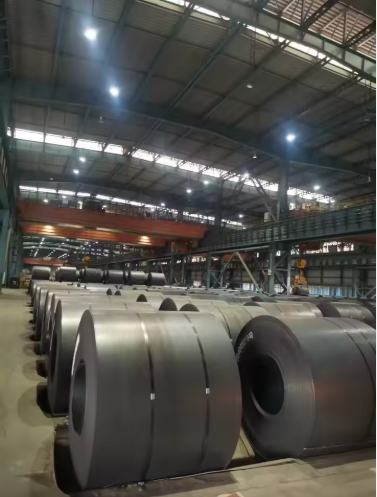
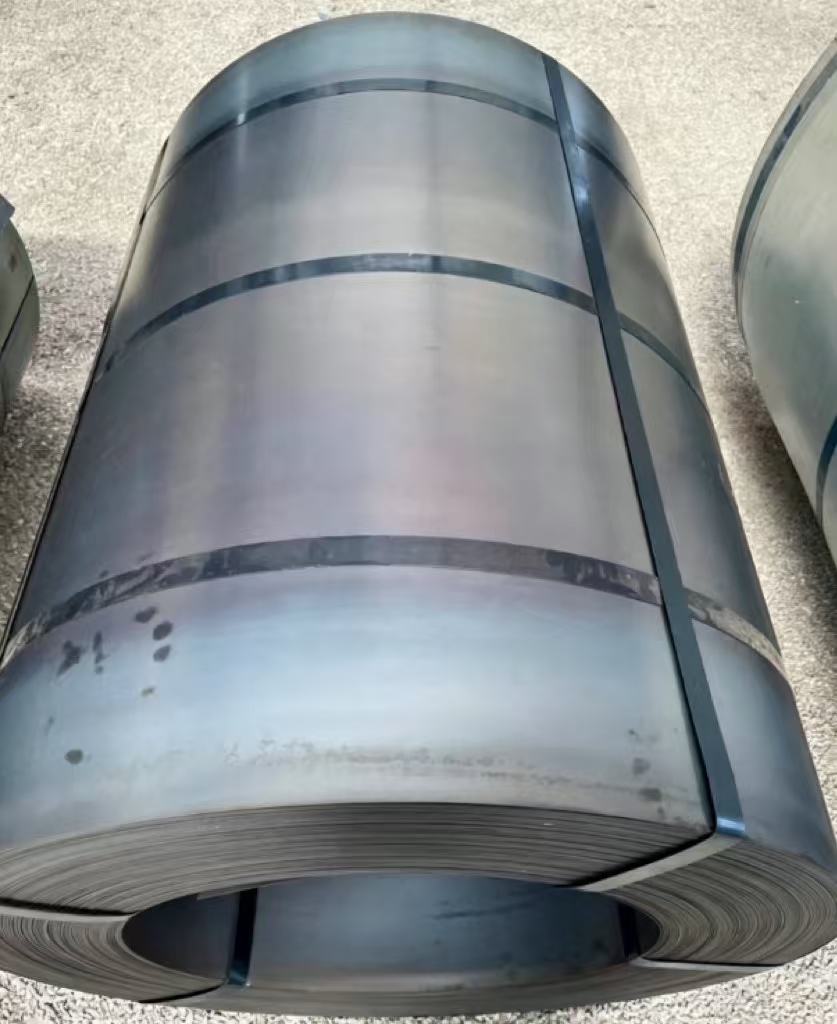
- Coil dimensions: Inner diameter (ID) is typically 508 mm or 610 mm; outer diameter (OD) ranges from 900 to 2,100 mm; coil weight from 3 to 30 MT. These parameters must align with the buyer’s decoiler and coil car specifications.
- MOQ: Mill direct orders typically carry a minimum of 25–50 MT per grade/dimension combination. Service center supply allows lower MOQs (3–10 MT) with a price premium of 5–15%.
- Lead times: Ex-stock material from service centers ships within 3–7 business days. Mill-direct custom rolling carries lead times of 4–10 weeks depending on mill scheduling and grade complexity.
- Freight considerations: Carbon steel coil is classified as heavy, dense cargo. FCL (20-foot container) typically accommodates 20–22 MT. For ocean freight, proper coil banding, moisture-barrier wrapping, and dunnage are mandatory to prevent transit damage and surface oxidation.
Conclusion
Carbon steel coil remains the most versatile and cost-efficient metallic coil material available to industrial buyers at scale. Its graded composition system allows precise property targeting; the choice between hot-rolled and cold-rolled processing addresses the full range of dimensional and surface requirements; and its compatibility with welding, forming, and coating processes makes it a universal substrate across industries. For procurement teams, the priorities are clear: align material grade to mechanical requirements, specify the correct rolling and surface condition, verify standard compliance and MTR documentation, and structure supply arrangements that balance MOQ flexibility against volume pricing. A disciplined approach to these variables translates directly into lower total material cost and more resilient production supply chains.