

Executive Summary: The strongest steel profile depends on load type. For bending resistance, wide-flange (W-shape) I-beams dominate. For torsion and axial compression, hollow structural sections (HSS) deliver superior performance. Grade selection (e.g., ASTM A992, S355) further defines capacity.
How Steel Profile Geometry Determines Structural Strength
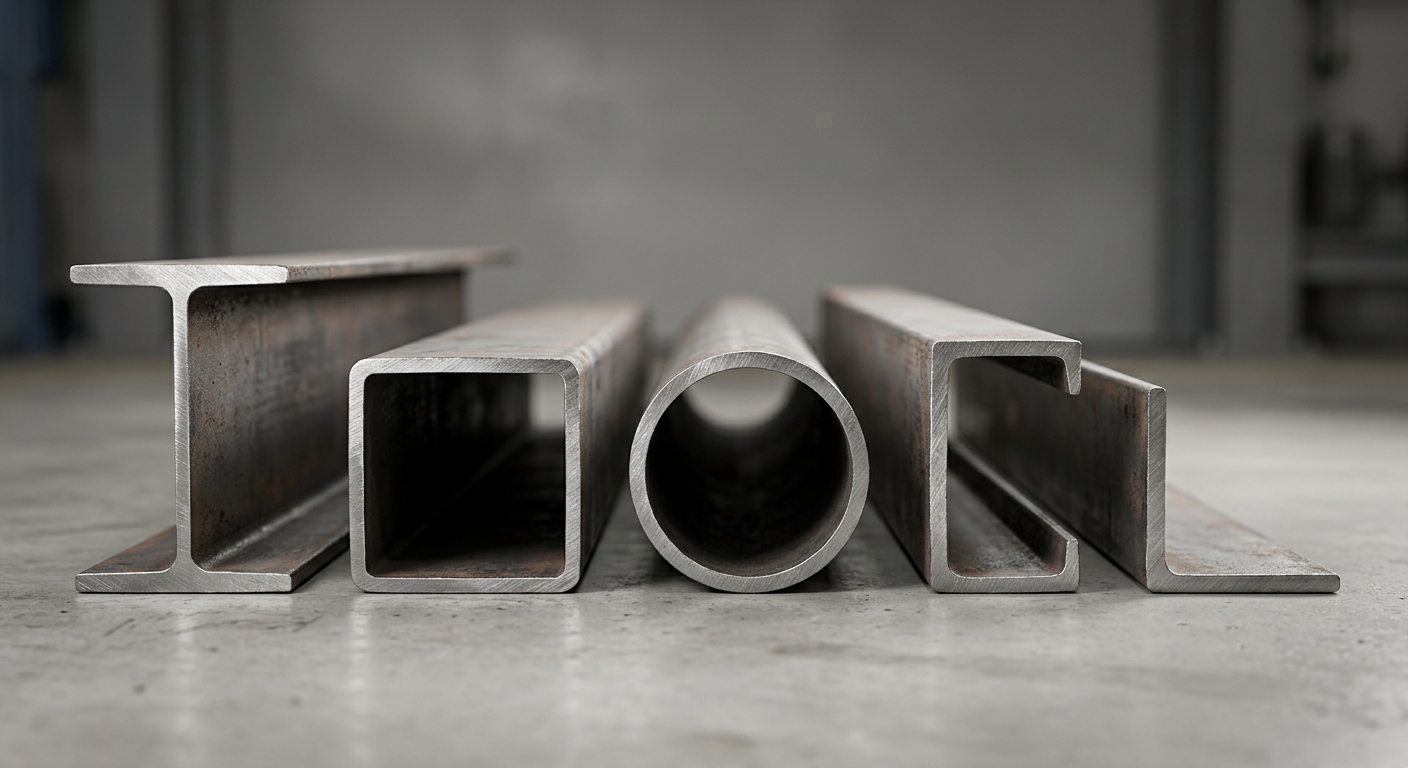
Structural strength is not solely a material property — geometry governs how efficiently a steel profile resists applied forces.
Moment of Inertia: The Primary Bending Metric
- Moment of inertia (I) measures a cross-section’s resistance to bending.
- Wide-flange profiles concentrate material at the flanges, maximizing I relative to cross-sectional area.
- A W310×97 section achieves I_x = 222 × 10⁶ mm⁴, outperforming an equivalent-weight channel section by 40–60%.
- Distributing mass away from the neutral axis is the geometric principle behind I-beam dominance in flexural applications.
Section Modulus and Elastic Resistance
- Section modulus (S = I/c) directly governs elastic bending stress capacity.
- Deeper profiles increase c (distance from neutral axis to extreme fiber), amplifying moment resistance.
- For heavy-load beam applications, W-shapes with depth-to-width ratios of 1.5:1 to 3:1 optimize both stiffness and material efficiency.
Profile Efficiency Comparison
| Profile Type | Relative Bending Efficiency | Torsional Stiffness | Axial Capacity (per kg) |
|---|---|---|---|
| Wide-Flange (W/H) | ★★★★★ | ★★ | ★★★★ |
| Hollow Section (SHS/RHS) | ★★★ | ★★★★★ | ★★★★★ |
| Channel (C/U) | ★★★ | ★★ | ★★★ |
| Angle (L) | ★★ | ★ | ★★ |
| T-Section | ★★★ | ★★ | ★★★ |
| Circular Hollow (CHS) | ★★★ | ★★★★★ | ★★★★★ |
Wide-Flange I-Beams: Maximum Bending Resistance
The wide-flange steel profile (W-shape in AISC; HEA/HEB in European standards) is the benchmark for bending-dominated structural applications.
Why W-Shapes Lead in Flexural Performance
- Flanges carry the majority of bending moment; the web resists shear.
- Web slenderness ratios are engineered to prevent shear buckling under service loads.
- ASTM A992 steel (F_y = 345 MPa, F_u = 450 MPa) is the standard grade for W-shapes in North America.
- European HEB 300 sections deliver I_x = 25,170 cm⁴, suitable for spans exceeding 12 m under heavy distributed loads.
Load-Bearing Capacity Data
| Section | Weight (kg/m) | I_x (cm⁴) | M_pl (kNm) @ A992 |
|---|---|---|---|
| W200×100 | 100 | 113,000 | 780 |
| W310×97 | 97 | 222,000 | 1,430 |
| W460×97 | 97 | 445,000 | 1,930 |
| HEB 300 | 117 | 25,170 | 1,160 |
- Deeper sections (W460 series) achieve 2.5× higher plastic moment than shallower equivalents at identical weight.
- For steel profile load-bearing capacity in multi-story frames, W-shapes remain the industry default.
Limitations
- Open cross-section creates low torsional rigidity (St. Venant torsion constant J is small).
- Lateral-torsional buckling governs design when compression flanges are unbraced over long spans.
- Not optimal where combined bending + torsion loads occur simultaneously.
Hollow Structural Sections: Superior Torsion and Axial Performance
Hollow structural sections (HSS) — including square (SHS), rectangular (RHS), and circular (CHS) profiles — excel where torsional resistance and axial compression govern design.
Torsional Resistance Mechanism
- Closed cross-sections generate Bredt torsion, distributing shear stress uniformly around the perimeter.
- Torsional stiffness of a CHS 219.1×10 is 50–100× greater than an equivalent open W-section.
- For crane runway girders, canopy structures, and space frames, HSS profiles prevent warping failure modes that open profiles cannot resist.
Axial Compression Efficiency
- HSS profiles achieve the highest axial load capacity per unit weight among standard steel sections.
- Symmetric geometry eliminates weak-axis buckling bias present in W-shapes.
- A CHS 168.3×8 (ASTM A500 Grade C, F_y = 317 MPa) sustains 1,340 kN axial load at a 3 m effective length.
- Column slenderness ratio (KL/r) is minimized due to equal radii of gyration in all directions.
HSS vs. Open Profile: Torsion Comparison
| Property | W310×97 (Open) | SHS 250×250×10 (Closed) |
|---|---|---|
| J (torsion constant, cm⁴) | 62 | 14,800 |
| C_w (warping constant, cm⁶) | 3,940,000 | ~0 |
| Torsional rigidity ratio | 1× | ~240× |
| Axial capacity (3m, kN) | 2,100 | 2,450 |
- For best steel profile for construction applications involving combined loading, HSS sections consistently outperform open profiles in torsion-sensitive scenarios.
Width-to-Thickness Ratio and Local Buckling Capacity
Local buckling is a critical failure mode in thin-walled steel profiles. The width-to-thickness (b/t) ratio governs whether a section is compact, non-compact, or slender.
Classification Framework (AISC 360 / EN 1993-1-1)
- Compact sections: Full plastic moment capacity develops before local buckling.
- Non-compact sections: Partial yielding occurs; capacity reduced.
- Slender sections: Elastic local buckling governs before yield.
Critical b/t Limits (ASTM A992, F_y = 345 MPa)
| Element | Compact Limit (λ_p) | Non-Compact Limit (λ_r) |
|---|---|---|
| I-beam flange | b/t ≤ 9.15 | b/t ≤ 24.1 |
| I-beam web | h/t_w ≤ 90.6 | h/t_w ≤ 137 |
| HSS wall (SHS) | b/t ≤ 26.9 | b/t ≤ 35.2 |
- Exceeding compact limits reduces available plastic moment by 10–30%.
- High-strength grades (S460, A514) have tighter b/t limits due to higher yield stress, making section compactness harder to achieve.
- Seismic applications mandate compact sections to ensure ductile energy dissipation.
High-Strength Steel Grades and Profile Selection
Material grade is the second axis of strength optimization after geometry.
Standard Yield Strength Grades
| Standard | Grade | F_y (MPa) | F_u (MPa) | Typical Profile Application |
|---|---|---|---|---|
| ASTM A992 | — | 345 | 450 | W-shapes, structural frames |
| ASTM A500-C | Grade C | 317 | 427 | HSS columns, trusses |
| EN 10025-2 | S355 | 355 | 510 | European beams, columns |
| EN 10025-6 | S460 | 460 | 570 | High-load columns, bridges |
| ASTM A514 | — | 690 | 760 | Heavy plate, high-rise cores |
Grade Impact on Profile Design
- Upgrading from S355 to S460 reduces required section weight by 20–25% for identical moment demand.
- A514 (F_y = 690 MPa) is used in heavy-load steel section applications like transfer beams and bridge girders.
- Higher grades require weld procedure qualification (PWHT may apply) and stricter fracture toughness verification (Charpy V-notch testing).
- Yield strength grades define high-strength structural steel profile selection in seismic zones where ductility ratios must be maintained.
Real-World Application Scenarios
Case 1 — Long-Span Industrial Building Frame
- Profile selected: W460×97 (ASTM A992)
- Span: 18 m, distributed load 35 kN/m
- Rationale: Maximum I_x minimizes mid-span deflection (L/360 serviceability limit).
- W-shape flanges provide direct bolted connection to column caps without stiffener plates.
Case 2 — Multi-Story Column Under Combined Axial + Torsion
- Profile selected: SHS 300×300×12.5 (S355)
- Load: 4,200 kN axial + 85 kNm torsion
- Rationale: Closed section eliminates warping; equal radii of gyration prevent weak-axis failure.
- HSS achieves 18% weight saving over equivalent W-shape column.
Case 3 — High-Rise Transfer Beam
- Profile selected: Welded plate girder, S460 steel
- Span: 9 m, point load 6,000 kN
- Rationale: Custom plate dimensions optimize b/t ratio for compact classification; high-strength grade reduces depth, preserving floor-to-floor height.
FAQ: Steel Profile Strength — Common Technical Questions
Q1: Which steel profile geometry maximizes moment of inertia under bending loads?
Wide-flange (W/H) sections — flanges at maximum distance from neutral axis.
Q2: How does HSS resist torsional stress versus open profiles?
Closed section activates Bredt shear flow; torsional stiffness is 50–240× higher than open W-shapes.
Q3: What yield strength grades define high-strength structural steel profile selection?
S460 (EN) and A514 (ASTM) for heavy-load applications; S355/A992 for standard frames.
Q4: How does width-to-thickness ratio affect local buckling capacity?
Exceeding compact b/t limits reduces plastic moment capacity by up to 30%.
Q5: Which steel profile achieves the highest axial load capacity per unit weight?
Circular hollow sections (CHS) — equal radii of gyration maximize column efficiency.
Q6: Can I-beams be used where torsion is significant?
Not recommended; add torsional bracing or switch to HSS for torsion-dominated loads.
Q7: Does higher steel grade always mean a stronger profile?
Higher F_y increases capacity but tightens b/t compactness limits; geometry must be re-verified.
Q8: What is the lightest steel profile for heavy axial loads?
CHS with S460 grade achieves the best strength-to-weight ratio for pure compression columns.
Conclusion
No single steel profile is universally strongest. The optimal selection follows a three-axis decision:
- Load type → Bending: W-shape; Torsion/Axial: HSS/CHS
- Material grade → S355/A992 for standard; S460/A514 for high-load scenarios
- Compactness → Verify b/t ratios before committing to high-strength grades
For heavy-load steel section design, engineers should run parallel checks on moment of inertia, torsional constant, local buckling class, and effective length simultaneously — not sequentially.
When specifying the strongest steel profile for a project, consult AISC 360, EN 1993-1-1, and manufacturer mill certificates to confirm grade-specific mechanical properties before finalizing section schedules.
References & Standards
- AISC 360-22: Specification for Structural Steel Buildings
- EN 1993-1-1:2005 (Eurocode 3): Design of Steel Structures
- ASTM A992/A992M: Standard Specification for Structural Steel Shapes
- ASTM A500/A500M: Cold-Formed Welded and Seamless Carbon Steel Structural Tubing
- EN 10025-6: Hot-Rolled Products of Structural Steels — High Yield Strength Quenched and Tempered
- Galambos, T.V. & Surovek, A.E. (2008). Structural Stability of Steel. Wiley.
- CISC Handbook of Steel Construction, 11th Edition