

Quick answer
Stainless steel plate contains ≥10.5% chromium, forming a passive oxide layer that resists corrosion. Mild steel plate lacks this alloy content, offering higher ductility at lower cost but requiring surface protection in corrosive environments.
Metallurgical Composition: The Chromium Threshold
1. How Chromium Content Defines Stainless Plate Steel
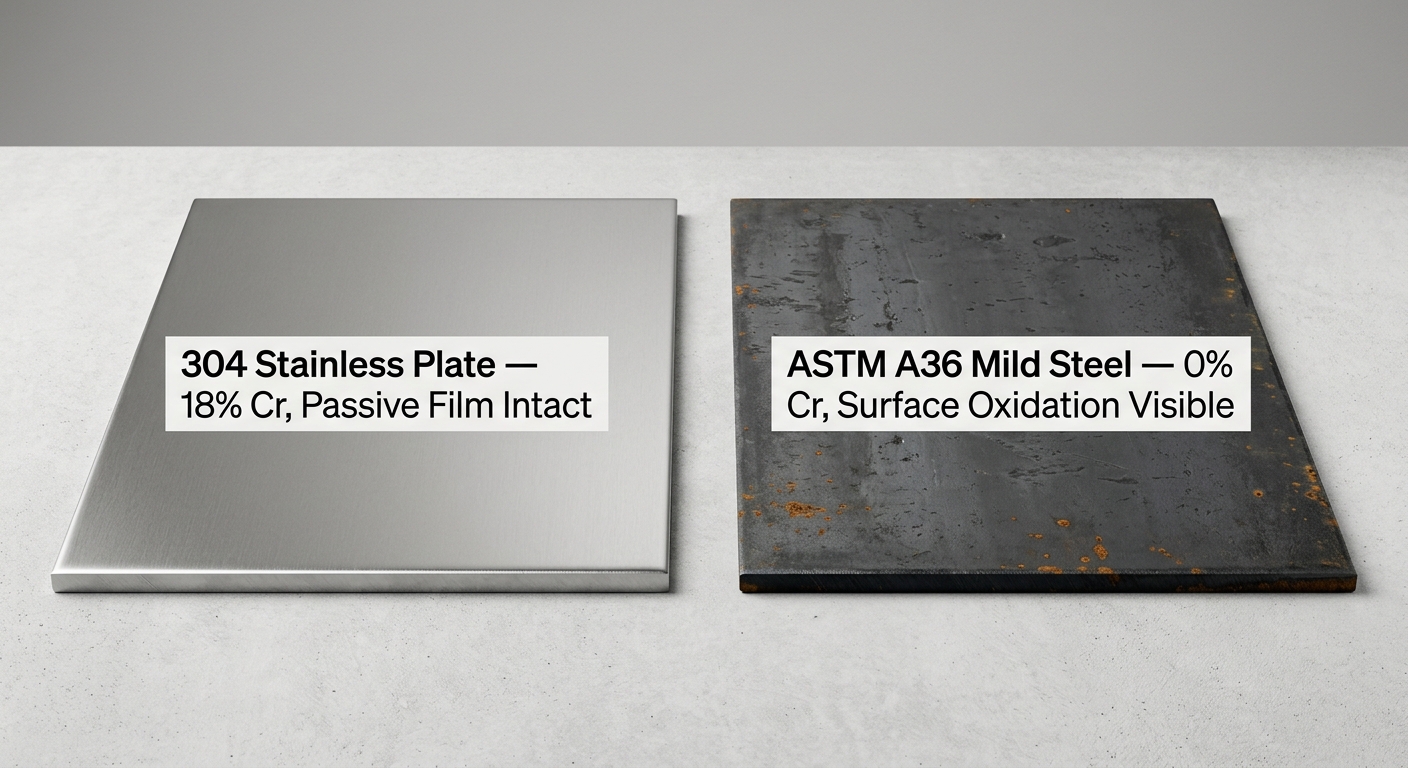
- Chromium ≥10.5% (by mass) triggers passive film formation — the defining metallurgical boundary between stainless and carbon steel.
- 304 stainless plate steel: 18–20% Cr + 8–10.5% Ni; yield strength ~205 MPa.
- 316 stainless plate: adds 2–3% Mo; enhances pitting resistance index (PREN) to ~25.
- Mild steel (ASTM A36): 0.25–0.29% C, ≤0.04% S, zero intentional Cr; yield strength ~250 MPa.
2. Microstructure and Phase Composition
| Property | 304 Stainless Plate | ASTM A36 Mild Steel |
|---|---|---|
| Crystal Structure | Austenitic (FCC) | Ferritic/Pearlitic (BCC) |
| Chromium Content | 18–20% | <0.05% |
| Nickel Content | 8–10.5% | Nil |
| Carbon Content | ≤0.08% | 0.25–0.29% |
| Yield Strength | ~205 MPa | ~250 MPa |
| Tensile Strength | 515–690 MPa | 400–550 MPa |
- Austenitic FCC lattice in stainless plate steel resists hydrogen embrittlement better than BCC mild steel.
- Higher carbon in mild steel enables easier welding with standard electrodes but accelerates oxidation.
- Stainless plate’s passive Cr₂O₃ film self-repairs in oxidizing environments — mild steel forms Fe₂O₃ (rust) permanently.
Stainless Plate Processing: Annealing vs. Cold-Rolling
1. Annealing Process Effects
- Solution annealing (1,010–1,120°C) dissolves carbide precipitates in stainless plate steel, restoring corrosion resistance post-welding.
- Annealed 304 plate: elongation 40–50%, hardness ~150–190 HB.
- Annealing eliminates sensitization (Cr depletion at grain boundaries) — critical for chemical-grade stainless plate processing.
- Mild steel annealing targets stress relief only; no passive film regeneration occurs.
2. Cold-Rolling and Mechanical Property Benchmarks
- Cold-rolled stainless plate (2B, BA finish): thickness tolerance ±0.05 mm; surface Ra ≤0.5 µm.
- Cold-rolling increases yield strength by 30–60% via work hardening — 304 CR plate can reach 310–520 MPa yield.
- Mild steel cold-rolled plate (ASTM A1008): yield strength 230–310 MPa; limited corrosion improvement.
| Processing Method | Stainless Plate Yield Strength | Surface Finish | Corrosion Resistance |
|---|---|---|---|
| Hot-rolled annealed (2D) | ~205 MPa | Matte, Ra 1.0–2.0 µm | High |
| Cold-rolled (2B) | ~310 MPa | Semi-bright, Ra ≤0.5 µm | High |
| Cold-rolled (BA) | ~310 MPa | Mirror-bright, Ra ≤0.1 µm | Very High |
| Mild steel HR (A36) | ~250 MPa | Mill scale | Low (uncoated) |
| Mild steel CR (A1008) | ~280 MPa | Smooth | Low (uncoated) |
- Stainless plate processing route directly determines suitability: food-grade applications require 2B or BA; structural applications accept 2D or HR.
- Cold-rolling mild steel does not improve corrosion resistance — galvanizing or epoxy coating remains mandatory.
Corrosion Performance: Salt-Spray Test Data
1. ASTM A36 vs. 304 Stainless Plate Under ASTM B117
- ASTM B117 salt-spray standard: 5% NaCl solution, 35°C continuous exposure.
- ASTM A36 mild steel plate: visible red rust (Fe₂O₃) appears within 24–72 hours of uncoated exposure.
- 304 stainless plate: no red rust observed after 500–1,000 hours; pitting may initiate beyond 2,000 hours in chloride-rich environments.
- 316 stainless plate: withstands 2,000–5,000 hours due to molybdenum-enhanced PREN (~25 vs. ~18 for 304).
2. Corrosion Rate Quantification
| Material | Corrosion Rate (mm/year, seawater) | Salt-Spray Rust Onset | Coating Required? |
|---|---|---|---|
| ASTM A36 Mild Steel | 0.10–0.20 | 24–72 hours | Yes (mandatory) |
| 304 Stainless Plate | 0.001–0.005 | >500 hours | No |
| 316 Stainless Plate | 0.0005–0.002 | >2,000 hours | No |
- Corrosion rate differential: mild steel corrodes 40–100× faster than 304 stainless plate in equivalent marine conditions.
- Lifecycle cost analysis: stainless plate eliminates recoating cycles (typically $8–15/m² every 5–7 years for mild steel structures).
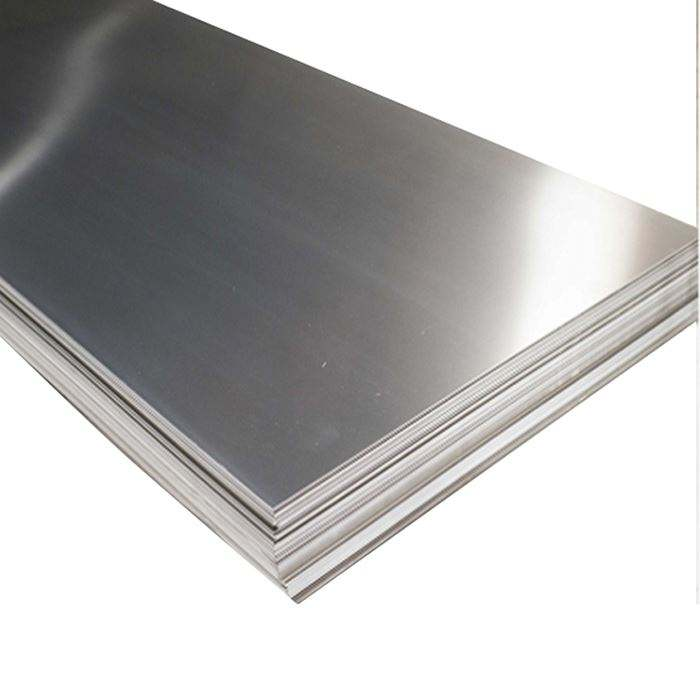
Stainless Plate Supplier Qualification vs. Mild Steel Procurement
1. Supplier Qualification Standards for Stainless Plate
- ISO 9001:2015 certification is baseline; food/pharma sectors require additionally EN 10204 3.1 or 3.2 mill test reports (MTRs).
- Stainless plate supplier must provide: heat number traceability, chemical composition certificates, mechanical test data per ASTM A240 or EN 10088-2.
- Surface finish verification: profilometer Ra measurement, visual inspection per ASTM A480.
- Third-party PMI (Positive Material Identification) via XRF testing is standard practice for critical stainless plate procurement.
2. Mild Steel Plate Procurement Criteria
- Governed by ASTM A36 or EN S275/S355; MTRs typically 2.2 (non-witness) certificates suffice.
- Dimensional tolerance per ASTM A6/A6M; no surface finish specification required for structural use.
- Procurement focus: mill scale condition, flatness tolerance (≤3 mm/m), and carbon equivalent (CE ≤0.43 for weldability).
Key qualification gap: Stainless plate supplier audits require alloy composition verification at every heat; mild steel procurement relies on grade designation alone in most industrial contracts.
Stainless Plate for Sale: Pricing Structure and Alloy Surcharge Dynamics
1. Alloy Surcharge vs. Commodity Index Pricing
- Mild steel plate pricing tracks HRC (Hot-Rolled Coil) commodity index — volatile but predictable via futures markets (CME Group).
- Stainless plate for sale pricing = base price + alloy surcharge (AS), recalculated monthly by major mills (e.g., Outokumpu, Acerinox).
- Alloy surcharge components: nickel (LME Nickel price), chromium (Cr ferro-alloy index), molybdenum (for 316 grade).
2. Price Benchmarks and Volatility
| Material | Typical Price Range (USD/metric ton) | Price Driver | Volatility Level |
|---|---|---|---|
| ASTM A36 Mild Steel Plate | $600–$900 | HRC index, scrap price | Moderate |
| 304 Stainless Plate (2B, 3mm) | $2,200–$3,500 | Ni + Cr alloy surcharge | High |
| 316 Stainless Plate (2B, 3mm) | $3,000–$4,800 | Ni + Mo surcharge | Very High |
- Nickel price swings of $5,000/ton on LME translate to ~$350–$500/ton stainless plate price movement.
- Buyers sourcing stainless plate for sale should negotiate quarterly alloy surcharge caps or index-linked contracts to manage exposure.
- Mild steel buyers hedge via futures; stainless plate procurement requires direct mill negotiation or distributor frame agreements.
Real-World Application Scenarios
Scenario A — Food Processing Plant:
- Equipment contact surfaces: 304 or 316 stainless plate (2B finish, Ra ≤0.8 µm per EHEDG guidelines).
- Mild steel excluded due to FDA 21 CFR and EU 1935/2004 food-contact material regulations.
- Stainless plate supplier must provide EN 10204 3.1 MTR + surface roughness certificate.
Scenario B — Structural Mezzanine (Indoor, Dry):
- ASTM A36 mild steel plate: adequate for load-bearing floors, beams, gussets.
- Cost advantage: A36 plate at $700/ton vs. 304 stainless plate at $2,800/ton — 75% cost reduction.
- Epoxy primer + polyurethane topcoat provides 10–15 year corrosion protection indoors.
Scenario C — Coastal Infrastructure (Marine Zone):
- Splash zone structures: 316 stainless plate preferred; PREN >25 resists chloride pitting.
- Mild steel requires hot-dip galvanizing (85 µm zinc per ISO 1461) + cathodic protection — total cost premium narrows vs. stainless plate lifecycle cost.
- Stainless plate processing: pickled and passivated (PA) finish restores passive film after fabrication.
FAQ: Stainless Plate vs. Mild Steel Plate
Q1: How does chromium content differentiate stainless plate steel metallurgically?
≥10.5% Cr forms a self-repairing Cr₂O₃ passive film absent in mild steel.
Q2: What stainless plate processing route suits hygienic applications?
Cold-rolled 2B or BA finish; Ra ≤0.8 µm per EHEDG standard.
Q3: How fast does ASTM A36 rust vs. 304 stainless plate?
A36 rusts within 24–72 hours; 304 stainless plate exceeds 500 hours in ASTM B117 testing.
Q4: What certifications should a stainless plate supplier provide?
EN 10204 3.1 MTR, ASTM A240 compliance, XRF-verified heat traceability.
Q5: Why is stainless plate for sale more expensive than mild steel?
Monthly alloy surcharges tied to LME nickel and chromium ferro-alloy prices.
Q6: Can mild steel replace stainless plate in food equipment?
No — FDA 21 CFR and EU 1935/2004 prohibit bare mild steel in food contact.
Q7: Which stainless plate grade resists chloride best?
316 stainless plate (PREN ~25) outperforms 304 (PREN ~18) in marine environments.
Q8: How does cold-rolling affect stainless plate mechanical properties?
Yield strength increases 30–60% via work hardening; surface Ra improves to ≤0.5 µm.
Conclusion
The fundamental difference between stainless steel plate and mild steel plate is chromium content and its metallurgical consequences — passive corrosion resistance, processing flexibility, and total lifecycle cost.
Core findings:
- Stainless plate steel (≥10.5% Cr) corrodes 40–100× slower than ASTM A36 in equivalent environments.
- Stainless plate processing — annealing or cold-rolling — enables precise mechanical and surface property control unavailable in mild steel.
- Stainless plate supplier qualification requires heat-level MTRs and PMI verification; mild steel procurement is grade-designation driven.
- Stainless plate for sale carries alloy surcharge volatility; lifecycle cost analysis often justifies premium in corrosive or regulated environments.
Professional recommendation: Select stainless plate (304 or 316) where corrosion resistance, hygiene compliance, or maintenance-free service life is required. Specify mild steel A36 for structural applications in dry, protected environments where cost optimization is the primary driver. Always request EN 10204 3.1 documentation from any stainless plate supplier regardless of application.
References and Standards
- ASTM A240/A240M — Standard Specification for Chromium and Chromium-Nickel Stainless Steel Plate
- ASTM A36/A36M — Standard Specification for Carbon Structural Steel
- ASTM B117 — Standard Practice for Operating Salt Spray (Fog) Apparatus
- ASTM A480/A480M — General Requirements for Flat-Rolled Stainless and Heat-Resisting Steel Plate
- EN 10204:2004 — Metallic Products — Types of Inspection Documents
- EN 10088-2 — Stainless Steels — Technical Delivery Conditions for Sheet/Plate
- ISO 9001:2015 — Quality Management Systems
- LME Nickel Price Index — London Metal Exchange
- Outokumpu Stainless Steel Handbook, 11th Edition
- EHEDG Guideline Document 8 — Hygienic Equipment Design Criteria