

For procurement managers, facility operators, and maintenance engineers sourcing stainless steel at scale, surface condition is not an aesthetic concern — it is a compliance, liability, and lifecycle cost issue. A degraded surface finish can harbor bacteria, accelerate corrosion, and void material warranties. Conversely, a well-maintained stainless steel surface extends asset service life by 30–50%, reduces replacement frequency, and supports regulatory audit readiness across food processing, pharmaceutical, and architectural sectors.
This guide provides a structured framework covering industrial-grade polishing methods, daily and deep-clean protocols, approved compound selection, and long-term protective maintenance strategies. Whether you are specifying maintenance standards for a new procurement contract or optimizing an existing facility SOP, these protocols are designed to reduce total cost of ownership while preserving surface integrity across the full asset lifecycle.
Understanding Stainless Steel Surface Properties
1. Surface Grades & Finish Types
Stainless steel is supplied in a range of standardized mill finishes, each with distinct surface roughness (Ra) values and polishing requirements. Understanding finish classification is the first step in specifying the correct maintenance approach.
Common industrial finishes include:
- 2B Finish: Cold-rolled, smooth, and slightly reflective. Ra typically 0.1–0.5 µm. Standard for food equipment and pharmaceutical vessels.
- No. 4 Finish: Brushed, unidirectional grain produced by 150–180 grit abrasives. Ra 0.2–0.8 µm. Widely used in commercial kitchens and architectural panels.
- BA (Bright Annealed): Mirror-like finish, Ra < 0.1 µm. Requires non-abrasive polishing compounds only.
- No. 8 Mirror Finish: Fully reflective, produced through sequential grit progression to 320+ grit followed by buffing. Requires the highest maintenance precision.
Grit progression — 180 → 240 → 320 — is the standard sequence for restoring a damaged No. 4 or finer finish. Skipping grits introduces micro-scratches that are visible under directional lighting and compromise cleanability ratings.
2. Why Stainless Steel Loses Its Luster
Surface degradation in stainless steel follows predictable mechanisms:
- Chloride contamination: Chlorides from cleaning agents, seawater, or food residues break down the passive chromium oxide layer, initiating pitting corrosion.
- Heat tint: Welding and thermal processing create oxidation bands (golden to blue-black) that indicate chromium depletion at the surface.
- Mechanical scratching: Cross-grain abrasion from improper wiping or incompatible cleaning pads disrupts finish uniformity and creates crevices for bacterial adhesion.
- Organic contamination: Oil, grease, and biological residues block the passive layer from self-regenerating in oxygen-rich environments.
Identifying the root cause before selecting a polishing or cleaning method prevents compounding damage — particularly on high-specification finishes like BA or No. 8.
How to Polish Stainless Steel: Methods & Materials
1. Mechanical Polishing Techniques
Mechanical polishing is the primary restoration method for scratched, heat-tinted, or heavily soiled stainless steel surfaces. Equipment selection depends on surface geometry, finish target, and production scale.
Key equipment categories:
- Angle grinder with flap disc: Suitable for weld seam blending and heavy scratch removal. Start at 80–120 grit; progress to 180 minimum before switching to finer methods.
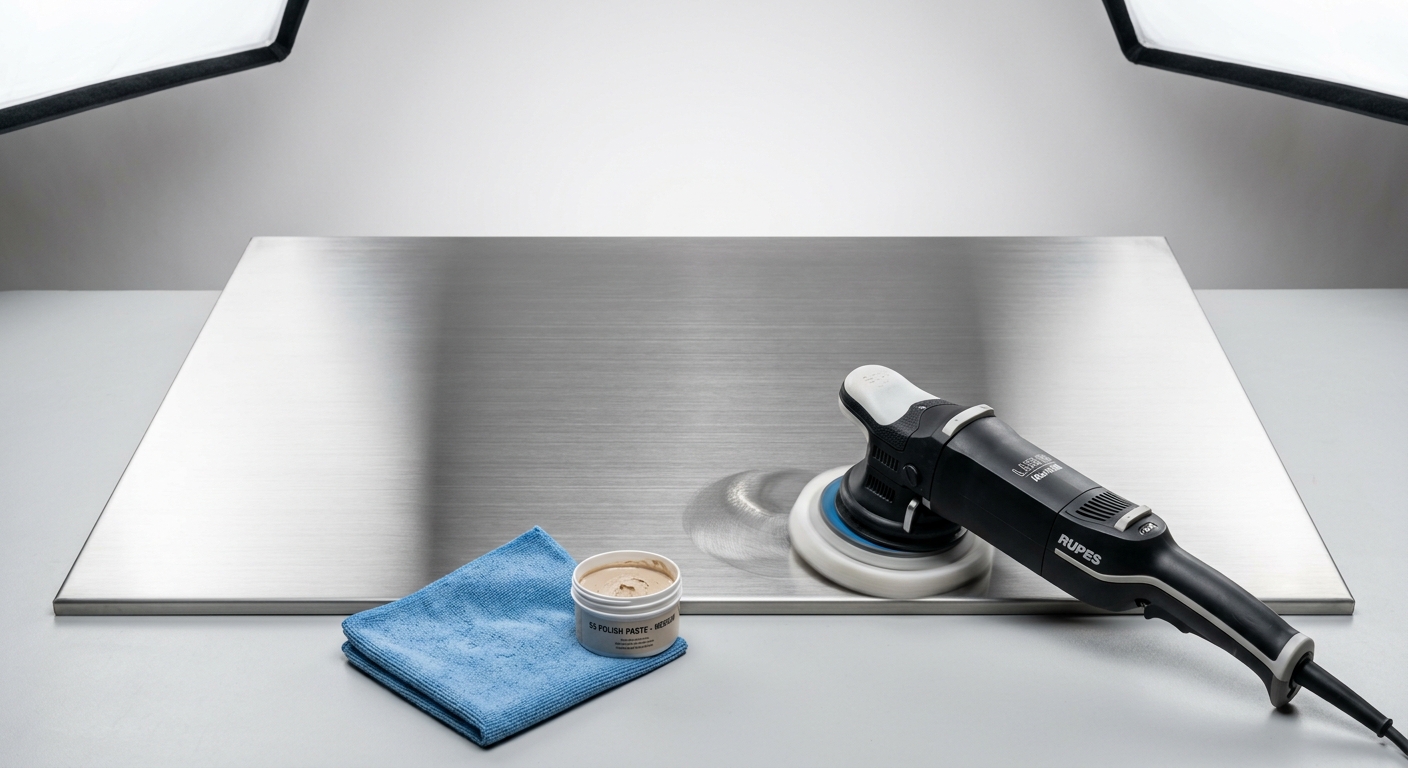
- Orbital/random orbital polisher: Preferred for flat sheet panels. Minimizes directional grain inconsistency. Use with 3M Scotch-Brite or equivalent non-woven abrasive pads.
- Buffing wheel with polishing compound: Final-stage method for BA and No. 8 finishes. Use white or green compound depending on target reflectivity.
Critical protocol: Always polish in the direction of the existing grain on brushed finishes. Cross-grain polishing on No. 4 surfaces is a non-recoverable error without full re-grinding.
For large-scale industrial applications — process vessels, architectural cladding, food conveyors — automated belt polishing systems offer consistent Ra output and reduce labor variability.
2. Best Polish for Stainless Steel Appliances & Industrial Surfaces
Compound selection must align with the finish type, application environment, and regulatory requirements.
Compound categories:
- Abrasive paste (aluminum oxide or silicon carbide base): Effective for scratch removal and finish restoration on No. 4 and 2B surfaces. Not suitable for BA or mirror finishes.
- Electrochemical polishing compounds: Acid-based formulations (typically phosphoric/sulfuric acid blends) that dissolve micro-peaks, reducing Ra and improving corrosion resistance. Requires PPE and ventilation controls.
- Nano-coating sealants: Applied post-polish to create a hydrophobic barrier. Extend re-polishing intervals by 40–60% in high-traffic environments.
- Food-grade polishing compounds: NSF-certified, zero-VOC formulations for food contact surfaces. Examples include Bar Keepers Friend (oxalic acid base) and NSF-listed passivation gels.
| Polish Method | Applicable Finish | Abrasive Level | Food-Grade Safe | Avg. Cycle Time | Est. Cost/m² |
|---|---|---|---|---|---|
| Mechanical Polish | No.4 / 2B / No.8 | Medium–High | Compound-dependent | 30–90 min | $8–$25 |
| Chemical Compound | 2B / BA | Low–Medium | NSF options available | 15–45 min | $5–$18 |
| Electropolishing | All grades | Non-abrasive | Yes (post-rinse) | 2–8 hrs (process) | $20–$60 |
| Passivation Treatment | All grades | None | Yes (ASTM A967) | 1–4 hrs | $10–$35 |
How to Clean Stainless Steel: Daily & Deep-Clean Protocols
1. Stainless Steel Cleaning Tips for Routine Maintenance
Routine cleaning is the single highest-impact maintenance activity for preserving stainless steel surface integrity. Incorrect daily cleaning causes more cumulative damage than infrequent deep-clean failures.
Core principles:
- Always use pH-neutral detergents (pH 6–8) for routine cleaning. Alkaline cleaners above pH 10 can accelerate stress corrosion in sensitized alloys; acidic cleaners below pH 4 risk passive layer dissolution.
- Wipe in the grain direction on brushed finishes. Circular or cross-grain wiping with abrasive cloths creates visible scratch patterns that accumulate over time.
- Use microfiber or soft non-woven cloths. Steel wool, abrasive sponges, and carbon steel brushes are prohibited — they embed ferrous particles that initiate rust spots.
Frequency guidelines by sector:
| Application Sector | Routine Clean Frequency | Deep Clean Frequency |
|---|---|---|
| Commercial Kitchen | Daily | Weekly |
| Pharmaceutical / Biotech | After each batch | Monthly + validation |
| Architectural (Interior) | Weekly | Quarterly |
| Marine / Coastal | 2× weekly | Monthly |
2. Removing Tough Stains, Rust & Discoloration
When routine cleaning is insufficient, targeted chemical treatment is required. The approach depends on stain type:
- Surface rust (tea staining): Apply oxalic acid-based cleaner (e.g., 5–10% solution) for 10–15 minutes, then rinse thoroughly. Compliant with ASTM A380 surface preparation guidelines.
- Heat tint from welding: Use citric acid passivation paste (ASTM A967 compliant) applied to the affected zone for 30–60 minutes. Neutralize and rinse with deionized water.
- Chloride-induced pitting: Light pitting can be addressed with phosphoric acid treatment followed by passivation. Deep pitting requires mechanical re-surfacing to below the pit depth before chemical treatment.
- Organic staining (oils, grease): Alkaline degreaser followed by passivation restores the chromium oxide layer. Confirm no chloride content in the degreaser formulation.
Document all chemical treatments in the asset maintenance log — a regulatory requirement under EN 1672-2 for food equipment and FDA 21 CFR Part 117 for food contact surfaces.
Stainless Steel Surface Care: Compliance, Storage & Long-Term Protection
1. Industry Standards & Regulatory Requirements
Procurement specifications for stainless steel maintenance must reference applicable standards to ensure supplier and contractor compliance:
- ASTM A380: Standard practice for cleaning, descaling, and passivation of stainless steel parts and equipment. Defines acceptable chemical treatments and verification methods.
- ASTM A967: Covers passivation specifications including citric acid and nitric acid methods, with acceptance criteria (water immersion test, high humidity test).
- EN 1672-2: European standard for food machinery surface hygiene, specifying minimum Ra values and prohibited surface treatments for food contact zones.
- FDA 21 CFR Part 117: Requires food contact surfaces to be smooth, corrosion-resistant, and cleanable — directly governing finish specification and maintenance documentation.
For procurement teams, these standards should be embedded in vendor qualification checklists and maintenance contractor SOPs. Request passivation test reports and surface roughness (Ra) certificates as standard delivery documentation for critical assets.
2. Protective Coatings & Preventive Maintenance Programs
Long-term surface protection reduces polishing frequency and extends compliance intervals:
- PVC protective film: Applied during fabrication and transit to prevent mechanical damage. Must be removed within 6 months to prevent adhesive bonding degradation, especially in UV-exposed environments.
- Wax-based sealants: Applied post-polish on architectural and appliance surfaces. Repels water, fingerprints, and minor contaminants. Reapplication interval: every 3–6 months depending on traffic.
- Passivation scheduling: For process equipment in chemical or food environments, schedule passivation every 12–24 months or following any weld repair, mechanical damage, or chemical contamination event.
Building a maintenance SOP: A structured preventive maintenance program should define cleaning agent specifications, polishing compound approvals, inspection checkpoints (visual + Ra measurement), contractor qualification requirements, and non-conformance escalation procedures. For facilities managing 500+ m² of stainless steel surface, a digital asset maintenance log integrated with inspection schedules delivers measurable ROI through reduced emergency remediation costs.
Conclusion
Maintaining stainless steel surfaces at industrial scale requires a structured, specification-driven approach — not ad hoc cleaning. The key takeaways for procurement and facility management teams are: match polishing method to finish grade, select compounds based on regulatory environment and food-contact status, enforce grain-direction cleaning protocols, and schedule passivation treatments in alignment with ASTM A380/A967 benchmarks.
A standardized maintenance program reduces total cost of ownership, supports regulatory compliance across food, pharmaceutical, and architectural sectors, and extends asset service life measurably. For organizations managing large stainless steel inventories, the ROI on a documented surface care SOP — including approved compound lists, inspection intervals, and contractor qualification criteria — consistently outperforms reactive remediation spending. Treat surface maintenance as a procurement specification, not an afterthought.